


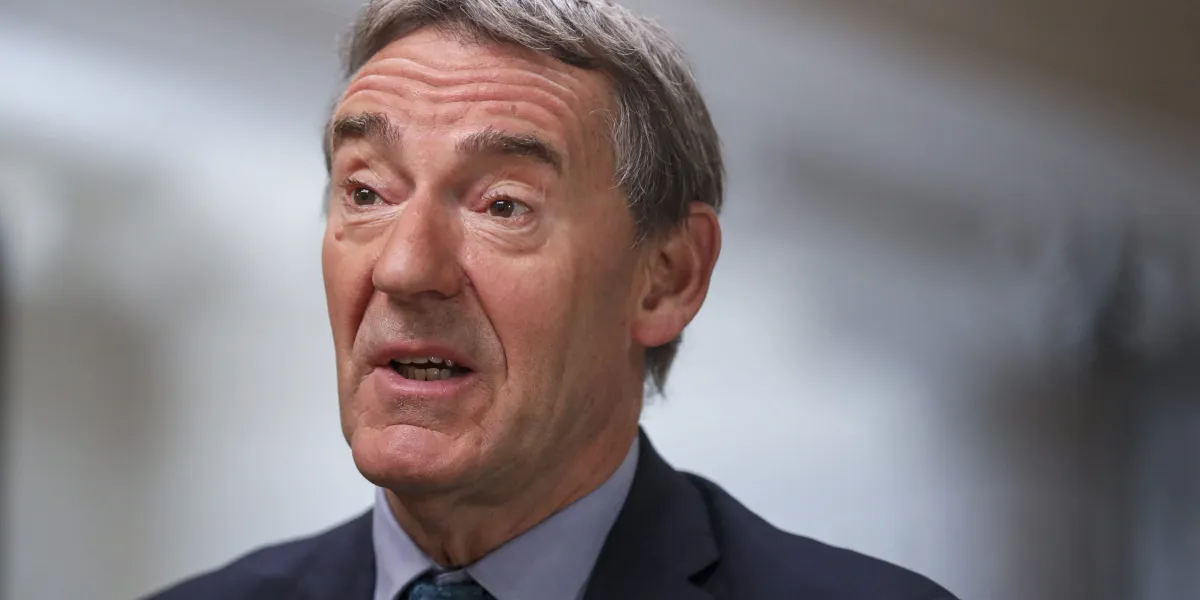
Jim O’Neill, the economist who coined the BRICs acronym, has said the West must accept that China and India will not seek to become like Western nations as their influence over the global economy grows.
Speaking in London after launching the BRICS+ Thinking think tank, the former Goldman Sachs executive criticised the European Union for failing to build deeper partnerships with the world’s emerging economies.
O’Neill created the term in a 2001 Goldman Sachs economics paper, identifying Brazil, Russia, India and China as countries likely to play an outsized role in the global economy. At the time, the four nations accounted for less than 10% of global GDP.
He now says the group has become increasingly dependent on its two Asian members. “Economically, 25 years later, BRICS has become utterly dependent on the ‘ICs’,” O’Neill said, referring to India and China.
“China and India have surpassed the numbers that we showed could happen. Brazil and Russia actually, after the first great decade—their share of global GDP is back to where it was when I dreamt the name up.”
Data compiled by Fulcrum Asset Management shows cumulative per-capita growth since 2000 of 554% for China and 246% for India. The comparable figures were 45% for the US, 30% for continental Europe and 29% for the UK.
O’Neill said China was still growing faster than Western economies, but argued that India had the stronger demographic prospects.
“This is India’s moment in the sun because of its demographics,” he said. “It now has a clear 15 to 20 years where it should grow 7 to 8%. And if India got its mojo together on reforms, it could easily be 10%.”
Jim O’Neill calls for a new global economic approach
O’Neill said the original BRICs concept was intended to encourage discussion about global co-operation as well as economic growth. The G20 expanded after the financial crisis, when governments were searching for new approaches to managing the economy and capital markets.
But he said agreements on banking regulation had not been matched by a substantial reshaping of global institutions. Western countries, he argued, had retained privileges that limited the influence of emerging economies.
“The spirit of that kind of world, of policy corporation, just vanished,” O’Neill said.
He described European countries as “very lazy, very content, subconsciously still colonial, and unambitious”, arguing that France, Italy and Germany continued to seek individual places at the global table.
“France, Italy, and Germany all still want their own individual seat at the global table, even though these days, you know, is that justified?” he said. “But by them having those seats, that blocks the space for others to take more power.”
O’Neill also criticised what he called European hypocrisy over US tariffs, saying the EU single market had failed to create free trade in services because of protectionism in Germany, France and elsewhere.
He dismissed the claim, adopted by the US president, that America was being economically overtaken by China as a politically powerful but unsupported argument.
“It’s become this huge, strong mantra in the U.S. which is really sad because it’s not based on any evidence,” O’Neill said.
He added that China’s Communist Party had tightened control over the country’s business figures, placing the preservation of the party above other priorities and adopting a more nationalist approach.
O’Neill said the continuing growth of China and India, alongside global volatility, would eventually force Western countries to reconsider their approach.
“It will force more centrist thinkers and the core of liberal values to re-engage properly with the rest of the world,” he said.
He argued that Western governments should accept that many people in China and India did not want to adopt Western political models, rather than attempting to force them to do so.
Gavyn Davies, the former chief economist of Goldman Sachs global research, described O’Neill’s original paper as one of the most influential produced by an investment bank economics department.
O’Neill said the continued exclusion of China and India from the G7 reflected an attachment to 20th-century institutions and showed the need for a significant change in the global economic order.
