


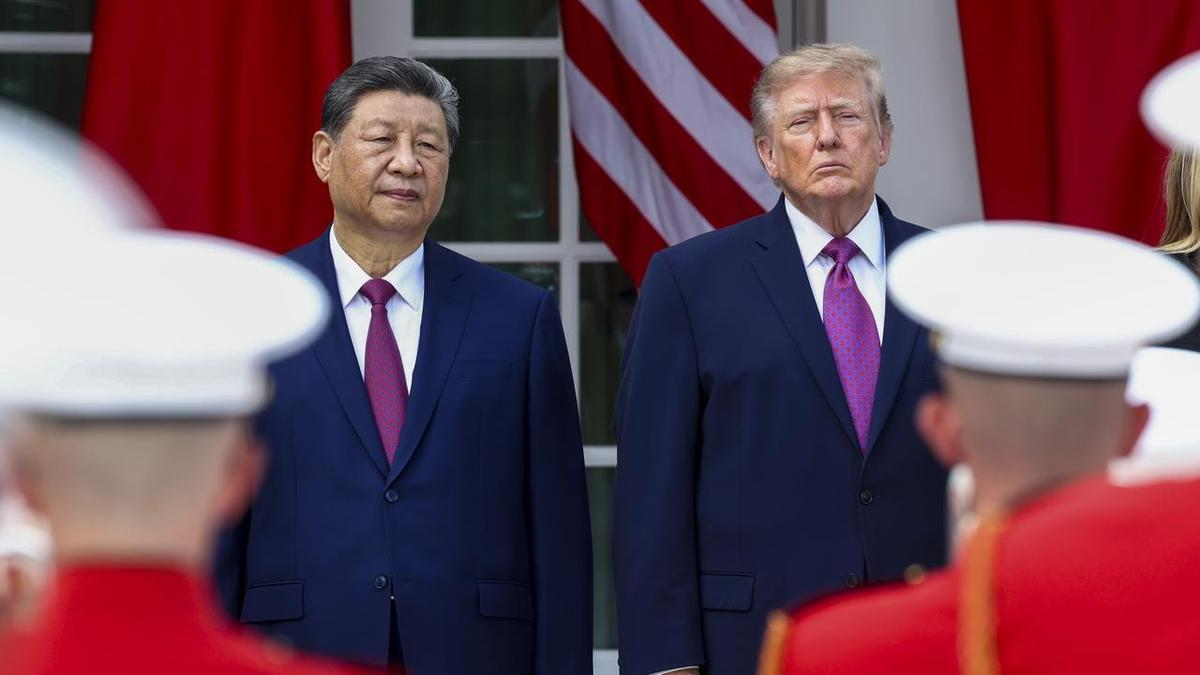
China and the United States have agreed to establish a channel for dealing with artificial intelligence-related incidents and to accelerate work on military crisis communications after a three-day summit between Donald Trump and Xi Jinping in Washington.
The measures were presented as steps towards preventing disagreements between the two powers from escalating, despite the absence of a major breakthrough on their fundamental differences.
China’s foreign ministry said the countries would sign a memorandum of understanding aimed at strengthening crisis communications and preventing crises between their militaries. The two sides are also due to hold an AI-specific dialogue in November to discuss the risks and benefits of the technology.
The agreement followed notably warm exchanges between Mr Trump and Mr Xi, whose talks took place after the US president escalated a trade war with China in 2025.
China and US agree further working-level talks
The White House said a board of trade focused on selected bilateral issues had gone into operation this week. The two countries also agreed to continue work on a pledge to reduce reciprocal tariffs on roughly 30 billion US dollars’ worth of goods.
The leaders extended their trade truce by two months. The White House said China had agreed to import at least 10 million tonnes of coal from the US in 2027 and 2028, while most tariff reductions would apply to non-sensitive goods including agricultural products and holiday decorations.
Washington said the two sides were continuing to address American concerns about rare earth supplies, with the aim of returning shipments to “appropriate levels”. China imposed export controls on rare earths in 2025 in response to US tariffs, reducing supplies sent to the US and other countries.
The countries agreed to meet again at the Asia-Pacific Economic Co-operation summit in Shenzhen, China, in November and later at the G20 meeting at the Trump National Doral Miami golf club in Florida.
They also said Iran should honour its stated commitment not to develop nuclear weapons, and that no country should charge a toll on international waterways, in an apparent reference to the Strait of Hormuz.
The White House said it welcomed China’s decision to add export controls on two further precursor chemicals for fentanyl. Both sides noted that law enforcement agencies had recently made arrests in cases linked to the drug.
Xi returned to Beijing on Saturday, according to Xinhua. Analysts said that although the summit had not resolved the countries’ main disputes, the new mechanisms could help make relations more stable.
“Personal diplomacy between the two leaders is important, but the emphasis on working-level engagement, military-to-military dialogue and crisis-management mechanisms suggests an effort to make that stability more durable and institutionalised,” said Wang Zichen, deputy secretary-general of the Beijing-based Center for China and Globalization.
