


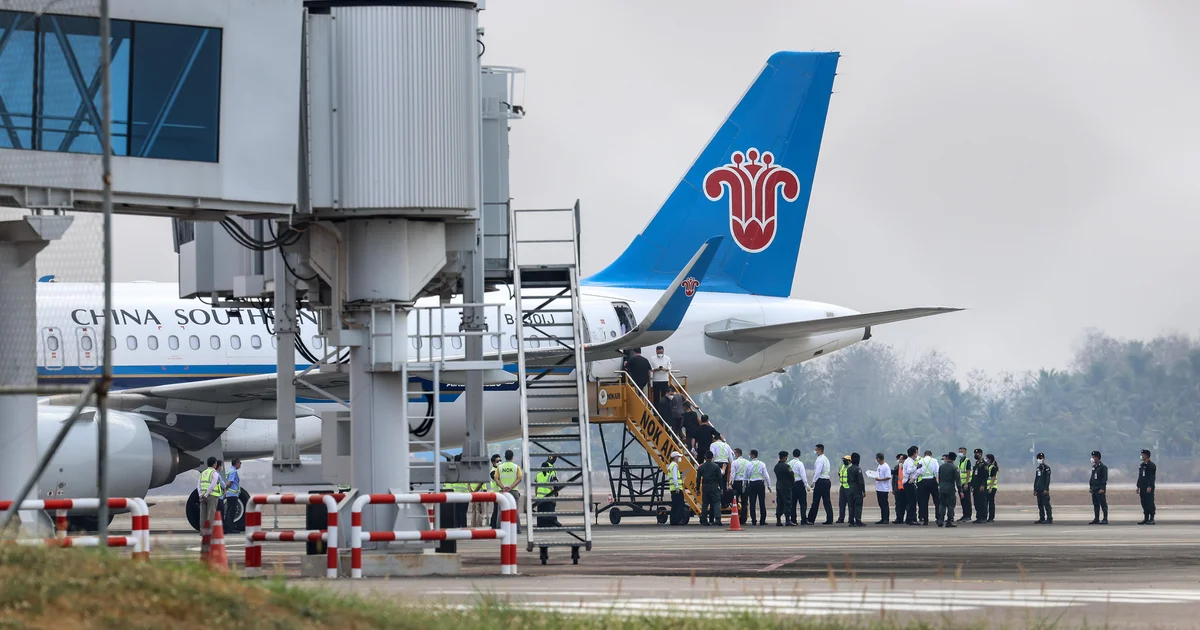
Three members of a criminal gang running scam centres in Myanmar’s Kokang region have been sentenced to death by a Chinese court, with dozens of others jailed for their involvement in a sprawling network of fraud and violent crime.
Quanzhou Intermediate People’s Court said Wei Huairen, Chen Dawei and Liao Jingfang were members of the “Wei family criminal gang”, which operated near China’s border with Myanmar.
The gang was involved in telecommunications fraud, drug trafficking, prostitution, illegal casinos and the murders of at least two Chinese citizens, the court said. Wei was identified as one of its leaders and was convicted of several offences, including murder.
The organisation is believed to have made more than 12.2 billion yuan (£1.8 billion), according to the court statement.
Three other members were given life sentences, while 55 received prison terms ranging from 24 years to three years and three months.
Analysts describe the Wei clan as one of four families controlling criminal syndicates in Kokang. China’s state broadcaster CCTV described it as the “most violent criminal force in northern Myanmar”, alleging that it had built an “iron triangle of political, military, and business criminal activities”.
The gang reportedly ran 14 large-scale scam compounds and brought Chinese nationals to Myanmar with promises of high-paying jobs. CCTV said police had found the remains of victims who had been bound with iron chains, including people with bullet wounds to their skulls.
China targets Myanmar scam centres
The case is part of a wider Chinese crackdown on scam-centre networks across south-east Asia, where criminals have defrauded victims of billions of dollars.
Some people working in the compounds are willing participants, while others are trafficked after being deceived by false job offers and held in prison-like conditions. The United Nations has warned that gangs in China and south-east Asia are making tens of billions of dollars each year through cyber scams.
Scam compounds have expanded across Myanmar’s loosely governed border areas during the country’s civil war, which followed the 2021 coup. The United Nations Office on Drugs and Crime said the industry had also spread to South America, Africa, the Middle East, Europe and parts of the Pacific.
Hundreds of thousands of people are estimated to work in scam centres worldwide. Myanmar’s compounds have attracted workers from China and other parts of south-east Asia.
The Wei family members were first indicted in October 2025. In January, China executed 11 people linked to the Ming family criminal gang, followed the next month by the executions of four members of the Bai clan for offences including fraud, murder, assault, kidnapping and extortion.
Myanmar’s military has faced pressure from China to shut down the operations, as Chinese citizens have both worked in and been targeted by the scams. Experts have said the junta has long turned a blind eye to the compounds, with profits believed to benefit militia allies involved in its fight against rebel groups.
