


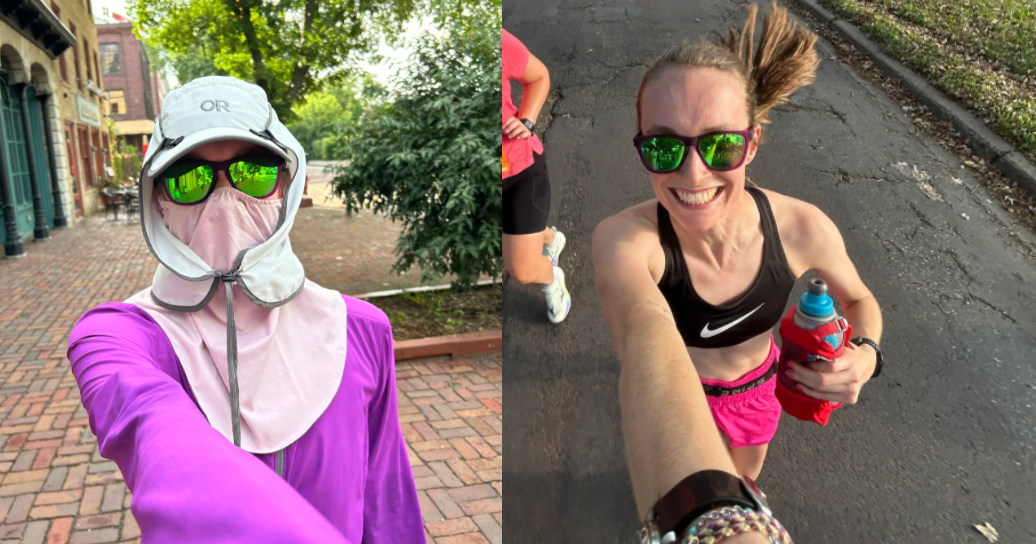
An experimental drug has dramatically increased one woman’s ability to tolerate sunlight after years of living with erythropoietic protoporphyria (EPP), a rare disorder often described as an allergy to the sun. Emily Pearson, from Minneapolis, has since run two marathons and spent a week outdoors without the severe pain that once followed even brief exposure.
Pearson was eight when her symptoms began. Within minutes of being outside, her hands and feet would become intensely painful, feeling as though they were “in a hot oven” while being pricked with “pins and needles”. The pain could last for days.
Her family spent years trying to find an explanation. Sun cream made no difference, so Pearson relied on protective clothing and avoided being outside whenever possible. Trips to the family’s cabin in Minnesota became a source of anxiety, with any prolonged exposure leaving her hands, feet and face in pain.
She was 17 when a doctor at the Mayo Clinic in Rochester, Minnesota, diagnosed EPP. The answer brought relief, but there was little she could do beyond limiting her exposure to sunlight.
Running became an important outlet. After 12 years as a competitive swimmer, Pearson took up half-marathons after leaving school, often running in several layers or in darkness at sunrise or sunset.
“Going to the grocery store, going to get gas, going for any kind of car ride or working outside, you constantly have to think about what you’re doing and how it’s going to affect your health, and dealing with those consequences after,” Pearson, now 25, said.
She added: “It was really hard, and it was really, really stressful. It was a big mental load, and it was never-ending.”
Bitopertin trial offers greater sunlight tolerance
Pearson heard about a clinical trial for bitopertin while volunteering at Sun Escape, a camp for children with EPP and similar conditions, in 2025. She was initially cautious about taking part, worried that the treatment might not work for her.
Bitopertin is a once-daily tablet designed to reduce levels of protoporphyrin IX, a molecule in the skin that is activated by sunlight. In people with EPP, genetic mutations cause too much of the molecule to be produced, leading to painful reactions.
Dr Sioban Keel, a porphyria specialist at the University of Washington involved in the trial, said she had heard similar accounts from other participants. “The impact I’ve seen it have on my patients has been a game changer,” she said.
“Patients that previously could never go out in the sun are able to go out in the sun … You’re like, ‘I can’t believe I’m hearing this,’” Dr Keel added.
Pearson began taking bitopertin in July 2025 as part of the trial’s second phase. Within weeks, she said, her tolerance to sunlight had started to improve.
Trial data published by Disc Medicine in April reported significantly reduced protoporphyrin IX levels and improved measures of sunlight tolerance among patients with EPP. The company said there were no notable safety concerns.
Bitopertin has now entered phase three trials, with 183 patients enrolled and results expected in the final quarter of 2026. The US Food and Drug Administration has declined to review the drug for expedited approval, saying more evidence was needed to demonstrate its impact on patients, according to a statement from Disc Medicine.
Pearson is continuing to take the medication through an open-label extension of the trial, in which participants can choose to remain on the treatment.
In October 2025, she completed her first marathon. She said she was able to spend the entire day outside in shorts and a T-shirt, without the protective clothing she had previously needed.
She trained for another marathon the following spring and ran it in June. In July, she returned to the family cabin and spent the week outdoors from sunrise to sunset without experiencing a reaction.
“It’s unimaginable. I cannot explain how big of a difference it makes, because the cabin and going outside used to be such a source of anxiety for me. Now, I had the best week ever,” Pearson said.
Pearson hopes to run another marathon in June 2027 and is considering taking part in a triathlon. She said the treatment had allowed her to spend time outdoors without constantly calculating the consequences.
“I’m able to feel free and live without all the worry and anxiety that I was before,” she said. “I’m 20 times happier. I’m more energetic. My life has literally changed so much.”
