


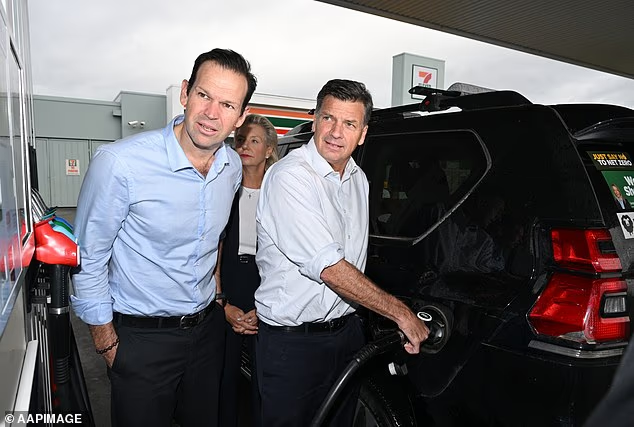
Australia’s Coalition has proposed an automatic fuel tax cut whenever global oil prices rise sharply, challenging the Albanese government’s decision not to introduce another temporary reduction in fuel excise.
Opposition Leader Angus Taylor said the proposed “Fuel Price Shield” could cut up to 27 cents a litre from petrol prices, saving about $15 on a typical tank.
Under the plan, fuel excise would be halved when the two-week average closing price of Brent crude rises above US$100 a barrel. The reduction would remain in place until the eight-week average fell below that threshold, or for three months, unless the government chose to extend it.
Taylor said the measure would give households and businesses protection from international energy shocks, which can quickly increase transport and operating costs.
“When global events send oil prices through the roof, Australians should know there is a clear automatic safeguard in place to provide temporary and targeted relief,” he said.
The proposal would also temporarily reduce the heavy vehicle road user charge to zero. The Coalition says this would ease costs for truck operators and could ultimately reduce freight expenses passed on through supermarkets and other consumer prices.
Coalition analysis suggests the mechanism would have been activated twice in the past five years: during the oil price shock in early 2022 and again in March 2026.
Fuel Price Shield attacked as ‘uncapped’ and ‘unfunded’
Treasurer Jim Chalmers rejected the proposal, warning that it could cost taxpayers billions of dollars in lost revenue without a clear funding plan.
Speaking on Sunday morning, Chalmers said the Opposition had not explained how it would pay for the policy.
“That’s what makes it uncapped and unfunded,” he said. “That’s why he can’t tell us how much it costs, how he’ll pay for it.”
Chalmers also accused Taylor of responding to political pressure rather than offering an economic solution.
“I think what we’ve seen overnight from Angus Taylor is more about polling numbers than petrol prices,” he said.
“He is under very serious political pressure and that matters much more to him than the cost of living pressures that people are feeling around the country.”
Despite criticising the Coalition’s proposal, Chalmers confirmed that Labor is not currently considering a further fuel excise cut. The government has instead said it is focusing on longer-term cost-of-living relief through tax reductions and wage growth.
The Albanese government previously cut fuel excise temporarily during the recent US-Iran conflict. The measure cost about $2.5 billion over three months before it was withdrawn.
Coalition says tobacco tax cut would fund fuel relief
The Coalition estimates that its fuel scheme would cost about $950 million for every month it operated.
Taylor said the cost would be met through another Coalition policy: an 80 per cent reduction in tobacco excise, which he said would raise $8 billion.
“We worked through that with the Parliamentary Budget Office and that will fully fund the cut to the fuel excise,” he said.
He described the plan as anti-inflationary, arguing that it would reduce transport costs and help motorists if fuel prices approached $3 a litre.
The Coalition has also said the Australian Competition and Consumer Commission would monitor wholesale and retail prices to ensure the savings reached motorists.
AMP chief economist Shane Oliver said the proposal was likely to be politically popular but questioned whether it would provide more than temporary relief.
He described fuel excise reductions as a “Band-Aid solution” and a “sugar hit”, arguing that they could lower prices in the short term without addressing the causes of higher fuel costs.
“The main beneficiaries are often those driving bigger, less fuel-efficient vehicles, who tend to be higher-income earners,” he said.
Oliver said a more targeted approach would be preferable, including support for truck drivers, farmers and low-income households.
He supported suspending the heavy vehicle road user charge during oil price shocks but warned that broad fuel tax cuts could weaken incentives for consumers to use less fuel or switch to alternatives such as electric vehicles.
“If fuel prices remain elevated for a long period, all this really does is delay the adjustment that eventually has to occur,” he said. “It’s a short-term measure that provides relief, but it doesn’t solve the underlying problem.”
