


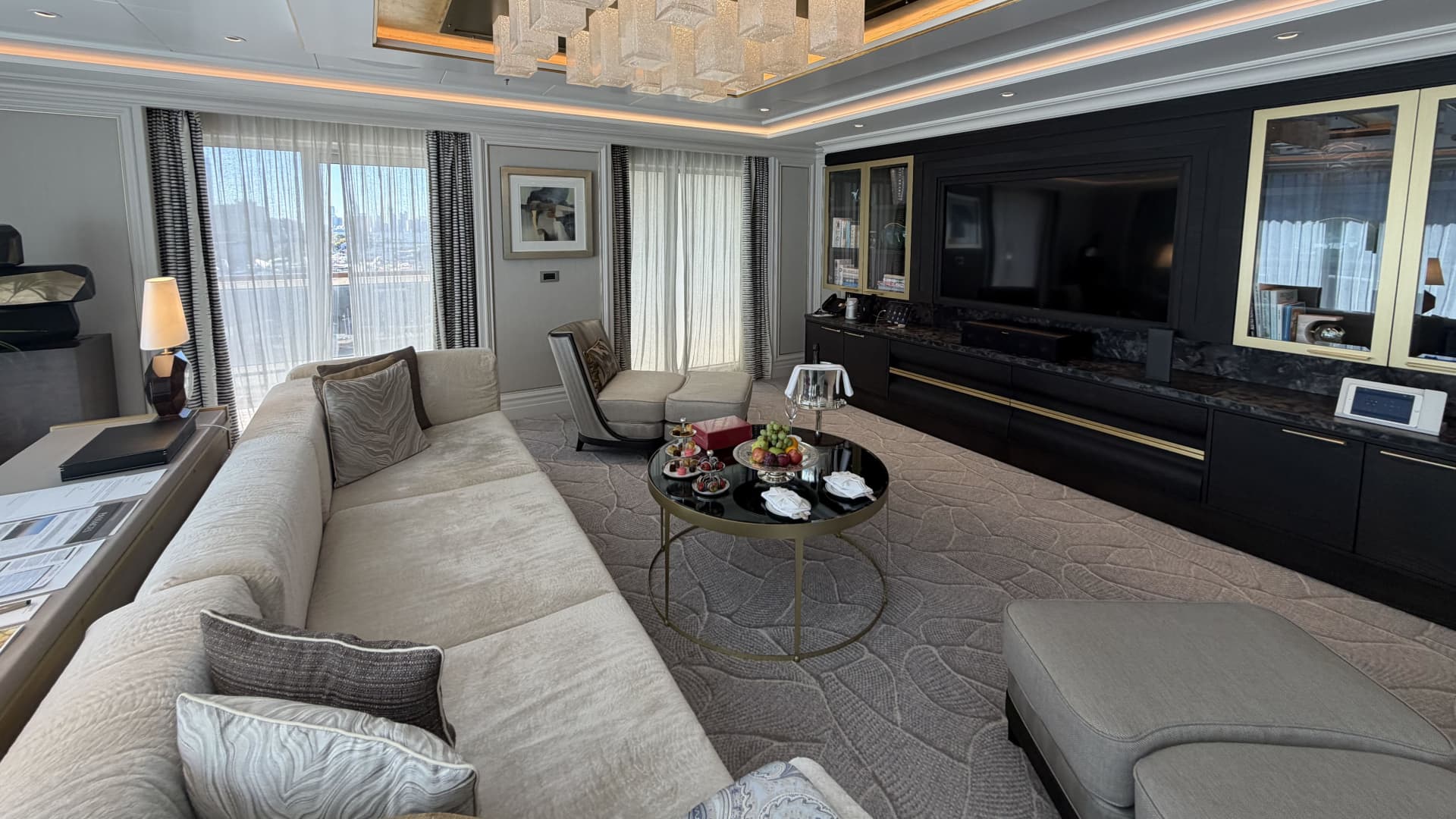
Luxury cruise lines are investing heavily in larger suites, smaller ships and more exclusive experiences as affluent travellers continue to pay premium prices for space and personal service.
Regent Seven Seas’ top accommodation on Seven Seas Splendor costs up to $15,000 a night. The 5,100-square-foot Regent Suite includes a Steinway piano, private dining room and wraparound deck with a hot tub and views comparable with those from the ship’s bridge.
The suite is almost always occupied, and several passengers sought it for the ship’s 151-night global voyage departing in January, Regent said.
The company is preparing to push prices higher still with Seven Seas Prestige, due to launch in December as Regent’s first new ship class in a decade. Its top suite will cost $25,000 a night.
Luxury cruise fleet set to expand
The growth of high-end cruising comes as operators look beyond the vast ships that can carry more than 7,500 passengers. Smaller vessels, some with fewer than 1,000 guests, are increasingly central to the industry’s investment plans.
Norwegian Cruise Line Holdings, which owns Regent and Oceania, has said it is concentrating on sharpening the brands’ position, improving the guest experience and strengthening their commercial performance.
Chief executive John Chidsey said Regent and Oceania were in good shape for 2027, although the company did not provide separate performance figures for the two brands.
Regent competes with Royal Caribbean’s Silversea and Carnival-owned Seabourn. Hotel brands including Four Seasons, Aman and Orient Express are also bringing luxury hospitality into the yacht-style vessel market.
The luxury cruise fleet is projected to grow from 104 ships in 2026 to at least 130 by 2036. Industry investment is increasingly being directed towards luxury and expedition operators, with orders favouring smaller ships and fewer berths.
Between 2020 and 2025, the number of luxury ships rose by 71 per cent and the number of berths by 84 per cent. Orders indicate a further 26 per cent increase in ships by the end of 2029, alongside a 32 per cent rise in capacity.
The trend extends beyond the cruise industry. United Airlines has introduced larger Polaris Studio suites with privacy doors and caviar service, while American Airlines has expanded its lie-flat capacity. American said premium passenger revenue per unit rose by 18.5 per cent in the third quarter, compared with 14.4 per cent in its main cabin.
Marriott reported that luxury revenue per available room in the US and Canada increased by 9.1 per cent year on year in the second quarter, against 5 per cent across its wider hotel business in the region.
Competition raises questions over luxury demand
Premium travel does not guarantee stronger financial performance. The Ritz-Carlton Yacht Collection has struggled with occupancy despite major marketing campaigns and has accumulated almost $700 million in losses since 2017, according to a Financial Times report cited in the source material.
As more companies enter the market, operators also face the challenge of preserving a sense of scarcity and persuading customers that increasingly high prices are justified.
Wynn Resorts has maintained high room rates in Las Vegas despite weaker visitor numbers over the past year, choosing not to fill every room with bargain-seeking travellers.
Las Vegas Sands said recent results were hit by weaker high-end business in Macau and Singapore. Chief executive Patrick Dumont said: “When the customers don’t show up, it’s a little problematic.”
He said he could not identify a single cause for the weakness and suggested that people might not be feeling as positive about the market, while arguing that the quarter could prove temporary.
Asked whether luxury travel risked becoming overcrowded, Mr Dumont pointed to long-term wealth creation in Asia and said companies needed to create experiences that customers wanted to revisit.
“It’s not about, are there enough customers,” he said. “It’s, can we create enough of an interesting set of experiences where people find us indispensable in their lives.”
