


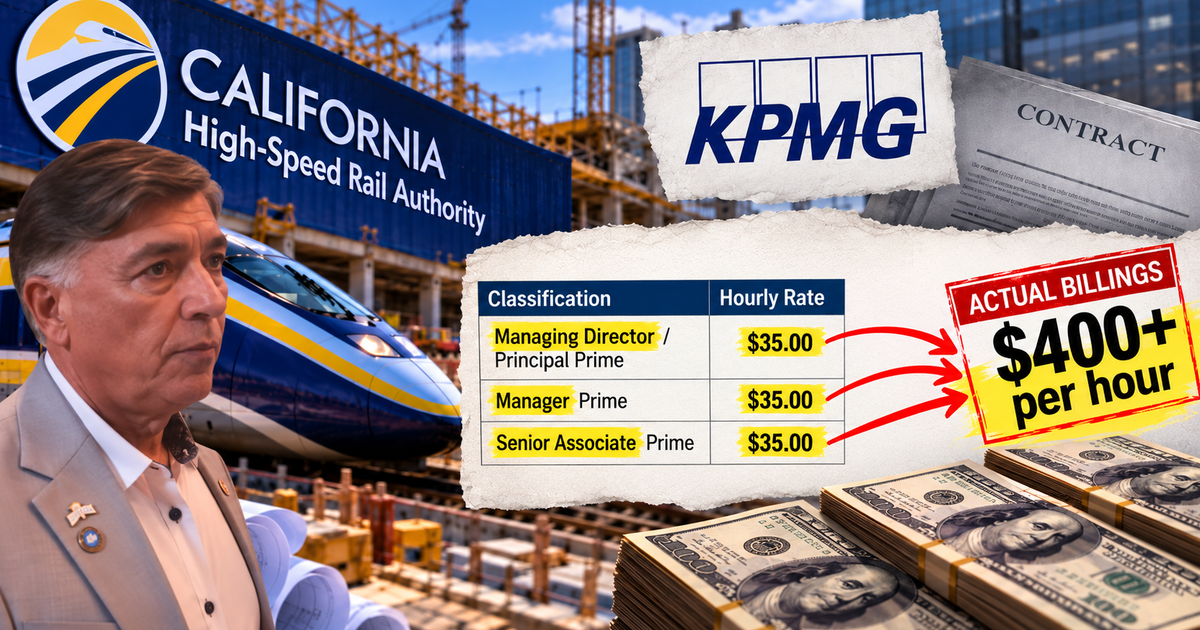
California High-Speed Rail paid KPMG roughly $2 million more than the consulting firm’s winning bid indicated over a four-month period, according to records showing that staff assigned to lower-paid roles were billed at a rate more than 12 times higher.
KPMG won a four-year contract worth $24 million after proposing an average hourly rate of about $200. But invoices reviewed from the first year show an average rate of more than double that figure, with the firm already having spent nearly half the contract’s total value.
The discrepancy centres on three classifications included in KPMG’s bid at $35 an hour: managing directors, managers and senior associates. The lowest-experience category, associates, was priced at $425 an hour.
High-Speed Rail later assigned more than 9,000 hours of work to managers and senior associates. KPMG billed thousands of those hours at the associate rate instead, records indicate.
The arrangement was challenged by CohnReznick Advisory, which scored higher than KPMG on technical qualifications but lost the contract by two points because of KPMG’s lower price.
CohnReznick alleged that KPMG had offered artificially low rates for senior positions it never intended to staff, while planning to bill the work under higher-priced classifications. State officials rejected the protest, describing the allegation as “mere speculation”.
Disputed KPMG billing rates
The bid documents show KPMG reducing its rates for managing directors, managers and senior associates from hundreds of dollars an hour under an earlier contract to $35. At the same time, the associate rate rose from $45 to $425.
The lower figures helped reduce KPMG’s weighted average price, which was used to score the bids. The records also indicate that employees listed as managers and senior associates were assigned under the associate classification, while managing directors were listed as partners at $460 an hour.
A Department of General Services hearing officer warned that High-Speed Rail had to ensure work was performed at the appropriate classification and that the authority could not assign work to a $35-an-hour manager and pay a higher rate because the employee used another title.
However, the task orders and invoices reviewed indicate that managers and senior associates were billed at $425 an hour. The difference amounted to about $2 million during the four months examined.
The documents also show that the winning bid listed a manager rate of $36.05 for the third and fourth years of the contract, while the signed agreement gave a rate of $453.20. Under the scoring rules, CohnReznick would have won had KPMG bid the higher figure.
High-Speed Rail evaluators had raised concerns about KPMG’s proposal, noting that it did not assign staff to the three positions priced at $35 an hour. The authority awarded the contract nevertheless.
KPMG said the authority was aware of its intended staffing approach when the contract was awarded. A spokesman said its December 2024 bid set out the people who would work on the engagement, their classifications under the state’s definitions and the billing rate for each person.
“KPMG’s bid in December 2024 detailed the people who would work on the engagement, their job classifications aligned to the state’s definitions, and the associated billing rate for each person,” the spokesman said.
The firm said it was investigating the proposal process and contract. It added that any violations of its own policies or those of the authority would be addressed appropriately, and that it would co-operate with the High-Speed Rail board and management.
Questions over oversight of the contract
The Department of General Services said its role was limited to checking whether a procurement complied with state law and procedural requirements. It said it did not have authority to oversee the rates an agency paid after a contract had been signed.
That responsibility rested with the High-Speed Rail Authority, which has not responded to repeated questions about the billing classifications or whether its chief financial officer authorised changes to the assignments.
The authority’s board chair said they would formally ask the Office of Inspector General to conduct an independent review of the contract, billing practices and oversight procedures.
“Our responsibility is to the people of California. I will continue to act decisively to ensure that every dollar spent on the high-speed rail programme is accounted for and aligned with the public interest,” the chair said.
The authority has announced that it will re-bid KPMG’s contract early after a separate Inspector General investigation into consultant spending. The agency has also told its board that an independent auditor identified more than $3 million in questioned costs, overbillings and recommended adjustments during the past two years.
KPMG’s contract is among four consultancy agreements awarded by chief executive Ian Choudri that together total about a quarter of a billion dollars over two years. The rail programme is projected to run out of money by the end of 2027 without additional funding.
Choudri and KPMG managing director Thierry Prate, who signed the agreement, did not respond to requests for comment.
