


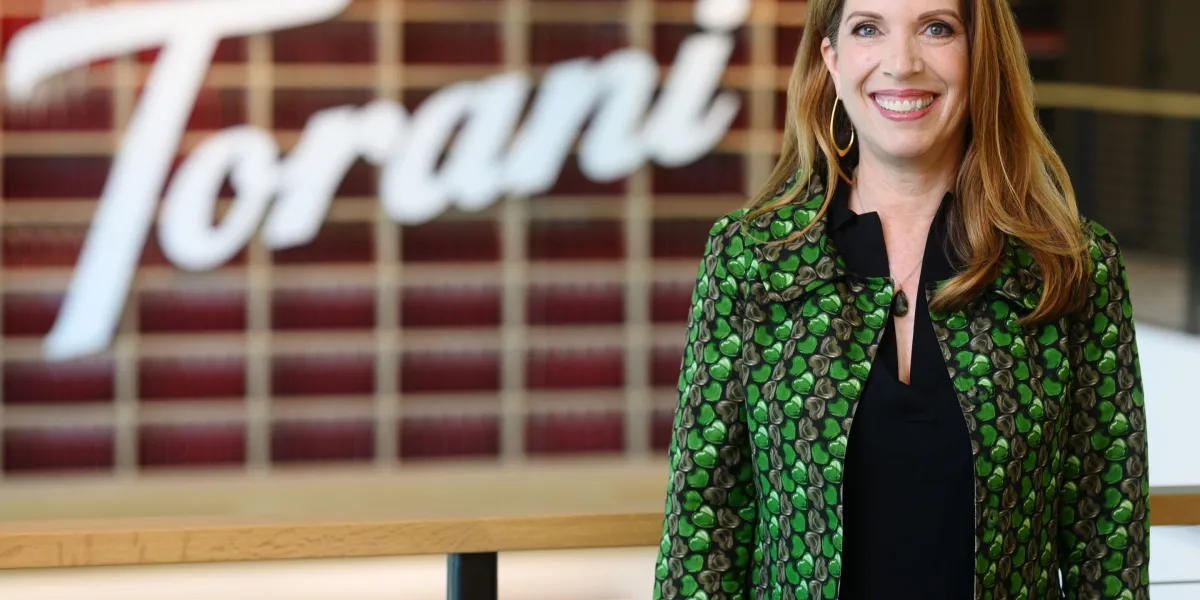
Layoffs are a choice rather than an inevitable response to financial pressure, according to Melanie Dulbecco, chief executive of flavoured syrup maker Torani, which says it has never made a mass job cut in its 101-year history.
Dulbecco said companies facing difficulty should first examine other costs before reducing their workforce, arguing that long-term resilience depends on retaining the people needed to restore growth.
“It’s very easy for us to say layoffs are not our approach. I think layoffs are a choice,” she said.
“I get it if a company is going through bankruptcy and has to make extremely challenging choices. Otherwise, I think it’s a financial exercise that doesn’t consider how you’re going to be resilient or regain momentum—because you do that with a team.”
Torani maintained its commitment to its staff during the Covid-19 pandemic, including when it moved its office to San Leandro in March 2020. The company mapped where employees lived before choosing the location, with the aim of retaining all of its workers and keeping commuting distances reasonable.
The move came as Torani had borrowed heavily to build a new factory and was facing increased uncertainty. Rather than furloughing or dismissing staff, it reduced marketing and advertising spending, paused employee travel and scrutinised budgets for non-essential costs.
“With significant financial uncertainty and a major Flavor Factory investment underway, we asked ourselves: What decisions will make us proud when we come out on the other side? We committed to getting through the crisis together without layoffs or furloughs,” Dulbecco said.
When coffee shops closed, Torani shifted towards online retail and grocery sales. After an initial decline, revenue recovered and ended 2020 up 15% year on year.
Dulbecco said the company’s longer-term approach had supported average annual growth of about 20% over 35 years. Torani is on course to exceed $800 million (£602 million) in revenue this year, she added.
US job cuts remain high as employers assess uncertainty
Torani’s policy stands in contrast to the wider American jobs market. Employers announced 573,195 job cuts in the first nine months of this year, according to Challenger, Gray & Christmas, although that was below the 946,426 cuts announced during the same period in 2025.
The employment consultancy said businesses were holding back while assessing economic conditions, including high energy costs, an uncertain war in Iran, a potential interest rate rise and the prospect of higher healthcare costs.
About 1.2 million job cuts were announced in the US last year, a 58% rise on 2024 and the highest level since 2020. Technology companies accounted for about 154,000 planned reductions, as the sector adjusted after pandemic-era overhiring and accelerated its use of artificial intelligence.
Artificial intelligence has nevertheless influenced Torani’s recruitment plans. Dulbecco said automation meant the company needed fewer new hires than it otherwise would have, with technology being used for some manual roles, market research, sales forecasting and demand planning.
“Our team doesn’t get worried about things like AI because they trust that we will both automate and elevate the work, that we will never do anything that squashes opportunities for people, and that we are looking out for everybody’s success,” she said.
