


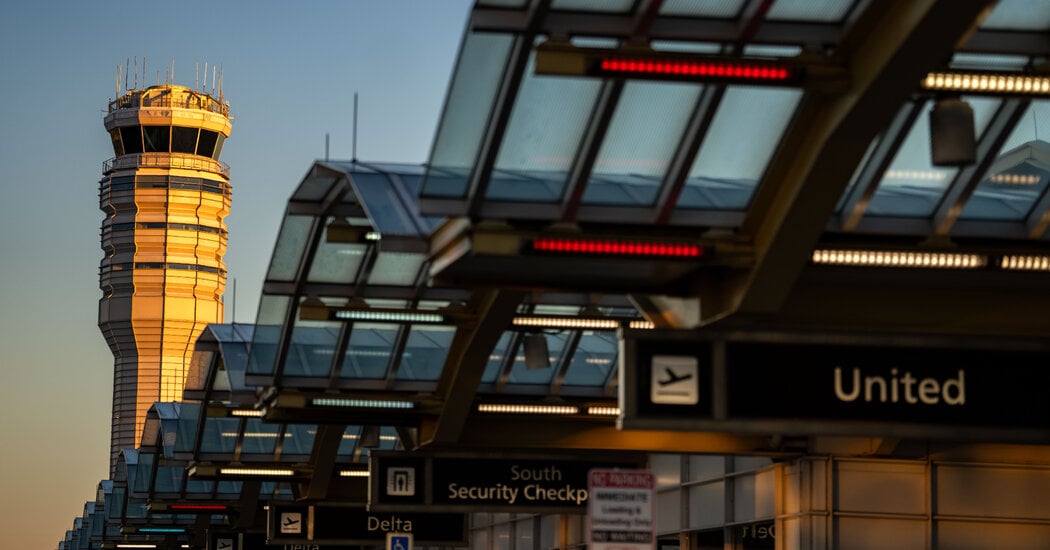
The Trump administration is to begin deploying an artificial-intelligence air traffic control tool in the Washington region on Monday, in the first stage of a planned nationwide system intended to predict and prevent flight delays.
Known as Strategic Management of Airspace, Routing and Trajectories, or SMART, the $875 million programme will initially cover Ronald Reagan Washington National Airport, Dulles International Airport and Baltimore/Washington International Thurgood Marshall Airport.
The system will examine airline schedules, weather patterns and other possible disruptions to forecast traffic flows, identify potential conflicts and suggest alternative routes before delays spread through the network.
A full national rollout is planned by 2028. The first phase will focus on same-day disruption, including weather-related delays, although officials say SMART is designed eventually to analyse congestion and scheduling data as much as a month ahead.
The Washington airspace has faced heightened scrutiny since the January 2025 collision between a commercial aircraft and an Army Black Hawk helicopter, which killed 67 people. The National Transportation Safety Board attributed some of the failures preceding the crash to the Federal Aviation Administration.
Transportation Department officials insist that SMART will support, rather than replace, human controllers. It will be based at the F.A.A.’s Air Traffic Control System Command Centre in Warrenton, Virginia, with recommendations passed to controllers at regional towers and other air traffic facilities.
Controllers will be free to accept or disregard the system’s suggestions, and the programme will not independently order changes to flight routes.
“We’re excited to launch SMART and take another major step toward improving air travel for the American people,” F.A.A. spokeswoman Hannah Walden said, describing it as “a new tool that will fundamentally change the way we manage our skies.”
The rollout follows the award of the development contract to Air Space Intelligence, a Boston-based software company, in June. Its speed has prompted discussion among officials and aviation experts, with the F.A.A. holding extensive talks to address concerns that the technology could create more problems than it solves.
Robert Mann, a former airline executive and aviation consultant, said SMART might produce better flight plans but was unlikely to resolve many delays that arise after a plan has been filed.
“Whether it’s on the ground or in flight or in the terminal area,” Mr Mann said, “you’re up against a whole bunch of other traffic which arrives roughly the same time, and that’s because they’ve experienced the same sort of random delays on the ground, en route, and in the arrivals area that you are.”
He said airlines could initially co-operate with the programme but might later regard it as an intrusion, given the cost of altering schedules that are planned and managed well in advance.
“We’ll see how long that acquiescence lasts,” Mr Mann added.
The introduction also comes as the F.A.A. faces a continuing shortage of air traffic controllers and a dispute with the union representing them over the number of staff required to address the shortfall.
The agency published a report last year estimating that it would need 14,633 controllers to be fully staffed, but revised that figure down by more than 2,000 positions this spring, arguing that more efficient scheduling could reduce the need for additional hires. In April, it reported having more than 11,000 fully certified controllers.
The National Air Traffic Controllers Association said new technology should complement the experience, training and professional judgement of controllers responsible for the safety of the national airspace system. The union added that it had not been involved in SMART’s design or testing.
At a congressional hearing this week, F.A.A. administrator Bryan Bedford called for billions of dollars more to modernise air traffic control, saying new technology was needed to “supercharge our ability to safely grow traffic and reduce the workload and strain on our controllers.”
