


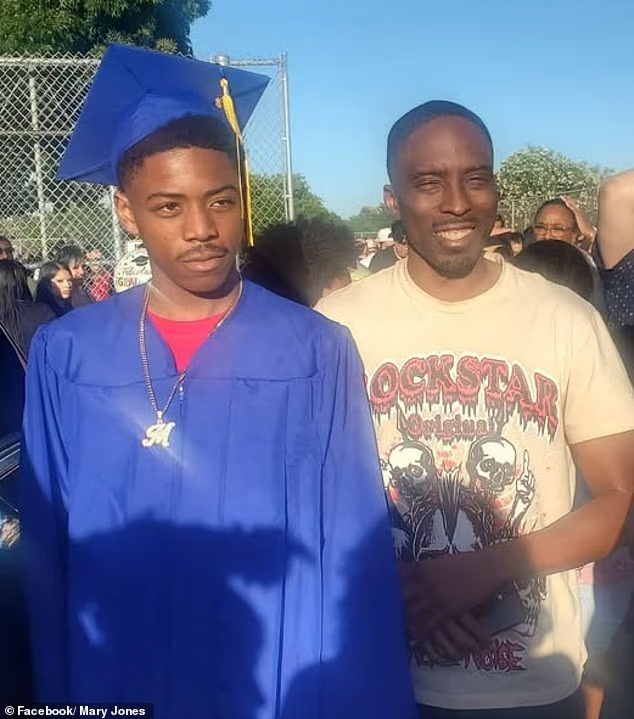
The Fairfield graduation shooting that killed 18-year-old Jamario Baker minutes after he collected his diploma is no longer an open manhunt. A 17-year-old was arrested in Texas on 10 July, thirty-seven days after the shooting, by US Marshals working with Fairfield detectives. He is held on suspicion of murder and awaiting extradition to California.
What happens to him next is decided by a piece of Californian law most reports have not explained, and it is the reason his name has not been published.
What happened on 3 June
Baker had just graduated from Sem Yeto Continuation High School. The ceremony was held on the Fairfield High School campus in Solano County, which shares its site and stadium with the continuation school. Around a thousand people attended.
Shortly after 7.15pm, gunfire broke out in the stadium car park as families were leaving. Baker was killed. Three other people, aged 11, 20 and 25, were wounded; police later said all three were in a stable condition and recovering. Parked cars were left with bullet holes in them.

Baker’s family say he was shielding his mother and 11-year-old sister when he was hit. His great aunt, Mary Jones, posted a photograph of him in a blue cap and gown standing beside his father, Roderick, and wrote: “That was my Great Nephew that was shot and killed. Rest in Heaven Jamario. He was protecting his 11 year old sister when he was shot.”
How the suspect was found
Fairfield police say the suspect left California within days of the shooting. That is the single fact that turned a local homicide inquiry into a federal fugitive hunt: once a wanted person crosses a state line, the US Marshals Service becomes the agency that goes after them.
In its statement, the department described dozens of witness interviews, hours of surveillance and phone-recorded video, photographs, electronic records, search warrants and forensic work across multiple jurisdictions. On the morning of 10 July, Marshals accompanied by Fairfield detectives served a search warrant and an arrest warrant at a house in the greater Dallas–Fort Worth area. Captain Nicholas McDowell said the suspect was taken into custody without incident.
Thirty-seven days is fast for a case that began with roughly a thousand potential witnesses in a dark car park and a suspect already out of state. Police credited the people who came forward.
Why the suspect has not been named
This is a point of difference between the American and British systems that often confuses UK readers. In England and Wales, a court can lift reporting restrictions on a defendant under 18, and in serious cases it frequently does.
California does not work that way. A case that begins in juvenile court is confidential by statute. Police do not release the name, the hearings are closed, and the file is sealed. It stays that way unless and until the case is moved into adult criminal court — at which point the proceedings, and the name, become public.
The hearing that decides everything
Californian prosecutors used to be able to file a case like this straight into adult court. That ended with Proposition 57, passed by voters in 2016. Since then, every case involving a minor starts in juvenile court, and the only route to adult court is a transfer hearing in front of a juvenile judge.
A later law, Senate Bill 1391, removed 14- and 15-year-olds from transfer altogether. A 16- or 17-year-old accused of a serious offence can still be transferred, but the prosecution has to ask for it and then prove its case by clear and convincing evidence — a higher bar than the ordinary civil standard. The judge weighs the young person’s maturity, their record, whether they can be rehabilitated within the time the juvenile system has left, and the circumstances of the offence.

Two very different outcomes
The gap between the two tracks is enormous, and it is worth setting out plainly.
If the case stays in juvenile court. California closed its state youth prison system, the Division of Juvenile Justice, in 2023 and moved responsibility to counties. Young people found responsible for the most serious offences are now held in county Secure Youth Treatment Facilities. Court jurisdiction runs to age 23, extending to 25 where the offence would have drawn a sentence of seven years or more in adult court. Murder qualifies. There is no life sentence available in that track, and no adult prison.
If the case is transferred. First-degree murder in California carries 25 years to life. On top of that sits Penal Code section 12022.53, the “10-20-life” firearm law: intentionally discharging a gun and causing death adds a further 25 years to life. Three other people were hit, which opens the door to attempted murder counts alongside.
One hearing, held in a closed courtroom, separates a term ending at 25 from a sentence measured in decades. That is why the transfer motion — not the arrest — is the moment this case is actually decided, and why the handling of teenage defendants in American shooting cases varies so widely from state to state.
What is still unknown
Four things have not been established publicly, and none of them should be assumed.
No motive has been given. Police have not said whether Baker was the intended target or was hit in gunfire aimed elsewhere. No charging decision by the Solano County District Attorney has been announced, and an arrest on suspicion of murder is not a charge. And police have not said whether anyone else is being sought — the original description of the shooting referred to a suspect or suspects, and only one person has been arrested.
The city in the meantime
In the days after the shooting, residents gathered at Fairfield Civic Center Park for a community healing circle. Nikila Walker Gibson, president of the Tri-City NAACP, asked those who came: “The question before is what do we do now, where do we go from here? Do we become more divided, do we retreat from one another, do we allow the fear to define the story of our city or do we choose something different?”

Ebony Antoine, who founded the non-profit Broken by Violence after losing her brother and her husband to gun violence ninety days apart, put the practical questions to CBS News: “Who’s going to pay for the final preparations, who’s going to pay for the mental health, is there going to be justice?” On the last of those, she said the community already knows where the problem starts. “When we know what the problem is, we can respond ahead of time and save lives.”
The Fairfield-Suisun Unified School District told families there was no indication of an ongoing threat to schools, and that counselling was available on every site. Superintendent Jennifer Sachs wrote: “What should have been a joyful celebration of our graduates was overshadowed by an act of violence that has left students, families, staff, and community members feeling shaken and heartbroken.”
Similar arguments about prevention rather than response are being had in cities across the United States, including Chicago, where officials have moved to create a dedicated gun violence prevention department.
What to watch next
Three markers will show where this is going: whether the suspect is returned to Solano County or contests extradition; whether the District Attorney files a petition in juvenile court and what offences it alleges; and whether prosecutors move for transfer to adult court. The last of those is the one that matters, and because the hearing is closed, it may be reported only after it has happened.
