


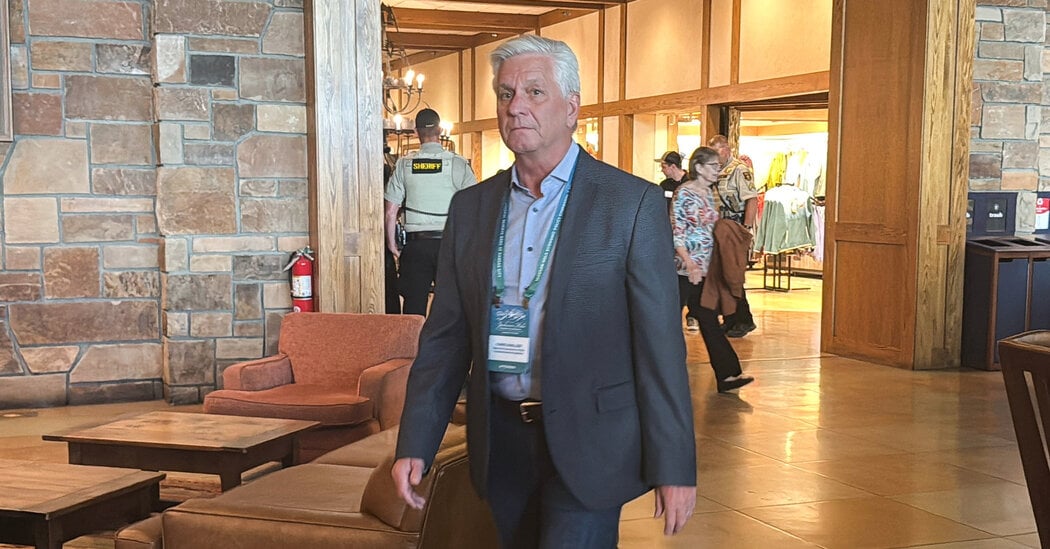
Federal Reserve officials have sent conflicting signals over whether US interest rates should be raised this month, with chairman Kevin Warsh insisting that persistent inflation should remain the central bank’s overriding concern.
The Federal Open Market Committee is due to meet on September 15 and 16, after leaving its target range unchanged at 3.5 to 3.75 per cent in July. Three policymakers voted against that decision, preferring a quarter-point increase.
Speaking at the Federal Reserve’s annual economic symposium in Jackson Hole, Wyoming, Mr Warsh said recent improvements in some inflation readings had not convinced him that price pressures were easing sufficiently.
“They do not tell me that underlying trends have meaningfully improved,” he said, arguing that the labour market remained “quite stable” while inflation was still above the Fed’s 2 per cent target.
Mr Warsh stopped short of explicitly calling for an increase at the forthcoming meeting and reiterated his opposition to giving markets guidance about the Fed’s next move.
His comments contrasted with those from Michael Barr, a Fed governor, who has adopted a more forceful tone in recent days. In a speech in Washington on Tuesday, September 1, Mr Barr warned that there was a risk of “broader price pressures taking hold”.
He said the Fed could afford to wait if incoming data showed inflation moving towards 2 per cent, but added: “If inflation appears not to be moderating sufficiently, then I think we should act decisively to raise rates.”
Mr Barr said inflation had fallen sharply from its peak of more than 7 per cent in 2022, but that progress had stalled in 2025. He attributed the renewed pressure partly to tariffs, conflict in the Middle East and the rapid expansion of artificial-intelligence investment, while warning that services inflation remained elevated.
Federal Reserve rate decision remains open
John Williams, president of the Federal Reserve Bank of New York and vice-chair of the rate-setting committee, offered a less definitive assessment in an interview with CNBC on Wednesday, September 2.
He said it was not yet clear whether current policy was restrictive enough to return inflation to target over the next year or two, or whether additional action would be required.
Mr Williams also said recent data had been encouraging, suggesting inflation was gradually easing as the effects of tariffs began to fade. He identified tariffs and the conflict in the Middle East as major contributors to inflation remaining above the Fed’s goal.
Longer-term Treasury yields have risen in recent weeks, but Mr Williams said the increase reflected the strength of the US economy and investment linked to artificial intelligence and data centres, rather than fears that inflation expectations were becoming unanchored.
The differing views leave the September decision finely balanced. Policymakers will have additional inflation and employment data to assess before the meeting, with the debate centred on whether continued price pressures warrant another increase or whether temporary shocks are already beginning to recede.
