


A Soviet-designed helicopter that carried the first CIA officers into Afghanistan after the September 11 attacks has been restored and put on display at the agency’s headquarters in Langley, Virginia, 25 years after the operation that opened the US response to al-Qaeda and the Taliban.
The seven-member team, code-named JAWBREAKER, landed in the Panjshir Valley on 26 September 2001, carrying millions of dollars in cash to help recruit and equip Afghan allies. Its mission was to gather intelligence and strengthen links with the Northern Alliance ahead of the US military campaign.
The operation came shortly after the assassination of Northern Alliance commander Ahmad Shah Massoud by al-Qaeda operatives, two days before the attacks in the United States.
The Mi-17 used for the mission remained in service until 2012 and flew more than 300 missions in Afghanistan. It was transferred to CIA headquarters in 2018, where it was installed among rocks intended to evoke the Afghan landscape.
Exposure to the elements caused the aircraft’s paint to fade and allowed small animals to get inside. Over the past year, openings were sealed and the helicopter was repainted to more closely match its appearance in 2001.
Its original markings were also restored, including the number “607”, the call sign of the Afghan pilot who flew the first mission. The marking helped the aircraft appear to be a Northern Alliance helicopter while identifying it as friendly to allied pilots.
Why the CIA used a Russian helicopter
The agency acquired the Mi-17 during the 1990s because its Soviet origins could help it operate without drawing attention. Both the Northern Alliance and the Taliban used the type, which CIA historian Rob Byer described as the “pickup truck of helicopters” in the region.
“The big reason we got an Mi-17 rather than flying in a Blackhawk is because it blends in,” Mr Byer said. “And when you’re going behind enemy lines, you’d like to blend in as much as you can.”
The aircraft was also capable of reaching the high-altitude Panjshir Valley. The JAWBREAKER team had to cross the Anjuman Pass, which rises to roughly 14,500 feet, and the Mi-17 was among the few helicopters able to make the journey.
It had no transponder to identify it to American aircraft, so the crew painted “USA” and an American flag on the tops of its stabilisers. The flag was left unfinished because there was no blue paint available. The aircraft was given the call sign “9-11-01”.
Former CIA officer David Tyson flew in the helicopter several weeks after the first team entered Afghanistan. He recalled a noisy and unreliable aircraft with leaking fuel, but said its pilots assured him it was airworthy.
“It was shaking a lot, fuel was leaking, very noisy, and I didn’t know if it was airworthy,” Mr Tyson said. “But I was assured by the pilots it was a good bird.”
Team Alpha and the battle at Qala-i-Jangi
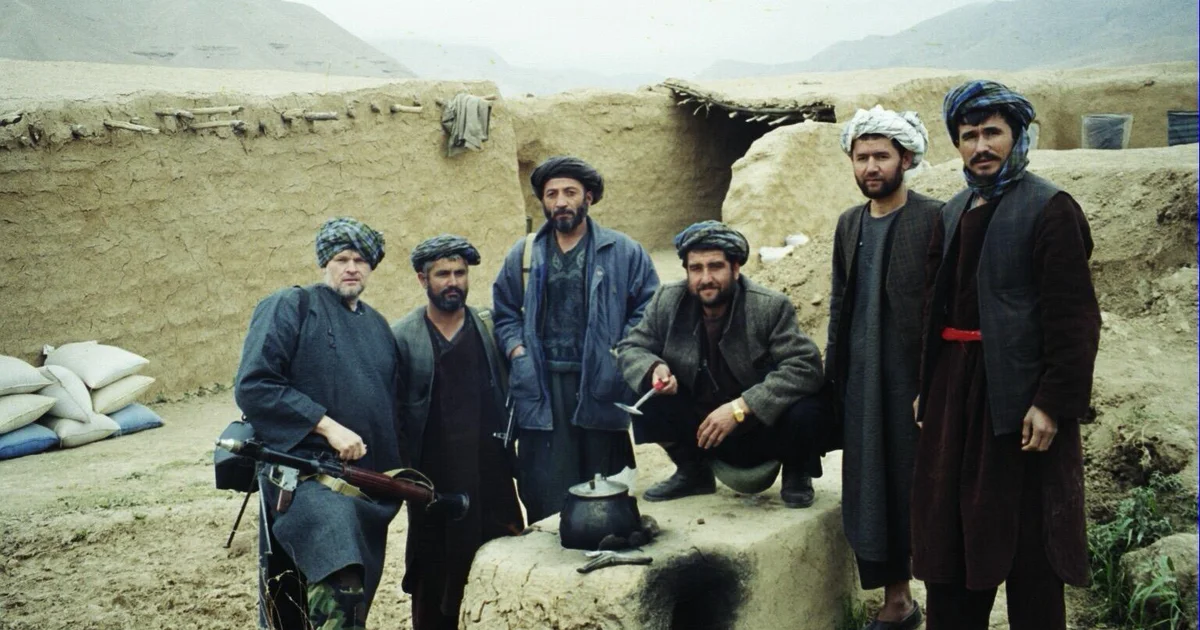
Mr Tyson later joined Team Alpha, which was inserted into northern Afghanistan on 17 October 2001, becoming the first Americans sent behind Taliban lines. The team worked with forces led by Uzbek commander Abdul Rashid Dostum as part of the campaign against the Taliban and al-Qaeda.
Mr Tyson’s role focused on intelligence and liaison work. His knowledge of Uzbek, Turkmen and Russian helped the team communicate with local forces, and he travelled with Afghan fighters on horseback through the mountains, sometimes for as long as 14 hours a day.
By late November, Taliban forces had collapsed across much of northern Afghanistan. Hundreds of foreign fighters surrendered and were taken to Qala-i-Jangi, a 19th-century fortress near Mazar-e-Sharif.
On 25 November, Mr Tyson and fellow CIA officer Johnny Micheal “Mike” Spann entered the compound to establish the identities and origins of the prisoners. Many said they were members of al-Qaeda who had sworn allegiance to Osama bin Laden. John Walker Lindh, an American who had joined the Taliban, was among them.
Hours later, the prisoners staged an uprising. Explosions and gunfire broke out as Mr Tyson tried to reach Mr Spann.
“I remember seeing his … silhouette or body on the ground,” Mr Tyson recalled. “I believe Mike was already dead when I got to him and I was able to shoot the men on top of him and took Mike’s rifle from him.”
Mr Spann, who was 32, became the first American killed in combat in Afghanistan. His death is commemorated by the 79th star on the CIA’s Memorial Wall.
Mr Tyson used Mr Spann’s rifle for the rest of his deployment. The weapon is now displayed in the CIA Museum alongside the boots he wore during the mission, later nicknamed “Dad’s lucky boots” by his son.
Mr Tyson said he still thinks about Mr Spann and his sacrifice every day. He and Mr Spann’s widow, Shannon Spann DeBruyn, are involved with Badger Six, a non-profit organisation supporting Afghan fighters who worked with Team Alpha and their families.
The organisation supports about 35 families with help including food, medicine, relocation and resettlement assistance. For Mr Tyson, the work has continued since the US withdrawal from Afghanistan in 2021 and the Taliban’s return to power.
Asked whether he felt an obligation to help Afghan partners who had been left vulnerable, he replied: “Sure, yeah. That’s what people do. That’s what we do.”
