


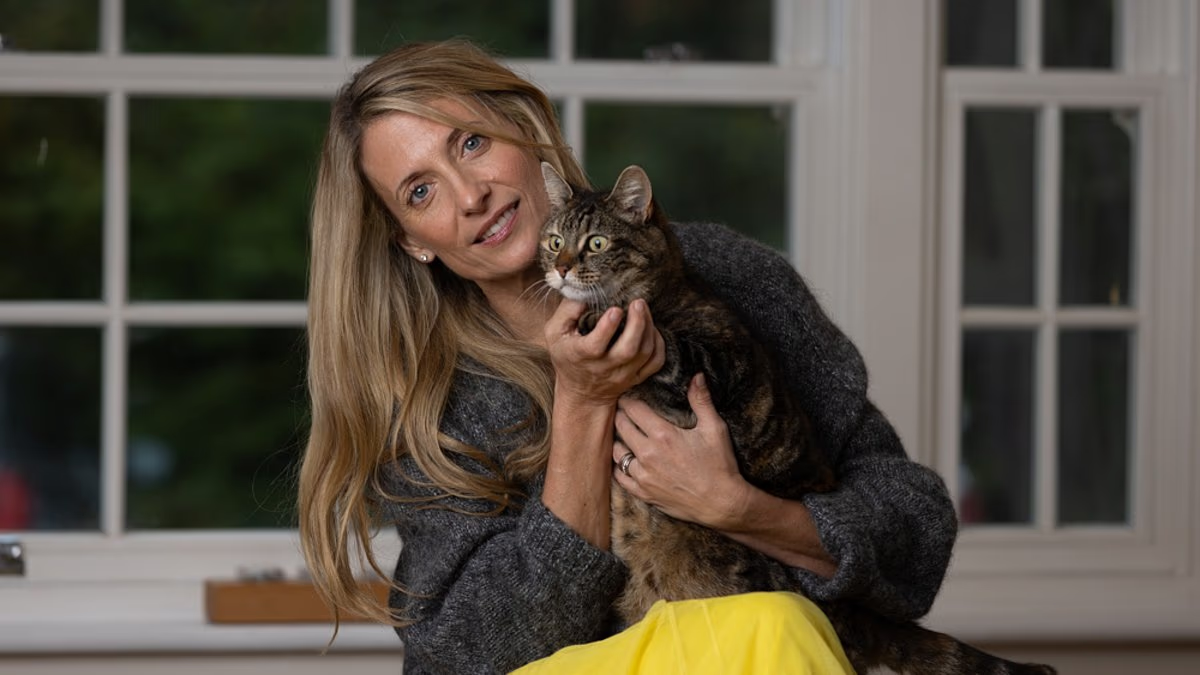
A menopause coach who helped woman manage their symptoms while secretly drowning her own sorrows in white wine has revealed how being sober has transformed her from the inside out.
UK-based fitness and women’s health expert Kate Rowe-Ham, now 50, embarked on Dry January in 2021 after her father was diagnosed with terminal pancreatic cancer mid-Covid.
‘I suppose looking back, drink had always featured heavily in my life,’ Kate, who now runs a women’s health platform called Owning Your Menopause, told the Daily Mail. ‘From about 15, everyone seemed to have a drink at parties, and I always enjoyed the buzz it gave me.’
However, as the years went by, alcohol increasingly became the thing ‘I reached for the second I wanted to avoid an issue or try to switch off’.
‘I didn’t know it then, but I had ADHD [Attention Deficit Hyperactivity Disorder] that can also make alcohol very addictive by nature’, she explained, adding ‘I guess drinking was always going to be my downfall’.
While alcohol helped her ‘manage a few traumatic episodes’ early on, Kate quickly realised she was spiralling out of control when she started drinking to process her father’s illness in September 2020.
‘I remember thinking in December 2020 that I’d had enough,’ Kate, who was perimenopausal at the time, said. ‘I was short with my family, snapping at the kids over nothing, running out of patience with my husband in seconds.
‘The perimenopause rage would come out of nowhere as well; this short fuse I’d never had before. HRT was helping some symptoms, but on its own it wasn’t enough; without doubt the alcohol was making all of it worse, especially the anger.
Now Kate is urging women who have experienced the ill effects of what she calls ‘grey area’ drinking – especially during menopause – to ‘go sober for 10 days’ and notice all the changes in their bodies.
A menopause coach who helped woman manage their symptoms while secretly drowning her own sorrows in white wine has revealed how being sober has transformed her from the inside out

Now Kate is urging women who have experienced the ill effects of what she calls ‘grey area’ drinking – especially during menopause – to ‘go sober for 10 days’ and notice all the changes in their bodies.
Kate never thought she had a problem with drinking, but she was forced to re-examine her ‘dysfunctional relationship’ with booze when her father – who died in March 2022 – was diagnosed with stage four pancreatic cancer in September 2020.
‘I didn’t like the person I became a lot of the time when I was drinking. I wanted that tummy-churning feeling of waking up and wondering who I might have to apologise to to become a thing of the past,’ Kate confessed.
Alcohol also exacerbated her perimenopause symptoms – including mood changes – as she tried to navigate her father’s illness while juggling her job as a full-time fitness coach with raising three children.
‘I remember thinking in December 2020 that I’d had enough,’ she said. ‘I was so excited on New Year’s Eve 2020 because I wanted to feel better, so I set myself the task of doing Dry January to see how a month felt.’
Kate admitted ‘it was hard’ at first as she tried to substitute her wine ‘ritual’ with a different habit.
‘Some of what I tried worked. I’d have a bath or a tonic on ice, and, in fact, eating earlier helped; what I know now is that balancing my blood sugars was a huge part of helping.
Other things that Kate found distracted her from thoughts of drinking were going for a walk or doing a ten-minute workout with weights before the ‘feeling would pass’.
‘I’d tell myself that I am not my thoughts when the “wine witch” would try to convince me otherwise.

UK-based fitness and women’s health expert Kate Rowe-Ham, now 50, embarked on Dry January in 2021 after her father was diagnosed with terminal pancreatic cancer mid-Covid. They are pictured here together before he died from the illness in 2022

Alcohol also exacerbated her perimenopause symptoms – including mood changes – as she tried to navigate her father’s illness while juggling her job as a full-time fitness coach with raising three children
Kate also taught herself to ‘say “no” to people I knew would trigger me or who wouldn’t understand’ her reasons for doing Dry January.
‘Alcohol is the only drug you’re questioned about when you say you don’t want it any more,’ she mused. ‘Some nights I went to bed really early just to get past the urge, and pretended I was tired rather than explain again.
‘That part nobody talks about, but it’s real, and it’s part of how you get through the first six months.’
The other part is celebrating the small wins as you start to transform during the sobriety journey, she added.
‘The body changes came quicker than I’d expected, and they surprised me because I hadn’t been chasing them,’ Kate, who worked as a fitness coach at the time, said.
Kate felt more confident in her body because eliminating alcohol meant her workouts became more effective.
‘My skin calmed first, then started to glow and the angry spots along my jaw I had been concealing cleared up,’ she continued.
The ageing puffiness she noticed in all her photographs had vanished, and when she looked in the mirror three months after deciding to quit, ‘I saw my own face again – not alcohol’s version of it’.
‘First my sleep improved, and that changed everything else. The night sweats dialled down. I felt calmer, less stressed and less angry,’ she outlined the positive symptoms of a booze-free lifestyle.
But nothing hit harder for Kate than the realisation that ditching the drink had dramatically improved her relationship with her children.
‘When I was drinking, I would happily let the kids game so I could have another drink. It just switched something off,’ she said. ‘My daughter clocked it before I did. She told me I was more present, and that one really hit home.’

Today, Kate allows herself a drink once or twice a month, but her relationship with alcohol has forever changed.

Kate felt more confident in her body because eliminating alcohol meant her workouts became more effective
‘My husband noticed too,’ Kate shared. ‘He liked this version of me – calmer, less irritable. However, drink had always been part of our relationship too, so he had some getting used to do. But he was very supportive from the outset.
Dry January turned into February, and Kate set herself a target of June 2021, which Kate ‘passed without really noticing’.
What she did register was how ‘mummy wine culture’ had impacted her life when she started sharing her sobriety story with other women.
‘Is there any surprise some mothers – including myself – turn to a glass of wine to feel something different than the anxiety, rage and short fuse perimenopause quietly hands you?’
‘I hadn’t clocked it before, but we wine mums were simply trying to deal with the overwhelming emotions our change in hormones landed us with,’ Kate said.
Two and a half years after she challenged herself to complete Dry January, Kate ordered a ‘rosé on a whim, just to prove I could’, only to discover it ‘tasted like vinegar’.
‘The drink had never been the thing,’ she reflected on her addiction. ‘The dopamine had been the thing, and once I’d named it, I couldn’t feed it the same way again.’
Today, Kate allows herself a drink once or twice a month, but her relationship with alcohol has forever changed.
‘I know that if I drink, I feel rubbish. I don’t sleep well, and the anger can come back, so I mostly choose not to, but if I do, I fully accept the consequences of my actions.
‘I always ask myself: Is it really worth it? And of course, for our overall health, the answer is no. Alcohol no longer controls me, and I am much nicer to live with.’
