


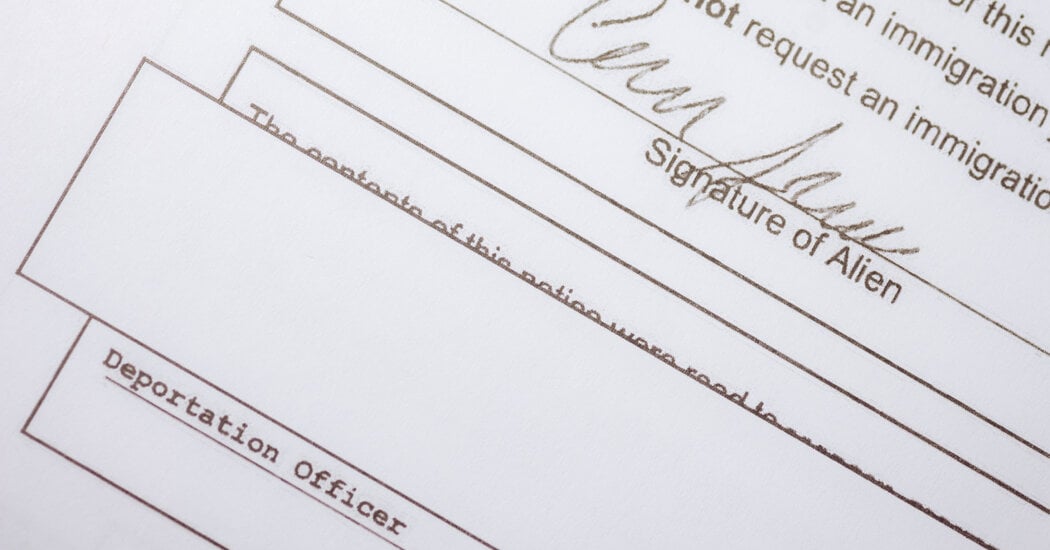
Immigration records requests are being denied or returned with extensive redactions under the Trump administration, lawyers say, leaving some people unable to prove their legal status and at greater risk of deportation.
The documents sought through the Freedom of Information Act can contain vital evidence, including old petitions, interview transcripts, court records and proof of a parent’s US citizenship. In many cases, lawyers say, they are the only way for immigrants to reconstruct their full immigration history.
Lawyers representing asylum seekers, crime victims, adoptees and people facing removal proceedings have described a sharp rise in missing or obscured records. Some requests have been rejected on the grounds that no documents could be found, even where applicants and their legal representatives knew the material existed.
Other applicants have received files in which key details were blacked out. Kelly Rojas, a lawyer providing pro bono assistance through the Amica Center for Immigrant Rights, said: “Delays and redactions pile on to the many other intentional ways immigrants are being deprived of due process in immigration court.”
Disputed handling of immigration records requests
The accounts echo allegations made by Timothy Turner, a former senior official in the records division of US Citizenship and Immigration Services (USCIS). In a whistleblower complaint to Congress last year, he alleged that the agency introduced policies early in the second Trump administration that made it more difficult for immigrants to obtain documents they were legally entitled to receive.
Mr Turner said staff were instructed in May 2025 to withhold documents written in languages other than English. He also alleged that marriage certificates, joint bank statements, tax forms and parts of immigration court transcripts were being held back on privacy grounds.
He further claimed that requests could be rejected because of inconsistencies in a person’s name. A request might fail, he said, if a hyphenated surname appeared in government records but only one part of it was included on the application, even when relevant documents had been located.
Federal law allows individuals to seek their immigration files through the Freedom of Information Act. A court order issued in 2020 requires the government to respond within 30 business days.
The Department of Homeland Security said its public-records officials provide documents promptly and explain why records cannot be found. USCIS said it receives more than 2,000 Freedom of Information Act requests a day, most relating to individual immigration files.
The agency said it carefully verifies applicants’ identities because many people share names, dates of birth and countries of birth. Where an identity cannot be established definitively, it said applicants are told the reason and allowed to correct and resubmit their requests.
The Justice Department, which oversees the immigration court system, declined to comment. The White House did not directly address the allegations, but spokeswoman Lauren Bis said: “all illegal aliens receive full due process and have their claims heard.”
Andrew R Arthur, a former immigration judge and fellow at the Center for Immigration Studies, said privacy protections could explain some redactions and denials. He rejected the suggestion that the practices necessarily violated immigrants’ rights, pointing out that applicants could sue if they believed their requests had been improperly handled.
“There is a lot of due process built into this system,” Mr Arthur said.
Delays threaten deportation defences
Lawyers say the practical consequences can be severe, particularly for people in detention or with imminent court hearings. Mr Turner told a federal judge in August that more than 35 per cent of requests from immigrants facing deportation were closed without documents between September 2025 and March 2026. He compared that with about 8 per cent in the previous six months.
He said he was told that filing another request would not cost applicants anything. But the delay, he argued, could deprive them of the time needed to prepare a defence.
“Now imagine being the one who has to refile: in detention, your hearing three weeks away, your defense potentially sitting in a file the government has and you don’t,” Mr Turner said. “From there, the cost looks very different.”
One case involves Cipriano Alarcon-Galvez, a 54-year-old Mexican national who requested a copy of a green-card petition filed by his naturalised American mother in 1993. The petition could help establish his eligibility for permanent residency and amnesty after he entered the United States without permission as a child.
More than half of the records he received were fully redacted, according to responses reviewed by his lawyer. A separate request by his mother produced copies of petitions, but information about her children had been blacked out.
Mr Alarcon-Galvez is now facing deportation, with a court hearing scheduled for December. His appeal over the records is expected to be processed by May 2027. He has four US-citizen daughters and has lived in Oceanside, California, for decades.
“It’s almost like a joke,” said Caroline Matthews, his lawyer, who added that he “has a constitutional right” to his documents.
In another case, Washington lawyer Zachary A Kohn sought records relating to a Salvadoran client whose application for permanent residency was rejected because of a 25-year-old deportation order she did not know about. Officials initially said they could not find the documents needed to challenge the order.
After Mr Kohn sued, the government produced the records on condition that the case be withdrawn, he said. His client can now pursue her case, but only after paying thousands of dollars in legal fees and waiting almost a year.
Gregory Luce, who represents international adoptees seeking to establish that they are American citizens, said requests that had previously produced useful files began returning heavily redacted or withheld documents around April 2025.
He later sued on behalf of about two dozen adoptees. Data submitted to the court showed that USCIS had redacted or withheld more than 80 per cent of documents for his clients since 17 April 2025, compared with an average of 10 per cent between May 2024 and April 2025.
Patricia M Corrales, an immigration lawyer in the Los Angeles area and former Immigration and Customs Enforcement prosecutor, said the policy could have direct consequences in court. “If you hide the information from immigrants and you have lousy lawyers filing documentation for them, they’re going to be deported,” she said.
