


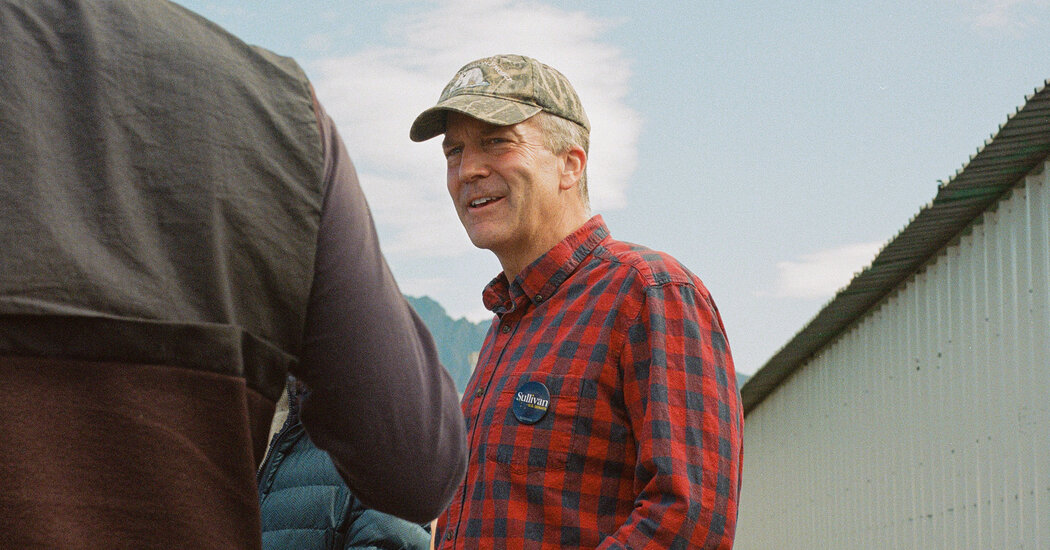
Senator Dan Sullivan is backing President Donald Trump’s tariffs in Washington while largely avoiding the issue on the campaign trail in Alaska, where he faces a close re-election contest and voters are dealing with higher prices.
The Republican’s position has drawn fresh scrutiny because his older brother, Frank Sullivan, runs the family manufacturing business RPM International, which makes products including Rust-Oleum, Roto-Rooter and The Pink Stuff.
RPM has repeatedly described tariffs as a significant financial challenge. On an earnings call in April, Frank Sullivan said the uncertainty created by tariffs, government shutdowns and war was frustrating businesses and consumers.
“From a high-level perspective, we seem to have a whole of government that doesn’t like stability, whether it’s tariffs or government shutdowns and now war,” he said. “That volatility, I think, is frustrating a lot of folks.”
The company has responded by moving some manufacturing, renegotiating arrangements with importers, stockpiling materials and increasing prices. Those measures helped it deliver its 52nd consecutive year of higher dividends, benefiting shareholders including Senator Sullivan.
Tariffs become an Alaska election issue
RPM executives have referred to tariffs more than 85 times during quarterly earnings calls. In October 2025, Frank Sullivan estimated that their total unmitigated impact on the company was between 90 million and 95 million dollars, with about half offset through changes to manufacturing, supplier agreements and price rises.
He said the company had initially struggled to increase prices quickly enough to keep pace with the duties. “It would have been nice to raise prices earlier,” he told analysts. “The challenge with this tariff regime is it’s on again, off again.”
By April 2026, RPM had introduced weekly reports tracking tariff effects by region, country and product category. It also began reformulating products and offering smaller package sizes after customers started moving away from premium spray paint priced at 10 dollars a can.
“We had, as you’ll recall, in fiscal ’26 a pretty volatile year, as did everybody,” Frank Sullivan said on a call last month. “Our guess is it’s going to be another duke-it-out volatile year.”
Despite those pressures, RPM reported paying nearly 350 million dollars in dividends and share buybacks in July, a 7.3 per cent increase on the previous year. Senator Sullivan’s holding in the company was worth as much as 5 million dollars in his latest financial disclosure, and it has been his largest single investment since he entered the Senate in 2014.
His filings say the transactions form part of an ongoing long-term portfolio diversification strategy and are managed by an outside financial investor. They show that he has sold as much as 800,000 dollars in RPM shares over the past eight years.
In Alaska, Democrats are seeking to make tariffs and affordability central to the contest between Mr Sullivan and former representative Mary Peltola, the Democratic nominee. State party leaders have dubbed the policy “Dan Sullivan’s tariffs”, while Mr Sullivan has described Ms Peltola as a “lower 48 liberal”.
Alaska imports most of its consumer goods and food from outside the state and has close economic ties with Canada. New 50 per cent US tariffs on Canadian exports prompted retaliatory measures, adding to concerns over costs.
Greg Wolf, president of the Alaska International Business Center, said the impact was increasingly difficult to ignore. “It’s certainly not cheaper to do business here or cheaper to be a consumer here than before the tariffs started,” he said. “Things are more expensive now than before. Everyone knows that.”
Mr Sullivan has opposed measures seeking to end tariffs on Canada, Brazil and other trading partners, putting him at odds with fellow Alaska Republican Senator Lisa Murkowski, who has warned of “negative impacts in store for Alaskan families and businesses”.
Asked last month whether tariffs had benefited Alaskans, Mr Sullivan did not address the policy directly, instead pointing to tax cuts and increased domestic energy production. His aides have said the duties are needed as leverage to secure international co-operation on trade and drug trafficking.
His campaign declined to comment on his personal finances or give his view on the latest tariffs on Canada. RPM representatives did not respond to requests for comment.
