


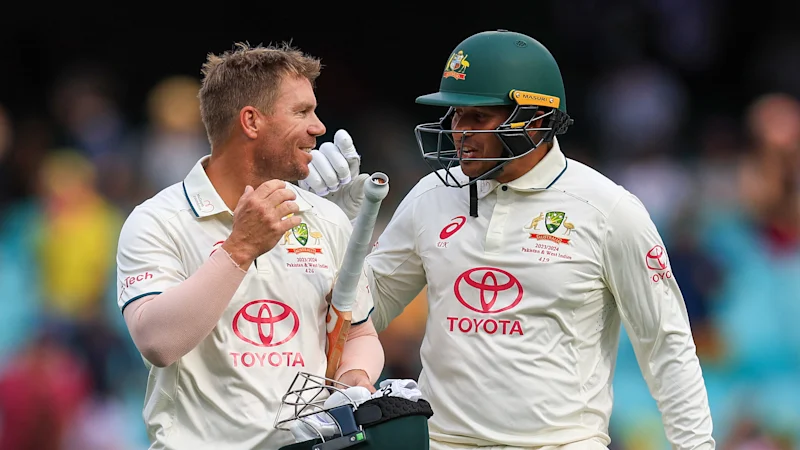
Usman Khawaja has said a six-year promise to David Warner was the main reason he revisited the Sandpapergate scandal in his autobiography, denying that the decision was driven by money.
The former Australia Test batsman said he had pledged to set out his account because he believed Warner, Steve Smith and Cameron Bancroft had been treated unfairly after the ball-tampering incident in South Africa in 2018.
“I had promised him for ages, because he’s had to carry this for eight years,” Khawaja said during an interview on Antoinette Lattouf’s podcast.
He said Warner, his former opening partner and longtime friend, did not know the contents of Sabr until two months before its publication. Khawaja added that the pair had barely discussed the issue between 2020 and 2026, despite the promise he had made.
“I text him two months ago, and he had no idea I was writing it, he was shocked,” Khawaja said. “I was fighting with what I was gonna put in the book the whole time.”
The book claims that the entire Australian team knew ball-tampering was taking place during the 2018 tour. Warner, who served a year-long suspension for his role, supported Khawaja’s account last week.
Fast bowler Mitchell Starc strongly rejected the claim, while Australia captain Pat Cummins described Khawaja’s recollections as “complete nonsense” during a 70-minute press conference in Sydney.
Chadd Sayers, the reserve bowler on the tour who played in the final Test, later offered support for parts of Khawaja’s version. Sayers said he had been responsible for taking the sandpaper from the field while acting as 12th man.
“My recollection isn’t as clear as it was obviously eight years ago, I just know that there were numerous conversations of it around in the change rooms,” Sayers said. “I knew that it was going to be used, as I believe everyone else did.”
Usman Khawaja rejects claims of commercial motive
Khawaja said he had recorded his memories shortly after the scandal and returned to them periodically as a way of processing what had happened. He said he could have removed the chapter from the book at any stage.
“Sandpaper didn’t just happen overnight, I wrote a whole bunch of stuff down days after it happened,” he said. “I didn’t write it down because I wanted to write a book … I didn’t look at it again for years.”
The 39-year-old also criticised the punishments imposed by Cricket Australia on Warner, Smith and Bancroft, arguing that they went beyond the sanctions handed down by the International Cricket Council.
He said the penalties were “grotesquely overboard” and argued that Australia had failed to accept collective responsibility for the episode, allowing speculation about it to resurface repeatedly.
Khawaja has faced heavy criticism since Sabr was released and has withdrawn from some events, although he continues to fulfil other commitments. He rejected suggestions that he had reopened the controversy for financial gain.
“I’m so grateful, God has given me so much, I don’t need any more money,” he said. “Having more money in my life is not going to change my life any more.”
Khawaja said the autobiography began after Australia’s defeat by England at Headingley in the 2019 Ashes, when Ben Stokes made an unbeaten 135. He had been dropped after the match and began writing down his thoughts because he did not want to forget the experience.
