


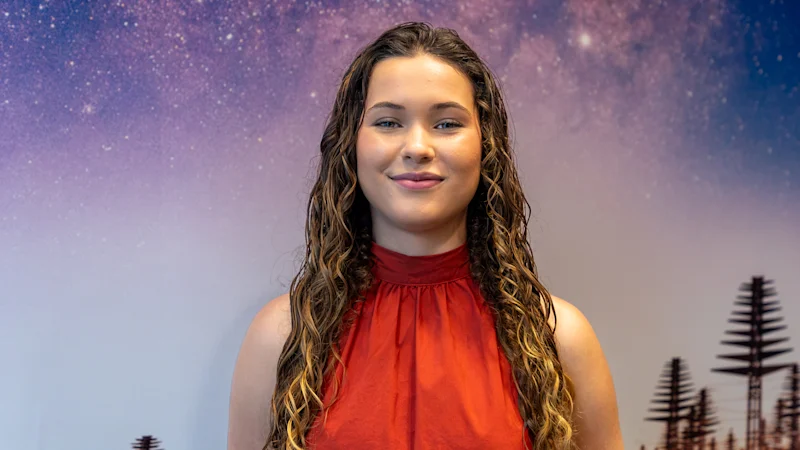
A University of Western Australia student from the Kimberley has become the first student from a Western Australian university selected for Monash University’s National Indigenous Space Academy programme.
Alaxandrea O’Brien, a proud Dulgubarra-Mamu and Jirrbal woman, is among eight First Nations tertiary students taking part in a 10-week placement involving NASA’s Jet Propulsion Laboratory in California and RAL Space in the UK.
The environmental engineering student will work with technical professionals at NASA/JPL on a project using satellite data to map water dynamics and examine environmental interactions and interfaces.
Her interest in space began in Broome, where she looked through a telescope and saw Saturn’s rings at a young age.
“It’s this wonderful place that you can’t easily get to, and it just bewilders and amazes any child growing up,” Ms O’Brien said.
“From there, I’ve just gone into a world of STEM and space, and it’s kind of followed me throughout my life. Even though I’m doing an environmental engineering degree, I did not think it was something that was applicable to NASA, but here we are.”
From the Kimberley to NASA
Ms O’Brien spent her early years in the Kimberley before moving to Broome, Kalgoorlie and then Perth. She said the region’s clear skies and distinctive natural phenomena had helped shape her fascination with space and constellations.
“There is no clear sky like our regional places in Australia,” she said. “It is definitely something I miss being in Perth because the way you can see the Milky Way is very different, and even just our other phenomena, like Staircase to the Moon.”
“I’m very much a Kimberley girl. I grew up there for about 11 years before I moved to Kalgoorlie, where I finished my high school education. So I went from beach country to desert country to city country, and here we are in space country.”
The placement will include work on real-life projects developed by mentors and contributions to current space missions, including ocean exploration vehicles and research into microorganisms aboard the International Space Station.
In preparation, the students completed a Space Boot Camp at Monash covering aerodynamics, robotics, rovers, astrophysics, planetary science, engineering, computer science and earth sciences, alongside past and current NASA and RAL Space missions.
Professor Chris Lawrence, director of the National Indigenous Space Academy at Monash University, said the programme offered Indigenous STEM students the opportunity to work at leading space research facilities.
“Students work in teams on real life space missions and contribute to space exploration and search for other planets, solar systems and the ultimate search for other life existence in the galaxies,” he said.
Ms O’Brien hopes the experience will help her explore the connection between Indigenous knowledge and environmental engineering as she completes her honours thesis at UWA.
She is particularly interested in the challenge of providing clean drinking water to remote communities, saying access to water was an issue that affected all Australians.
“If we’re struggling to support our urban areas, how are we ever going to support our regional remote areas where health outcomes are directly impacted by what you consume on a daily basis?” she said. “It is crucial to just all Australians. When you think about it, we need water.”
After developing her expertise, Ms O’Brien said she wanted to return her skills to the communities that had supported her, including those in the Kimberley, the Goldfields and far north Queensland.
Her advice to other young people is to remain curious. “Always ask the question, even if you think it’s silly, or even if you think someone else has asked it before,” she said.
