


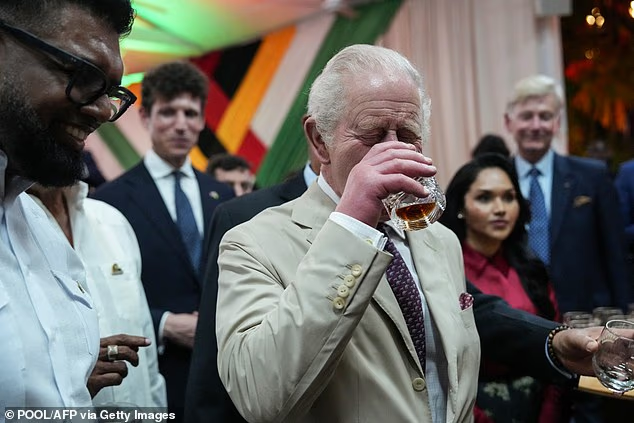
King Charles sampled a specially blended Guyanese rum at a reception in Georgetown, raising a glass with President Dr Mohamed Irfaan Ali during a two-day state visit to celebrate 60 years of relations between the two countries.
After sniffing the drink, the King took a swig, waggled his eyebrows and declared: “Very good!” He then took a second sip before admitting: “Somebody else will have to finish it!”
The exchange came at the end of a reception held in the garden of the State Residence, the president’s home in the Guyanese capital. Charles had been presented with a bottle of Royal Welcome rum and asked whether he drank it regularly.
“Do you drink this? Endless rum punches at the end of the day?” the King asked with a smile before clinking glasses with President Ali.
The president, appearing more accustomed to the drink, told the monarch: “You’ve just got to drink it down!” Charles replied: “It won’t last long.”
The relaxed moment reflected the warmth between the two men, who have met six times. They laughed and chatted throughout the evening after the King arrived from The Bahamas on the RAF government plane.
On arrival, President Ali personally greeted Charles at the airport. The two men held private bilateral talks before posing for photographs beside the president’s classic car collection, which had been put on display.
The leaders later stood for the British and Guyanese national anthems before watching a colourful performance celebrating Guyanese culture, featuring dozens of performers in bright costumes.
Charles sat between President Ali and Foreign Secretary Ed Miliband, who was seen slapping the King on the back at one point. The monarch tapped his toes and smiled broadly during the performances.
He appeared particularly engaged by a collaboration between the National Piping Centre, of which he is patron, and local Guyanese drummers. Charles tapped his fingers on his trousers as the musicians performed.
The cultural exchange followed previous performances by the pipers at Dumfries House, the King’s Scottish charity headquarters, which had impressed Guyana’s president and vice president.
Finlay MacDonald, director of the National Piping Centre, said: “The best thing we can do is travel and learn about people’s culture and music and share that.”
He said the group had travelled to seven of Guyana’s states, adding that meeting and working with local musicians was “something we will remember forever”.
The King also met Guyanese changemakers, parliamentarians, sportsmen and women, as well as Chevening and Commonwealth scholars, during the reception.
Charles and President Ali have developed a close relationship through their shared interest in the environment. The King has worked to help protect Guyana’s rainforest regions, while the president appeared in Charles’s Harmony documentary to thank him for his work.
President Ali has recently called for formal British acknowledgement of, and compensation for, Britain’s role in the transatlantic slave trade. However, it is understood that he does not intend to raise reparations publicly during the visit, which he wants to focus on “the present and the future”.
Guyana is Britain’s biggest trading partner in the Caribbean. The King’s visit forms part of a wider tour of Caribbean nations, following two days in The Bahamas.
