


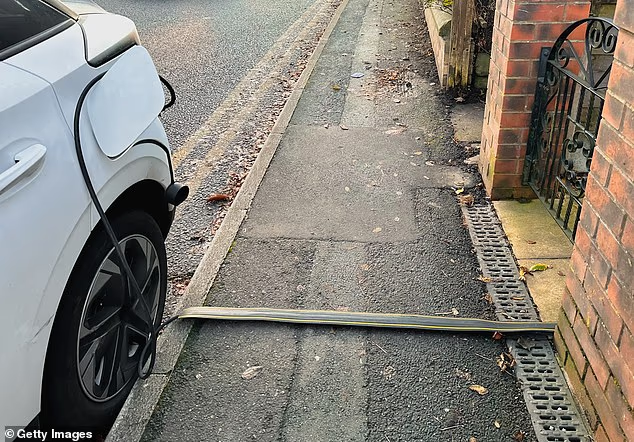
Electric car owners living in conservation areas could be prevented from charging at home from October 21 unless they obtain planning permission, under a last-minute change to new rules covering households without driveways.
The regulations were intended to let residents run a charging cable across a public pavement, protected by a cable cover, without needing permission. The measure was presented as a way of helping families who cannot park on their own property avoid relying on public chargers.
However, the Government removed 10,000 conservation areas from the scheme on September 25, less than a month before it is due to take effect.
About 6.8 million people live in those areas, of whom roughly 3.4 million do not have driveways. Around 6.2 per cent of cars nationwide are electric, meaning approximately 100,000 electric vehicle owners without off-street parking could be affected if they do not secure planning approval.
Electric car owners face higher charging costs
Charging at home typically costs about 7p per mile, compared with around 15p per mile at a public charger. The change could therefore increase costs for drivers who are unable to install a pavement-crossing cable.
One landowner in a conservation area said the exclusion had come as a surprise, claiming it had not been highlighted during the consultation process.
“The final legislation excludes conservation areas, despite this not being previously flagged in consultation,” they said.
They added: “That’s 10 per cent of all properties in the country, given we have 10,000 conservation areas.”
A Government spokesperson said ministers wanted to help households without off-street parking access domestic electric vehicle charging, but argued that the special character of conservation areas also had to be protected.
People in conservation areas with off-street parking can still apply for planning permission to install a cross-pavement charging solution, the spokesperson said. Local authorities can also grant blanket permission for such installations across an entire area.
The decision comes as ministers consider changes to electric car sales targets. Labour said in August that the existing net zero rules were not “fit for purpose” amid slower-than-anticipated demand and the risk of higher costs for drivers.
Under the proposed changes, up to half of all new cars sold at the end of the decade could still have fossil-fuel engines. Current rules state that only 20 per cent of new cars sold in 2030 will be permitted to use petrol or diesel.
