


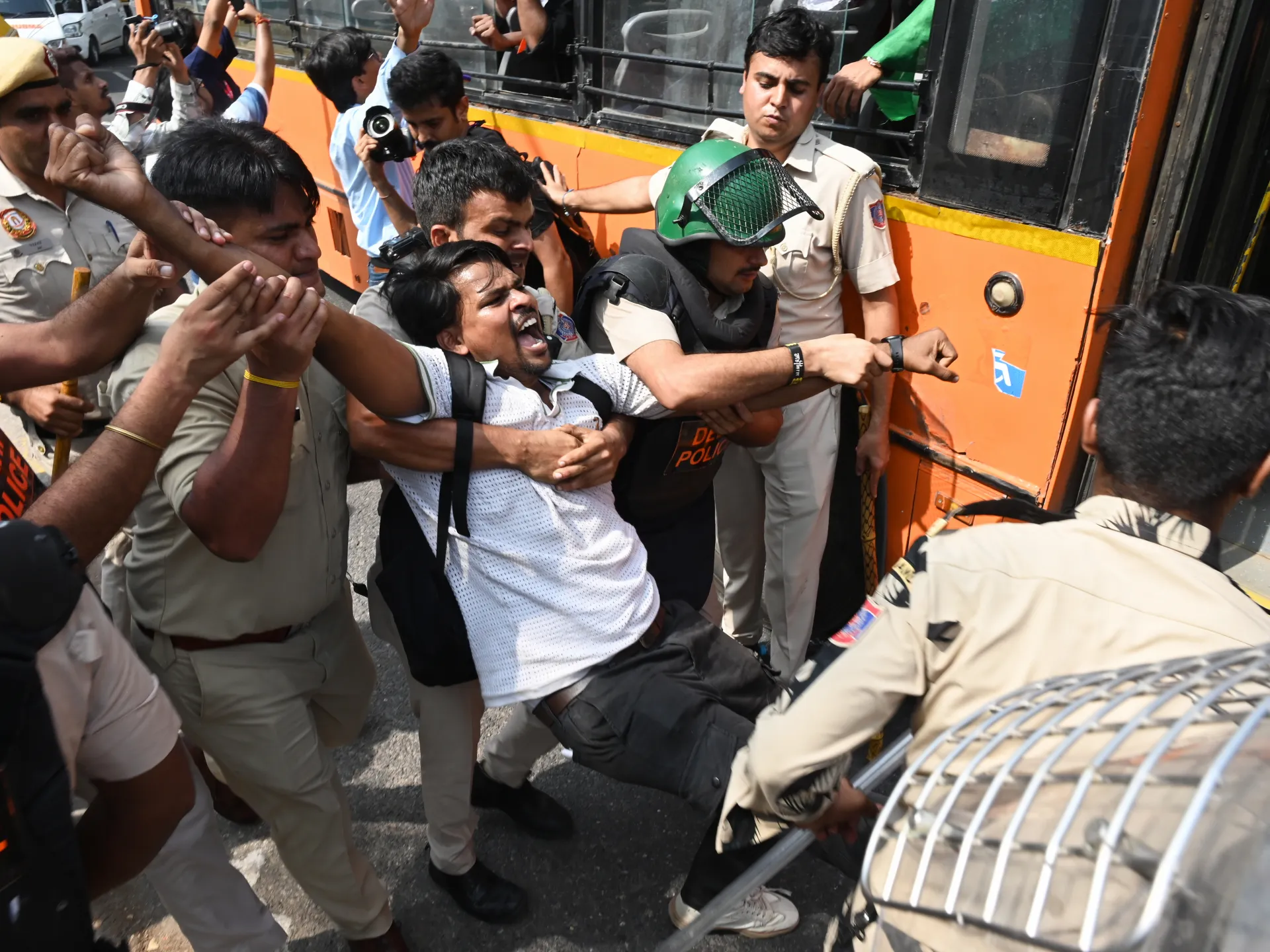
Protests against a purge of India’s electoral rolls brought New Delhi to a standstill on October 10, with thousands detained and the government accused of using emergency-era measures to suppress dissent.
Demonstrators gathered despite restrictions on travel to the capital, the deployment of paramilitary forces and reported disruption to internet services. Similar protests were said to have taken place in cities across India.
The demonstrations were organised by the Cockroach Janta Party (CJP) protest movement, whose supporters use the term “cockroaches” ironically. The movement has said further protests will take place, while opposition parties have announced another demonstration on Monday.
Several figures linked to the movement, including Ratna Singh, Abhijeet Dipke and Dhruv Rathee, were detained before the protest. Other activists, including Mahatma Gandhi’s great-grandson Tushar Gandhi, were also taken into custody.
Protesters repeatedly regrouped around the capital after being moved away from designated protest sites. By the evening, at least 2,500 demonstrators and 15 journalists had been detained across New Delhi and taken to temporary detention centres, although many were later released.
Dispute over India’s electoral rolls
The protests followed the Special Intensive Revision of electoral rolls, a process critics say stripped 130 million Indians of their right to vote. The exercise has also been blamed by opponents of the government for influencing elections, a claim presented in the commentary as no longer being disputed.
Opposition parties led by Rahul Gandhi met President Droupadi Murmu on Friday and told her that the government had undermined India’s democratic framework. Critics have also questioned whether Mr Modi remains fit to serve as prime minister.
The chief election commissioner, Gyanesh Kumar, oversaw the revision. A corruption case dating from 2006 involving Mr Kumar was said to have resurfaced, although no further details were given.
The government’s response to the protest has intensified accusations that democratic safeguards have been weakened during Mr Modi’s 12 years in power. The use of barricades, detentions and security forces has been compared by critics with measures associated with India’s emergency era.
The latest demonstrations have brought together young protesters from diverse backgrounds, in opposition to what critics describe as a governing strategy based on exclusion, demonisation and the creation of political enemies.
The CJP’s announcement that protests will continue suggests the confrontation is likely to deepen in the coming weeks. The demonstrations have also raised wider questions about the future of India’s political institutions and public confidence in the government, the army and the Delhi Police.
