


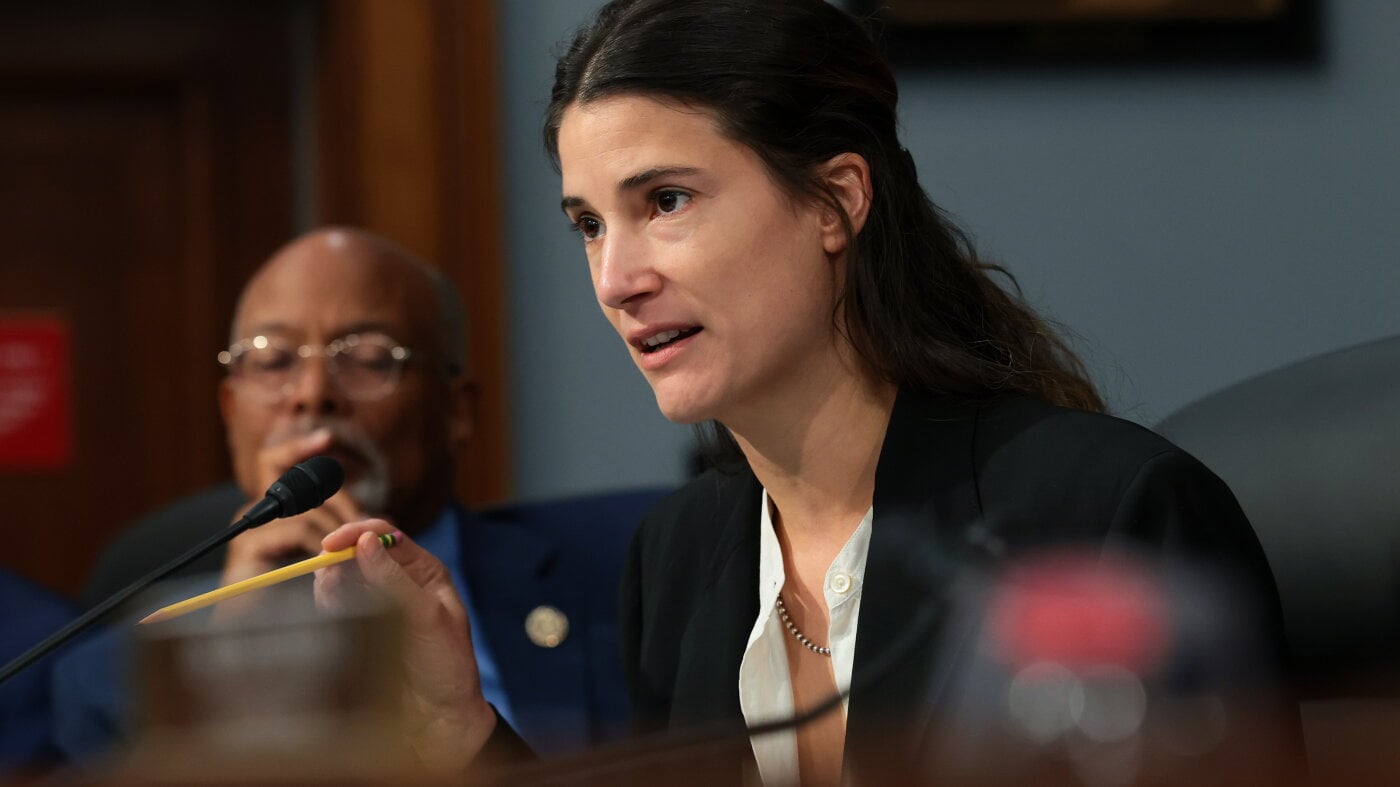
The race for Washington’s 3rd Congressional District has emerged as a pivotal contest in the battle for control of the US House, with Democratic representative Marie Gluesenkamp Perez defending a seat that Republicans believe they can reclaim.
The district in south-west Washington stretches across urban, industrial and rural communities, from the city of Vancouver to coastal towns on the Pacific. Although Donald Trump has won it three times, Gluesenkamp Perez turned it Democrat in 2022 and now faces Republican state senator John Braun.
“A lot of districts these days are pretty predictable in terms of their politics,” Mr Braun said during an interview at his small manufacturing business. “The third is not. You got to go earn those votes.”
The result could have consequences well beyond Washington state. Democrats are likely to need Ms Gluesenkamp Perez to retain the district if they are to secure a House majority, while Republicans need Mr Braun to hold on to power and advance Mr Trump’s agenda before the end of his presidency.
Both candidates face political obstacles. Ms Gluesenkamp Perez is seeking re-election during an anti-incumbency wave, while Mr Braun is running as a Trump-endorsed Republican at a midterm election in which the party in power, and an unpopular president, are often punished by voters.
A contest shaped by local loyalties
The candidates are both regarded as moderates within their parties. They own small businesses, live in rural towns and have focused their campaigns on manufacturing, natural resources and support for small firms.
They differ more sharply on traditional partisan issues, including abortion. But the district’s political character means neither can rely solely on a party label.
“We don’t vote down the ballot one way or the other,” said Erik Halvorson, the mayor of Longview. “Trump can win the city, but Marie Gluesenkamp Perez can win the city as well on the same ballot. So it’s really person specific.”
Mr Halvorson said voters valued loyalty and authenticity, as well as a candidate’s knowledge of local concerns. “You just have to be authentic,” he said.
The district has long been one of the most competitive in Congress. Former Republican representative Jaime Herrera Beutler regularly faced difficult races before being ousted in the 2022 primary after voting to impeach Mr Trump following the 6 January attack on the US Capitol.
For Mr Braun, one of the most immediate concerns is the impact of tariffs on industry. His company, Braun Northwest, manufactures emergency vehicles, and he said the cost of materials used in ambulances and fire engines had risen as a result of tariffs. The higher prices are ultimately passed on to the American cities and municipalities that buy them.
He argues that his experience gives him a particular understanding of the trades and manufacturing. But despite Mr Trump’s endorsement, he has sought to distinguish himself from the president on trade policy.
“There are some appropriate uses for tariffs,” Mr Braun said. “But kind of the indiscriminate use, the broad use, the blanketed use, just that doesn’t work. We need to be a little more thoughtful on tariff policy.”
Democratic discontent in Vancouver
Vancouver, the district’s largest city, has grown more progressive as investment has transformed its waterfront and downtown. Historic buildings have been converted into multi-use spaces, while new apartments, restaurants and a more walkable centre have helped attract residents and visitors.
That development has also fuelled concerns about affordability. Gretchen Hoyt, whose family has lived in Vancouver for four generations, said houses were increasingly out of reach for local people, with properties costing more than $700,000.
Clark County, where Vancouver is located, has gradually moved towards the Democrats since 2008. The city’s progressive shift has created problems for Ms Gluesenkamp Perez, who has consistently won the county since first running for Congress.
Two votes have particularly angered some Democrats. Ms Gluesenkamp Perez supported a Republican-backed measure known as the “Don’t Say Trans Bill”, which would require parental consent if a public school pupil wanted to use a different name or gender in the classroom.
She also backed the SAVE Act, Republican-led voter identification legislation supported by Mr Trump, saying it would help protect the US electoral system.
“People feel betrayed because people thought, ‘OK cool. She owns her own business. … Really. Like I’m one of you,’” Ms Hoyt said. “Then it felt like that was just a schtick in order to get the blue vote.”
Ms Gluesenkamp Perez defended her position on the SAVE Act, saying: “I do not support noncitizens voting in American elections — and that’s common sense to folks in Southwest Washington. Voting in our nation’s elections is a sacred right belonging only to American citizens, and my vote for the SAVE Act reflects that principle.”
Progressive Democrats in Vancouver responded by backing a primary challenger from the left. Although Ms Gluesenkamp Perez secured one of the top two places in Washington’s open primary system and advanced to the general election, the challenge exposed her vulnerability among the district’s Democratic base.
“Nobody is happy with Marie, but they’re not voting for John,” Ms Hoyt said. “So they’re voting their conscience. It feels like the lesser of two evils.”
Economic pressure along the coast
Beyond the cities, the election is being shaped by the condition of rural communities whose economies have traditionally depended on timber, fishing, farming and other natural resources.
Longview was founded to house workers at a local timber mill, but the decline of logging has brought mill closures and the loss of jobs. Mayor Halvorson said tariffs had also hit industries across the area.
In Bay Center, a small Pacific County community of about 200 people, Kathleen Nisbet runs Goose Point Oysters, the shellfish farm taken over from her family. She said the region had once been sustained by aquaculture but had become something of a ghost town as businesses disappeared.
Ms Nisbet said she dealt with ten regulatory agencies and estimated that agency fees cost her about $200,000 a year. She said regulation was necessary but had become difficult for smaller producers because it was fragmented, frequently changing and expensive.
She said the trade war had caused the farm to lose more than half of its international sales because of the political climate between the United States and Asian countries.
“We need to make sure that we are building community resilience through natural resources, which has been the traditional backbone of our communities,” Ms Nisbet said.
In nearby Ilwaco, a town of about 1,400 people, timber, seafood and cranberry production remain present but hospitality has become the leading industry. Restaurants, motels and small shops now rely heavily on visitors travelling to or from Cape Disappointment State Park.
The town earns most of its income during the summer and depends on federal money for infrastructure because its tax base is limited. Only about half of its population lives there throughout the year.
Ilwaco councilman Matt Lessnau, who grew up in the town and returned during the pandemic, said candidates needed to understand the economic pressures facing coastal communities and be able to relate to their residents.
“We have historically valued representatives that understand our economy and our struggles,” he said. “We have a very low tolerance for bulls***.”
Pacific County voted for Mr Trump in 2024 but also backed Ms Gluesenkamp Perez. She narrowly won the county in 2022, underlining the personal and local loyalties that make Washington’s 3rd Congressional District such a closely watched contest.
