


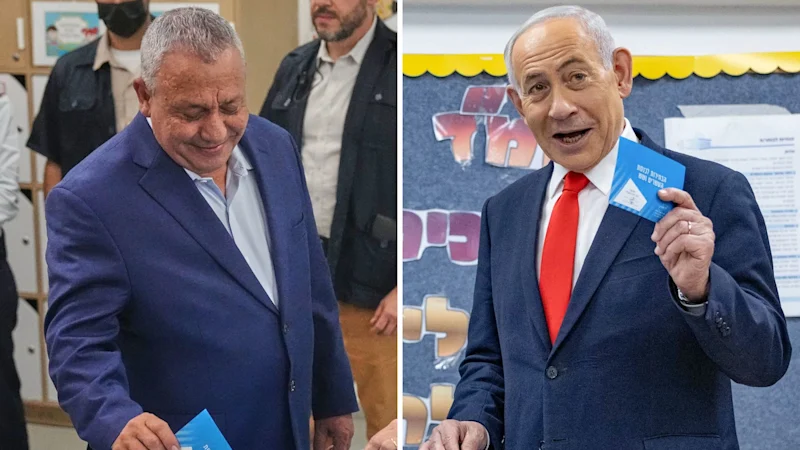
Israel has gone to the polls in an election widely viewed as a referendum on Prime Minister Benjamin Netanyahu’s nearly two decades in power, with the prospect of renewed conflict with Iran dominating the final days of the campaign.
Netanyahu and his main rival, former military chief Gadi Eisenkot, cast their votes on Tuesday as the country held its first national election since the Hamas attack of October 7, 2023, which plunged the Middle East into turmoil.
Netanyahu voted shortly after noon and said the occasion was “a very moving and fateful moment”. He added: “My wife and I are truly overwhelmed. We know what is at stake, and since I am not allowed to say things explicitly, I will say: Vote correctly.”
Eisenkot, speaking to a cheering crowd after voting in Herzliya, urged Israelis to turn out and remove what he called “the worst government Israel has known”. He acknowledged that victory was not guaranteed, saying the country was facing “perhaps the most critical day since the founding of the state”.
The contest is being fought between Netanyahu’s Likud and a centrist opposition bloc that has promised a change of direction. Polling has suggested a close result between the two groupings, however, meaning it may take time to establish which side can command the Knesset.
Reports approved by Israel’s military censor and published during the final days of the campaign alleged that Netanyahu had pressured his military chief to provoke a confrontation with Iran before the election. The claims appeared to point to high-level leaks from within the defence establishment. Defence Minister Israel Katz denied the reports.
The possibility of further military action has also been raised by US President Donald Trump, who said at the weekend that he was deciding whether to “make a deal” with Iran or “finish it off”. “It’s getting to be decision time,” he said.
Netanyahu posted an AI-generated image depicting a nuclear mushroom cloud over Tel Aviv and spoke during the campaign about using cryptocurrency to avoid international sanctions.
Israel election result may take time to emerge
Voting in Israel is voluntary, although turnout is usually high. At the previous election, 4.8 million of the country’s 6.8 million eligible voters took part, representing 71 per cent turnout, and a higher figure is expected this time.
Voters must cast their ballots in person on election day, apart from Israelis serving overseas, including diplomats and defence personnel, who can vote in advance by post.
Television exit polls are due to be broadcast at 10pm local time, providing the first indication of the result. Official figures will then be released, with a clear picture potentially emerging within hours but a final outcome taking considerably longer if neither bloc has a parliamentary majority.
The final tally is expected by October 30, while the official results are due to be formally published a week after the election, on November 4.
Israel’s 120-seat Knesset is elected through proportional representation. Voters choose party lists rather than individual candidates, and parties must secure at least 3.25 per cent of the national vote to win seats.
About a dozen parties are considered to have a chance of crossing that threshold. A party or coalition needs 61 seats to form a government, although a larger majority is preferred to provide greater stability.
No single party has ever won an outright majority in Israel, so the next government is expected to depend on coalition negotiations. Smaller parties could therefore play a decisive role as potential kingmakers.
President Isaac Herzog will consult party leaders once the final count is complete before asking the candidate he believes has the best chance of forming a government to take on the task.
That nominee will have up to 42 days to assemble a coalition. If the attempt fails, another candidate can be given the opportunity; if no government is formed, another election will be called while the existing cabinet remains in office as a caretaker administration.
There was also disagreement within the opposition before polling closed over whether anti-Netanyahu voters should back Eisenkot’s Yashar party or distribute their support among the bloc’s four parties.
Eisenkot has promoted a “big party” strategy intended to give him greater leverage in coalition talks by securing more seats than Likud. Yair Golan, leader of the centre-left Democrats party, criticised the approach, calling it “a mistake” and “a dangerous lie designed to weaken us”.
