


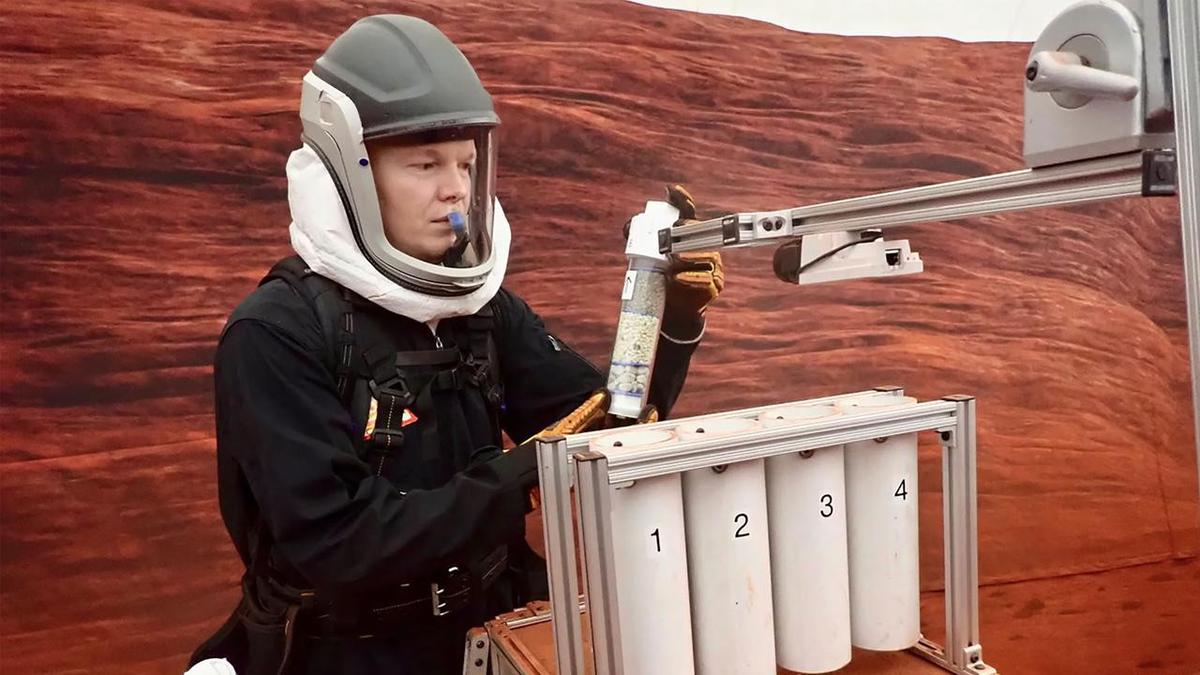
Four NASA astronauts are due to emerge on Saturday after completing a 378-day simulated Mars mission inside a habitat at the Johnson Space Centre in Houston, Texas.
Ross Elder, Ellen Ellis, Matthew Montgomery and James Spicer have lived since October 2025 in a 158-square-metre, 3D-printed facility designed to replicate conditions on the Red Planet.
The Crew Health and Performance Exploration Analog (CHAPEA) Mission 2 crew have grown crops, managed restricted resources and carried out suited spacewalks on an imitation Martian surface. Communication with their families has been limited to email, with delays intended to mirror those experienced during a Mars mission.
NASA to assess simulated Mars mission crew
After leaving the habitat, the astronauts will meet their families before undergoing two weeks of post-mission evaluations and assessments.
NASA scientists have been collecting health and performance data throughout the assignment. The findings will be used to examine how crews adapt to the routines and demands of long-duration missions, and how future explorers could remain healthy, active and connected during deep-space voyages.
The research will also examine the effect of restricted food and exercise systems on activities such as spacewalks, as well as the support required when communication delays can last up to 45 minutes each way.
Michael Stenger, chief scientist for NASA’s Human Research Program, said the mission had helped the agency understand the requirements of year-long missions, including medical and psychological care delivered across communication delays.
“When combining this Mars-realistic mission analog with a suite of physiological, psychological, and performance measures in a rigorously controlled environment, we’ll be able to translate the knowledge from these experiences to moon base and beyond,” he said.
The project forms part of NASA’s wider plans for long-term human exploration beyond Earth. The agency is seeking to land people on the Moon again in 2028 and aims to have a lunar base operating by 2032, with regular crew rotations and a continuous human presence.
The simulated Mars mission is intended to help develop the technologies and knowledge needed for those future deep-space missions, including eventual journeys to Mars.
