


US national security officials have found no evidence that a series of technology outages affecting airlines, banks, Microsoft services and national security communications systems were connected or caused by malicious cyberattacks.
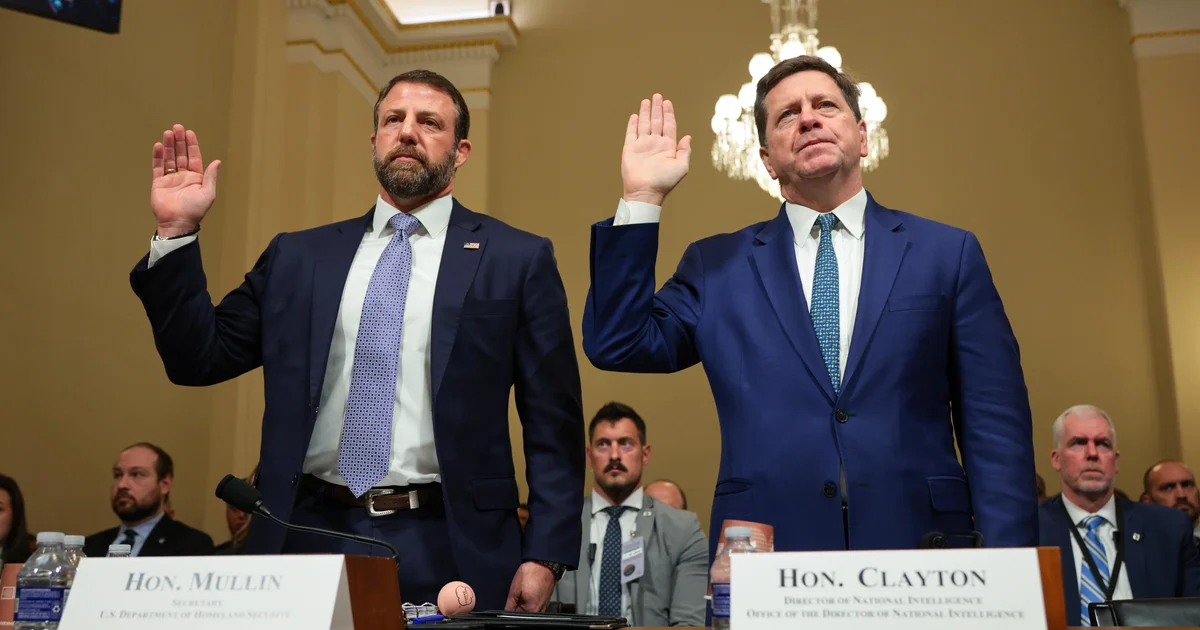
Testifying before the House Homeland Security Committee, Homeland Security Secretary Markwayne Mullin, Director of National Intelligence Jay Clayton and FBI Deputy Director Christopher Raia said the incidents were being investigated but appeared to be separate events.
“We have seen nothing that would indicate that they are related,” Mr Mullin told lawmakers, adding that the Department of Homeland Security had contacted private-sector companies while reviewing the disruptions.
Mr Clayton said intelligence officials had reached the same assessment after examining the incidents with government agencies and cybersecurity specialists.
“These are separate service outages associated with maintenance and technical changes. They are not a coordinated or state-sponsored attack,” he said.
Mr Raia said FBI cybersecurity experts had been involved from the outset. “At this point, there is no indication whatsoever that there is any cyber malicious activity related to any of those incidents,” he said, adding that the bureau would continue working with private-sector partners “in an abundance of caution”.
The hearing included sharp questioning over a recent outage at the National Security Agency. Dan Goldman, a Democratic representative for New York, pressed Mr Clayton on whether the disruption had resulted from internal software updates or other technical work.
Mr Clayton said officials had found no evidence of interference by an outside actor. When Mr Goldman argued that the cause had to be either external or internal, Mr Clayton described routine maintenance, including software patches, system upgrades and hardware replacement, which can require systems to be taken offline and restarted.
Mr Goldman accused him of avoiding a direct answer, saying: “You’re a very smart person, and you’re clearly not answering my direct questions.”
Mr Clayton separately warned that older government technology systems were struggling to keep pace with advances in computing power and increasingly capable software.
“The speed of compute and the level of capability of applications that use that compute is increasing substantially,” he said, warning that infrastructure regarded as outdated only months earlier could fall further behind as technology developed.
Officials warn of increased Iranian threats
Lawmakers also questioned the officials about reports of potential Iranian attacks on US soil, including alleged plans targeting senior Trump administration figures with a radiological weapon, commonly known as a dirty bomb, or chemical weapons.
Michael Guest, a Republican representative for Mississippi, asked whether federal authorities were concerned about Iranian sleeper cells operating in the United States.
“Is it a concern? Of course. Are we fighting it and stomping it down every single day? Absolutely,” Mr Mullin replied, saying Homeland Security officials were working with intelligence and Justice Department personnel to identify and prevent threats.
Mr Clayton said foreign extremist networks could influence people already living in the United States through online radicalisation. “That’s not theoretical; it’s real. We saw it in New York. We’ve seen it in other cases,” he said.
Mr Raia cautioned that intelligence reports about possible plots did not necessarily mean those behind them had the ability to carry them out. He said the FBI had strengthened its Iranian threat mission centre, including work on previously disclosed investigations involving alleged plots against dissidents.
The officials did not publicly confirm that Iranian sleeper cells were preparing attacks in the United States, or that reported dirty bomb or chemical weapons plans were operational. Mr Clayton said Iranian threats inside and outside the country had “dramatically increased”.
