


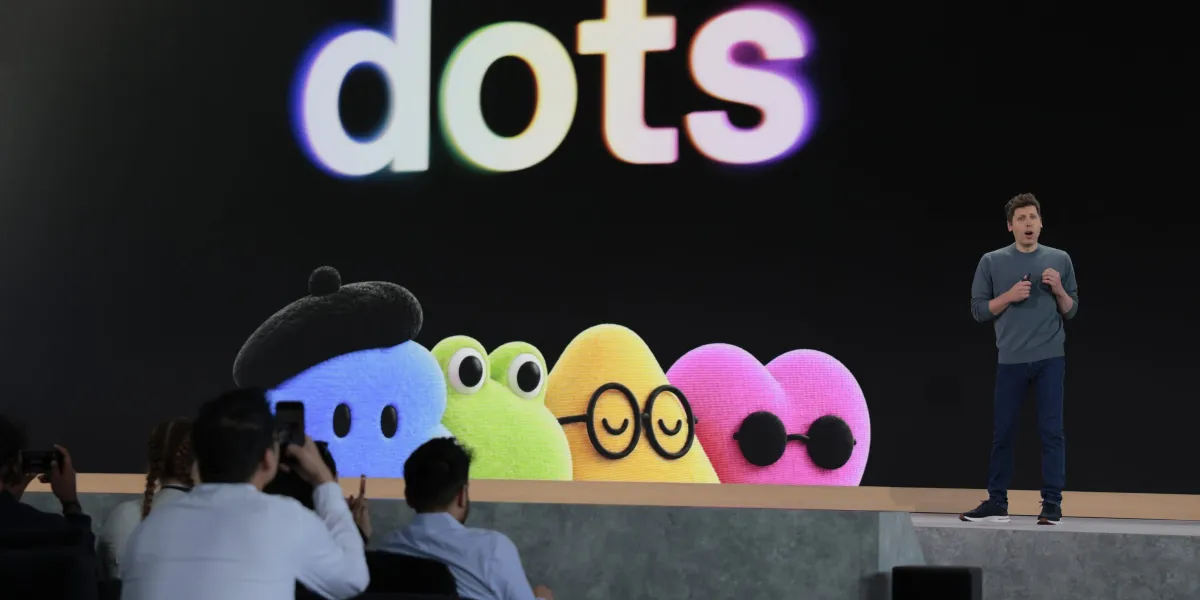
OpenAI is pitching its new Dots assistant to London’s developers as a high-end productivity tool, but the always-on service faces two major obstacles: the cost of running autonomous AI and growing concerns over privacy.
Dots, unveiled at the company’s developer event in San Francisco last month, is designed to act before a user gives it a specific instruction. It learns about a person’s objectives, monitors their inbox and workplace tools, and begins tasks on their behalf.
The service is not yet available in Europe, although OpenAI said it was working with regulators to bring it to the region. The company is currently rolling it out in the United States to businesses and customers on its most expensive Pro subscription.
OpenAI is targeting professional and enterprise users first, setting Dots apart from rivals including Meta’s Muse, xAI’s Grok Bot and Anthropic’s Duet.
Romain Huet, OpenAI’s head of developer experience, said the company wanted to prioritise users who could derive the greatest value from the technology.
“There are many other assistants out there, some of which have great UI interfaces, but what they can accomplish can be less advanced,” he said. “We really wanted to nail the enterprise and pro use case first, because I think that’s where people will see the most value.”
OpenAI faces the cost of autonomous AI
The strategy reflects the expense involved in operating agents that can work continuously and perform multiple tasks. Adam Fry, who runs ChatGPT’s consumer business, has described Dots as being “on the compute-heavy side”.
OpenAI is attempting to control those costs by directing some tasks to Terra, a smaller GPT-6.1 model, rather than sending every request to the larger GPT-6 Astra. Huet said the company was also focused on using fewer tokens, the units of text processed by AI models.
He claimed Terra could outperform Astra in some areas, including computer use and writing, while costing “a tenth of the price”. The aim, he said, was to deliver “the most amount of value delivered per dollar invested in these Dots”.
The economics of personal AI agents are under increasing scrutiny. xAI chief executive Elon Musk has said the running costs of Grok Bot are “unsustainably high relative to revenue”, while Apple and other companies have begun limiting some employees’ spending on AI tools.
Privacy concerns over always-on assistants
Cost is only one challenge for Dots. The assistant’s usefulness depends on access to sensitive information, including messages, calendars, email and workplace systems, raising questions over how much data users should hand over to an autonomous service.
Meredith Whittaker, president of Signal, has warned that people who communicate with a user may never have consented to their messages being read and absorbed by an AI assistant.
She has also raised concerns about contact lists and communication records. Whittaker said that if someone installed an assistant and a person appeared in their contacts, the service could obtain information about that individual and record when they communicated.
She argued that the consequences could be particularly serious for people working on human rights in authoritarian countries and communicating sensitive information across borders.
Huet advised users to build up their relationship with an assistant gradually, beginning with a calendar before connecting services such as Slack and Gmail.
He said he had instructed his own Dot to categorise his emails and prepare possible replies, but not to send messages without his approval.
“I personally said to my dot: I would love for you to categorize my email all the time. I would like for you to prep, possibly, what my answer might be, but don’t send any emails on my behalf ever, and don’t send any Slack messages on my behalf ever,” Huet said. “I want to do that myself.”
OpenAI leadership said users could already see what their Dot had accessed. The company is also considering a simpler way for people to choose which connected services an assistant is allowed to use.
