


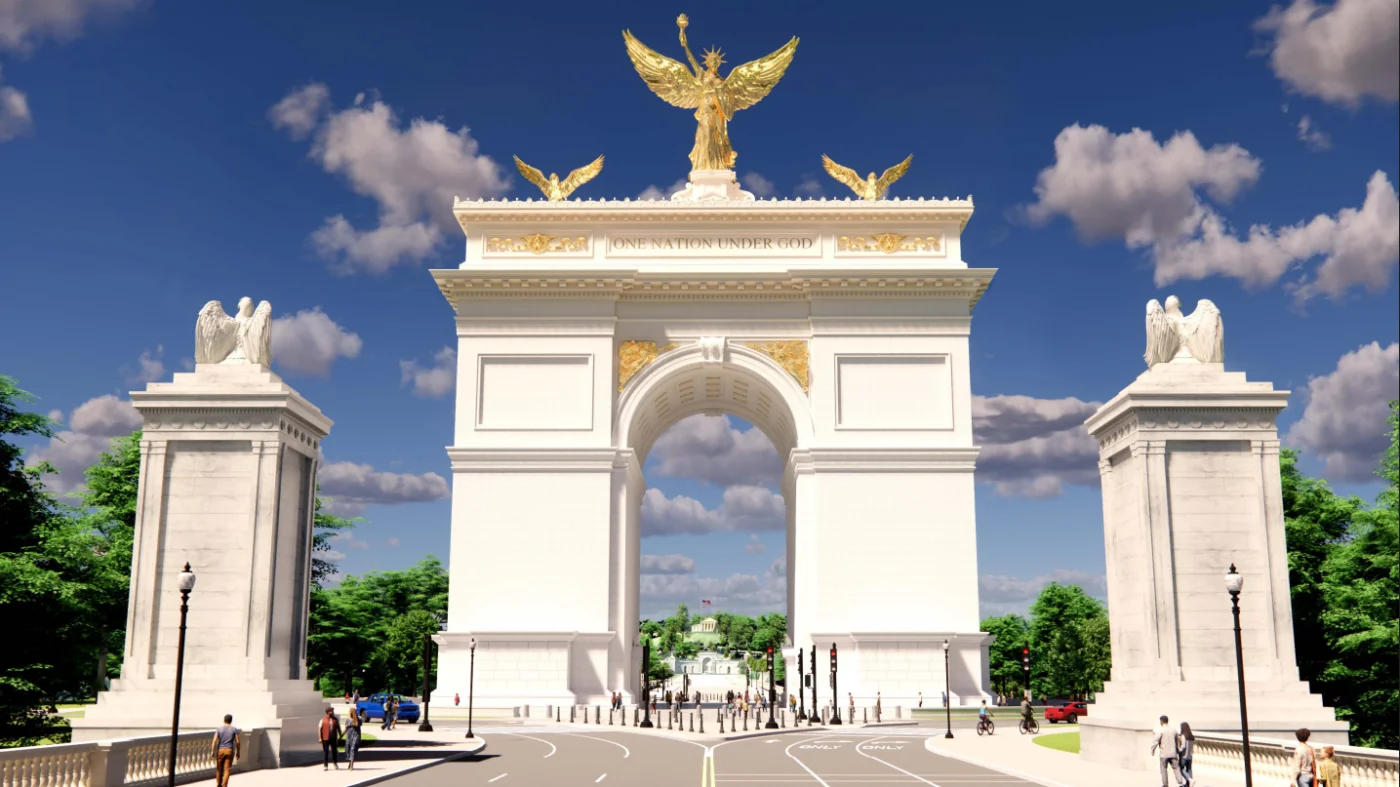
Donald Trump’s proposed 250-foot triumphal arch in Washington DC faces a decisive test on Thursday, when the National Capital Planning Commission considers whether to grant final approval for the controversial structure despite an ongoing legal challenge.
The commission is expected to approve the project, which the administration says could move to construction once the vote is followed by authorisation from the Department of the Interior. The government has told a federal judge that work could begin as early as Thursday.
The online meeting is expected to last five hours, with almost 120 members of the public registered to speak. The arch is the sole item on the agenda.
Opposition has come from Democratic lawmakers, veterans, historic preservation groups and others, with more than 100,000 people submitting written comments or speaking out at protests and earlier commission meetings.
Legal challenge over Trump arch
The proposed monument would stand in Memorial Circle, on Arlington Memorial Bridge between the National Mall and Arlington National Cemetery. Renderings show a white structure bearing the words “One Nation Under God”, topped by three gold statues and an eternal flame.
At 250 feet, it would be more than twice the height of the nearby Lincoln Memorial. The National Park Service has acknowledged that the project would affect the historical significance of dozens of nearby monuments, according to court filings described in the case.
Critics argue that the arch would obstruct important views, offend the memory of those buried at Arlington and create additional complications in the heavily used airspace around Washington. They have also portrayed it as an attempt by Mr Trump to establish a personal legacy in the US capital.
The White House has defended the proposal, saying it would “enhance the visitor experience at Arlington National Cemetery” and become “one of the most iconic landmarks not only in Washington, D.C., but throughout the world”.
The main legal dispute centres on whether Congress must authorise the project. Vietnam War veterans and an architectural historian suing the administration say construction cannot proceed without such approval.
The administration has not sought a new authorisation from Congress. Instead, it argues that a law passed more than a century ago, which authorised two columns on the traffic circle that were never built, also provides the necessary legal basis for the arch.
District Judge Tanya Chutkan is considering the veterans’ case alongside a separate lawsuit brought by the governments of Washington DC and Virginia. The jurisdictions have described the project as “flagrantly illegal” and say it breaches federal environmental and historic preservation laws, as well as Washington’s building-height restrictions.
They argue that construction would disrupt traffic, hinder emergency services, complicate flight paths serving Ronald Reagan Washington National Airport and threaten local wildlife. Their complaint also raises concerns about 320-foot cranes, excavation and sediment entering the Potomac River.
Construction preparations under scrutiny
Judge Chutkan has ordered the administration to notify the court within an hour of any decision by the planning commission, the National Park Service or the Interior Department relating to the arch. Officials must also provide notice within 30 minutes of any activity connected with, or preparing for, construction.
The administration asked for the deadline to be extended to 24 hours, saying decisions could take time to pass through official chains before a notice was ready to file. The plaintiffs opposed the request, pointing to a separate case in which the government gave less than a day’s notice before cutting down 430 trees at East Potomac Park.
The judge later clarified her wording but retained the same timetable. On Wednesday night, the government told the court that Grunley Construction Company, a Maryland-based firm, “may be — but is not necessarily — arranging off-site preparations for construction mobilization in anticipation of permit approval”.
The disclosure came after the judge heard arguments on the veterans’ request for an injunction blocking any construction activity before the case is resolved. At a hearing last Friday, she questioned the administration’s claims of urgency and national security.
The administration has said the arch could serve as a military complex containing snipers and ammunition, a description that was announced after the Federal Aviation Administration said the structure would not pose an airspace hazard provided its lighting met specified conditions.
The final designs submitted to the planning commission do not refer to drones or snipers. Defence Secretary Pete Hegseth nevertheless described the project in a court declaration as a “generational national defense opportunity”.
Judge Chutkan questioned how military equipment could be installed in a structure that the administration expects could receive up to 22,000 civilian visitors a day. She also challenged the suggestion that the arch could help deter attacks on the president when construction would take years.
The administration says building work would last between two and three years, with crews operating for 20 hours a day throughout the year. It says the first six months would focus on underground excavation and foundations, arguing that a judge need not intervene immediately because the views cited by opponents would not yet be affected.
Lawyers for Washington DC and Virginia reject that argument. They say the government would suffer no meaningful harm from waiting before starting what they maintain is an unlawful monument, while construction would be difficult to reverse once under way.
Mark Paoletta, the Trump-appointed chairman of the National Capital Planning Commission, has publicly supported the arch. The commission approved preliminary site and building plans over the summer, while the Trump administration has also secured approval of the design from the Commission of Fine Arts, whose members were appointed by the president.
Michael Lemmon, a veteran and retired foreign service officer named in the main lawsuit, is due to be the first registered speaker at Thursday’s meeting. He has said he hopes to be buried at Arlington National Cemetery, but not beneath the proposed structure.
In a court filing, Mr Lemmon wrote: “The thought of being interred in the shadow of what I believe to be a personal vanity project is profoundly disturbing to me.”
Mr Trump has described the arch as “one of the great things we’ve ever done”. Several Democratic lawmakers have vowed to oppose it if their party regains control of Congress, while critics have accused the administration of trying to accelerate approval before the midterm elections.
