


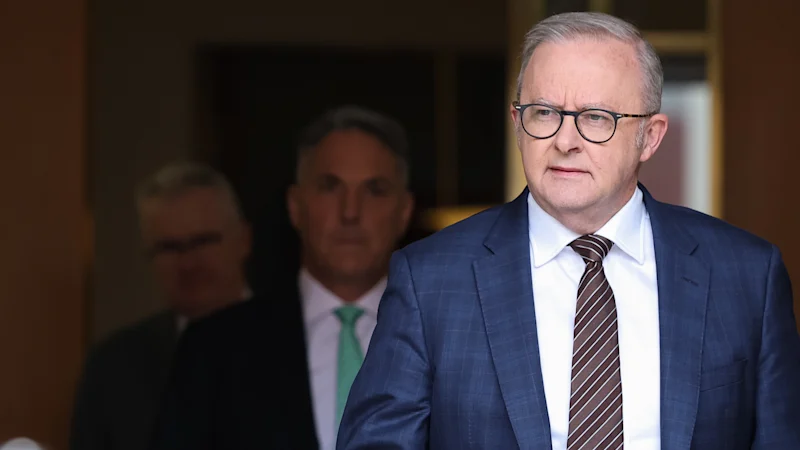
Anthony Albanese has assembled the largest and best-paid prime ministerial office in 13 years, while reducing staffing allocations for Australia’s growing crossbench, an analysis of more than a decade of federal data has found.
The review by the Centre for Public Integrity shows that Mr Albanese employed up to 65 advisers before the latest election and increased the proportion of staff on the highest salary bands to as much as 77 per cent.
The potential annual cost to taxpayers of his current 59-person office is $12.15 million before entitlements, based on the maximum salaries available to staff.
Anthony Albanese’s office expanded after 2022 election
Mr Albanese’s staffing levels rose sharply after Labor came to power in 2022, increasing from 50.8 full-time equivalent advisers working for Scott Morrison in his final days to 56.
The office later reached a peak of 65 advisers in the months before the most recent election. It now has 59 staff, still more than the average recorded under the Coalition governments between 2013 and 2022.
Malcolm Turnbull’s office was the largest among the previous Coalition prime ministers, reaching 54 advisers, while Mr Morrison’s peaked at 51.8 full-time equivalent positions.
The analysis found that Mr Albanese had employed 70 per cent more advisers on the top salary bands than Tony Abbott. His office was also up to 23 per cent larger than those of his predecessors.
Advisers can be paid between $156,510 and $317,152 at the equivalent 2026 rates, with the prime minister able to approve additional salary increases to attract candidates with expertise in areas including policy, strategy and media.
Under Mr Abbott, the proportion of advisers receiving top-band salaries peaked at 45 per cent. Mr Turnbull, Mr Morrison and Mr Albanese all increased the share after winning their first elections, but the analysis found that only Mr Albanese had continued to raise it steadily.
Crossbench staffing allocations cut
The expansion of the prime minister’s office has taken place alongside a reduction in the number of advisers available to independent and minor-party MPs.
The crossbench has grown from 23 MPs after the 2013 election to 34, including Greens, One Nation and teal independents. Under the Coalition, staffing allocations rose as the crossbench expanded.
After the 2022 election, however, Mr Albanese cut the standard allocation from four advisers per crossbench MP to one. The decision prompted protests from independent MPs, who argued that they needed expert assistance to deal with the demands of parliamentary work.
Some independents have since been granted additional staff, but the ratio of advisers to crossbench MPs remains below the levels seen under Mr Turnbull and Mr Morrison.
The analysis also identified disparities between parties and MPs. Fatima Payman, who left Labor during the previous term, is the only independent without additional staff, while Nicolette Boele is the only teal independent with one adviser rather than two.
The Greens receive more staff per MP than One Nation. If One Nation had the same proportional allocation, its four advisers would increase to nine.
Pay levels also differ sharply. Half of the advisers working for Labor and the Coalition are on the highest salaries, compared with one in nine crossbench advisers.
Between February and March 2025, just weeks before the election, Labor ministers appointed 17 additional advisers, including five to Mr Albanese’s office.
Calls for independent staffing decisions
The prime minister currently has sole authority to determine how many additional staff political opponents can employ. The arrangement has prompted calls for the power to be transferred to an independent body.
Geoffrey Watson SC, a board member of the Centre for Public Integrity, said the decision-making power “must be out of the hands of the prime minister and moved to an independent body such as the remuneration tribunal”.
A government spokesman said staffing decisions were made “with careful consideration” and that allocations had long been determined by the prime minister of the day, regardless of political party.
Mr Abbott, Mr Turnbull and Mr Morrison were approached for comment.
