


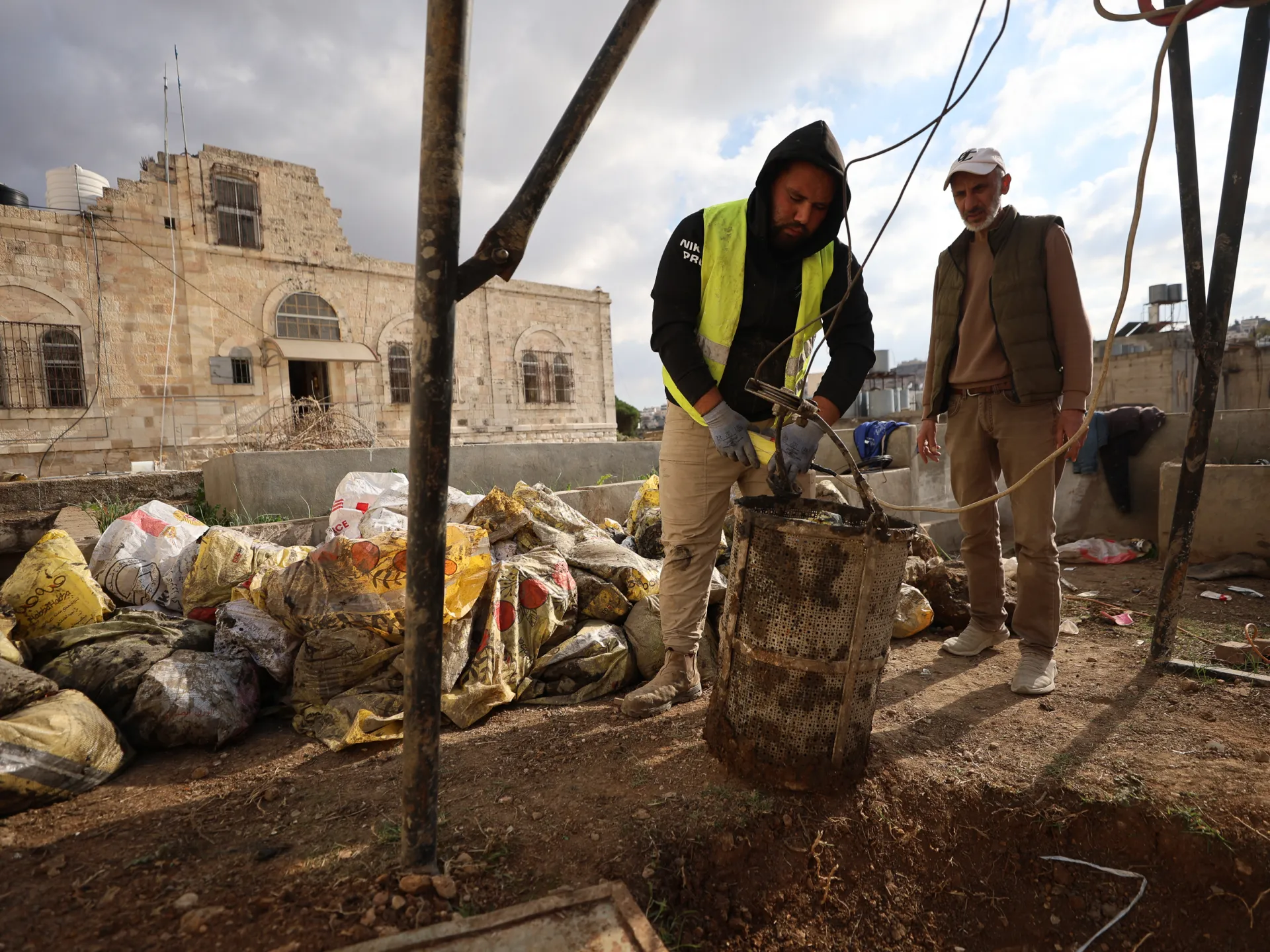
Restoration work on traditional wells in Hebron’s occupied Old City is providing Palestinian families with a more reliable water supply as shortages, restricted access and settler pressure make deliveries increasingly difficult.
The Hebron Rehabilitation Committee has restored 108 abandoned wells and says about 215 households have registered for the project since it began in July last year. More than 70 families signed up within the first few days.
The committee aims to complete work on the remaining wells next year. It says the scheme is intended not only to improve access to water but also to preserve the Old City’s historic fabric and help Palestinians remain in their homes.
For Umm Mohammad Jaber, 48, water shortages have turned routine tasks such as cooking and cleaning into daily struggles. Municipal supplies reach her home only once a month, while her family does not have enough storage capacity to last until the next delivery.
“People may be able to endure going without food or electricity, but without water, life comes to a standstill,” she said.
The Old City’s narrow streets, checkpoints and military gates make it difficult for tankers to reach Palestinian homes. Settlers occupying rooftops above houses and shops also make it harder for residents to install additional water tanks.
Restoring Hebron’s traditional water sources
Muhannad al-Jaabari, the rehabilitation committee’s director general, said the wells offered a practical response to the crisis while protecting an important part of Hebron’s heritage.
“Finding water means bringing life to the Old City,” he said.
About 40 wells have been restored in closed areas where Israel maintains strict military control. The work was carried out with the International Committee of the Red Cross, as movement restrictions made it particularly difficult for tankers to reach residents.
Each restoration requires the remaining water to be pumped out before dirt and rubble are removed. Workers then replaster and waterproof the walls, disinfect the well and refill it with fresh water.
Khaled al-Sharif, a supervisor on the project, said deep wells and sites in restricted areas presented additional risks and logistical problems. Teams must manage water, electricity and pumping equipment while bringing restoration materials through areas where movement is limited.
“Hebron is suffering from a severe water shortage. And when we talk about the Old City, we are talking about the difficulty of water tankers entering it because of its narrow alleyways,” he said.
The project has also helped Al-Jazaer Basic Boys’ School, which has 136 pupils and had faced persistent shortages for almost two years. The school had depended on water tanks and regularly needed to request extra supplies.
A restored well inside the school now provides water for drinking, cleaning and other daily needs. Principal Hisham al-Qawasmeh estimates that it can hold between 400 and 500 cubic metres, reducing the school’s reliance on outside deliveries.
“If there is no water and no school, these 70 families will naturally look for an alternative and that alternative will be outside the Old City,” he said.
Al-Qawasmeh said maintaining essential services was closely tied to keeping families in the area. “Schools consume more water than homes and water is the lifeblood of every place,” he said.
Water access and the fight to remain
The Old City has been under Israeli occupation since 1967 and remains under Israeli military control, while Palestinian civil jurisdiction is supposed to apply there. The rehabilitation committee says Israeli settler outposts have increased from four before October 2023 to 12 today.
It describes the expansion as part of pressure that is pushing Palestinian families, many of whom have owned property in the area for generations, to leave. The committee has responded with projects designed to improve living conditions and has rehoused more than 54 families in the Old City since October 7, while other families are waiting for suitable homes.
Daoud Hassan, 33, moved into a renovated abandoned house seven months ago with help from the committee. He had worked in construction in Israel but said he had been unable to find work after Palestinian workers were barred from entering following the start of the war in Gaza.
“We moved to the Old City because of our economic circumstances and to preserve our history and heritage,” Hassan said.
