


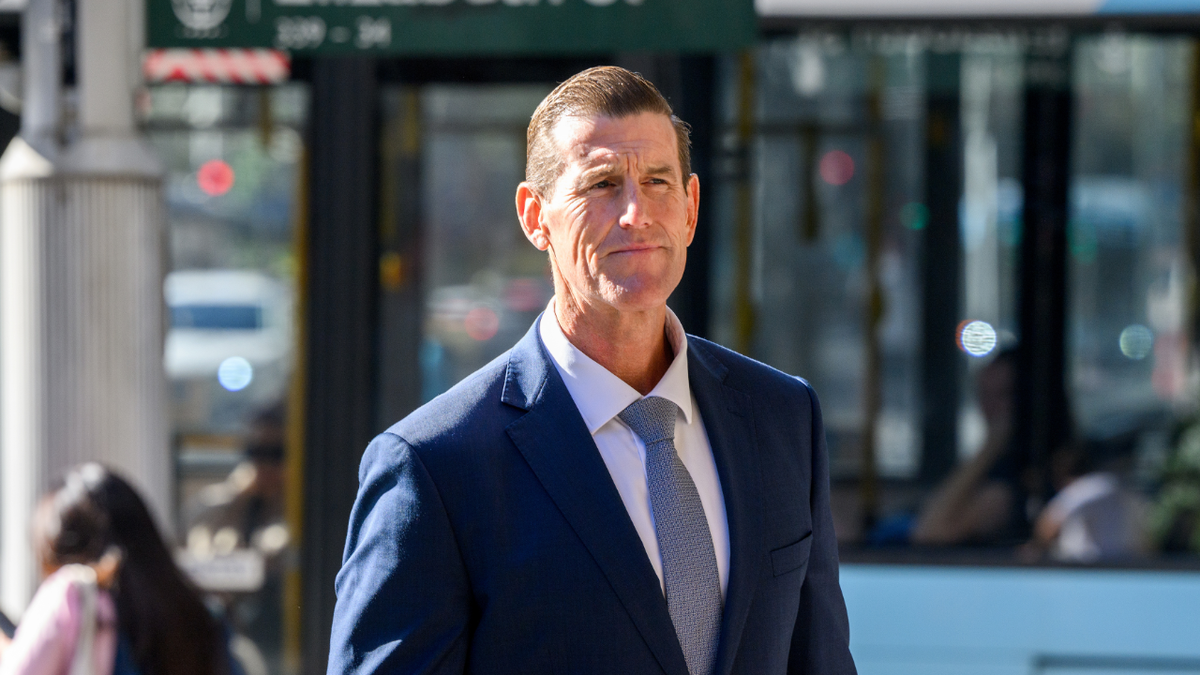
Ben Roberts-Smith has revealed he contemplated suicide for several months after being accused of war crimes in Afghanistan, while forcefully denying that he murdered prisoners or ordered their killings.
The 47-year-old former SAS soldier, who was arrested in April and charged with murdering or ordering the murders of five unarmed detainees, discussed the allegations in his first major interviews since they emerged publicly in 2018.
“I didn’t bloody murder anyone,” Roberts-Smith told 2GB host Ben Fordham in an interview broadcast on Thursday.
Asked whether he had shot prisoners or seen anyone else shoot them, he replied “no” to both questions.
Ben Roberts-Smith denies war crimes allegations
Roberts-Smith said the accusations had severely affected his mental health and that he had considered taking his own life over a period of between three and six months.
“I thought it might be a better option for my family if I just took my own life,” he said. “That’s rock bottom.”
He said he ultimately rejected the idea because he regarded it as surrendering and allowing his accusers to claim victory.
Roberts-Smith also described his 10 days in custody at Sydney’s Silverwater prison, where he said he was strip-searched and held in a cell with the lights on continuously because he was considered a suicide risk. He said he lost 6kg during his detention and wrapped a pair of underwear around his head to sleep.
A Federal Court judge previously found Roberts-Smith responsible for several killings during a defamation case brought against Nine newspapers.
Justice Anthony Besanko found that Roberts-Smith machine-gunned an unarmed prisoner, Mohammed Essa, in the back during a 2009 raid on a compound known as Whiskey 108. The judge also found that he took the prisoner’s prosthetic leg back to Australia and used it as a beer-drinking vessel.
Roberts-Smith rejected the allegation that he drank from the prosthetic leg, saying: “I didn’t drink out of it, which is just the truth. I did not and that’s for personal reasons.”
He said military organisations sometimes used dark humour to cope with the realities of war, but that it could be misunderstood.
Roberts-Smith is also accused of ordering the execution of Essa’s son, Ahmadullah, during a raid in April 2009 to give a new soldier experience. Court documents allege firearms were placed on the bodies to make it appear the men had been armed enemy combatants.
Further allegations relate to the village of Darwan in August 2012, where Roberts-Smith is accused of kicking a handcuffed man, Ali Jan, from a 10-metre cliff before ordering that he be dragged to a creek bed and shot.
Two months later, at Syahchow, he allegedly lined up two prisoners in a cornfield, shot one and ordered another soldier to shoot the second. Prosecutors allege he then threw a grenade at the bodies to conceal what had happened.
Roberts-Smith criticised the decade-long, 300 million dollar investigation into alleged Australian war crimes in Afghanistan, calling it “ludicrous”. He said the inquiry had broken many former servicemen and that some of the allegations had contributed to people taking their own lives.
He also criticised the federal government for changing war crimes laws retrospectively and offering compensation to Afghan families before his trial had begun.
Former defence minister Joel Fitzgibbon called into the radio programme to express his support for Roberts-Smith, describing the treatment of him by the legal system as “an absolute disgrace”.
Roberts-Smith, who received the Victoria Cross, said he had acted professionally during his military service and had never breached the rules of engagement.
“I’ve never committed a war crime in my military career,” he said. “I’ve never murdered a prisoner, and everything I did was inside the laws of armed conflict.”
