


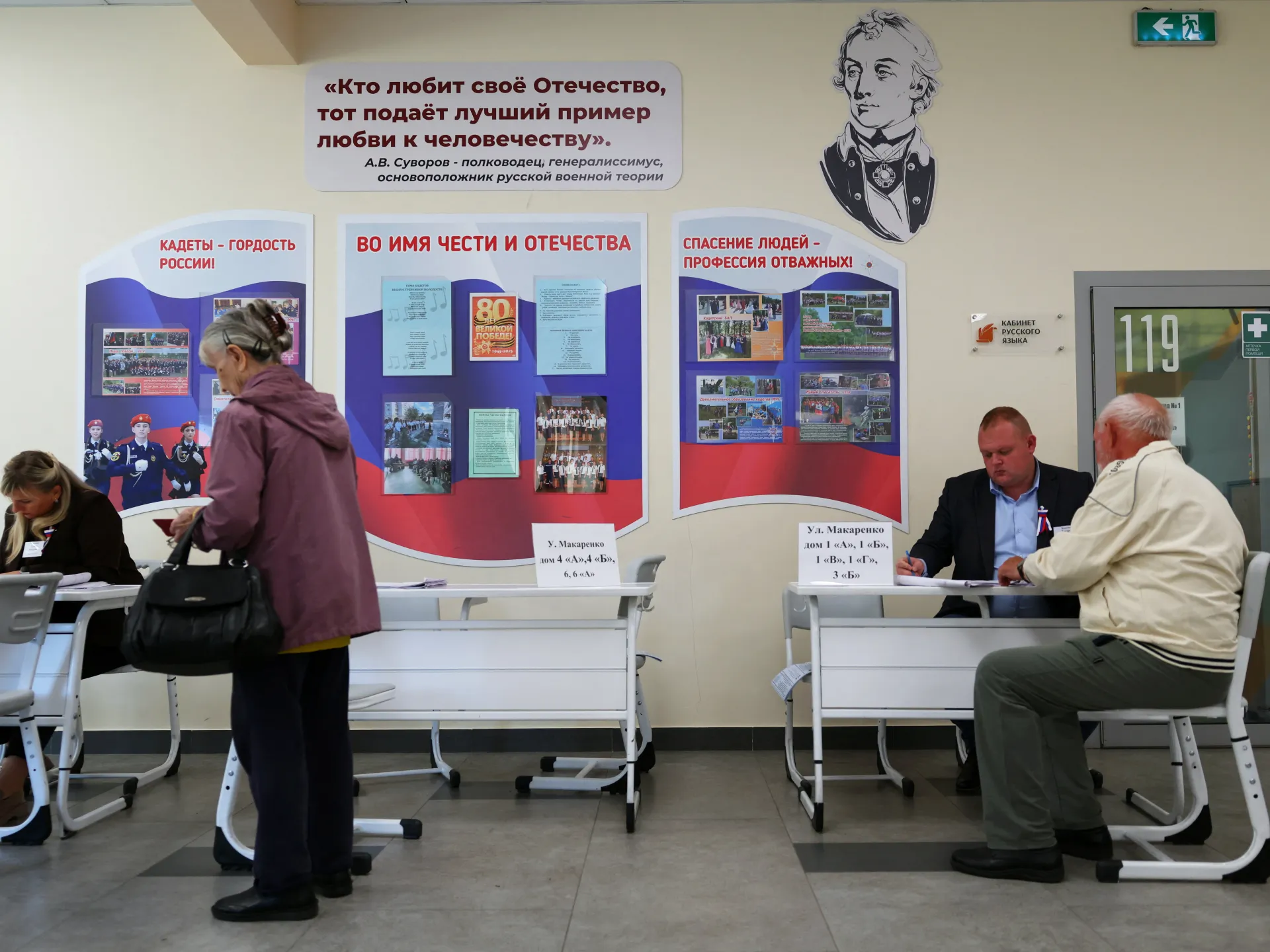
Russia’s parliamentary elections are being treated by the Kremlin as more than a formal exercise, with the authorities seeking high participation, reading the result as a measure of public sentiment and using the contest to reinforce the government’s political legitimacy.
The elections are taking place while the conflict with Ukraine continues and after a period of heightened political activity across the country. Senior politicians and officials have repeatedly stressed the importance of voting, while the authorities have sought to make participation as straightforward as possible.
Measures announced in the run-up to the poll have included additional subsidies for politically difficult regions, hastily introduced increases in payments to some public-sector workers and pensioners, and the postponement of unpopular decisions such as a planned nationwide rise in housing and utility tariffs.
Public discussion has also linked the election result to possible changes in Russia’s position on the conflict with Ukraine and to its future relations with Western countries. The outcome has been portrayed by some as potentially giving the Russian leadership greater freedom to act, although expectations about how that freedom might be used vary widely.
Russian parliamentary elections seen as a test of public engagement
Critics outside Russia commonly argue that the State Duma has little influence over the country’s most important decisions and that genuine power rests with a small circle around the Kremlin. From that perspective, the election is little more than a managed display of political competition whose result is effectively known in advance.
But the effort being devoted to the vote suggests that the authorities attach importance to what happens at the ballot box. The immediate priority is a strong turnout, which would demonstrate that society remains politically active rather than retreating into apathy or widespread cynicism.
Even support for parties opposed to United Russia would, in this calculation, be preferable to a large-scale refusal to participate. A sizeable vote would provide evidence that the public continues to regard elections as a meaningful channel for expressing its views.
The result could also act as a political barometer. Russia’s established parliamentary opposition reflects different social, economic, regional and age groups, and shifts in their support could influence the government’s future priorities.
A stronger performance by the Communist Party, A Just Russia or other left-wing candidates would point towards greater public demand for social programmes, action on inequality and a response to the economic legacy of the 1990s. A better result for New People and other right-wing candidates could strengthen the case for economic reform and more opportunities for private companies, including small and medium-sized businesses.
Significant support for the Liberal Democratic Party, meanwhile, would indicate stronger nationalist sentiment. The authorities might respond to each of these signals in different ways, but the balance between the parties would be difficult to disregard.
Possible changes after the State Duma vote
The elections may also lead to substantial changes in the composition of the federal government and other parts of the executive branch. Personnel changes could create space for new programmes and proposals while allowing the country’s senior leadership to maintain its broader political direction.
That prospect is significant because the vote is the first parliamentary election held during what Russia officially calls its “special military operation”. Russian society has changed during the conflict, leaving uncertainty over the preferences of those who have taken part in it or remain near the line of contact.
There is also uncertainty over how residents of the new Russian regions will vote, as the September contest is their first State Duma election in their new status.
For the Kremlin, the election therefore carries an element of risk. Its willingness to hold the poll under current conditions indicates that the authorities regard voting not merely as political presentation for foreign audiences, but as an essential means of testing public support and renewing their claim to legitimacy at home.
