


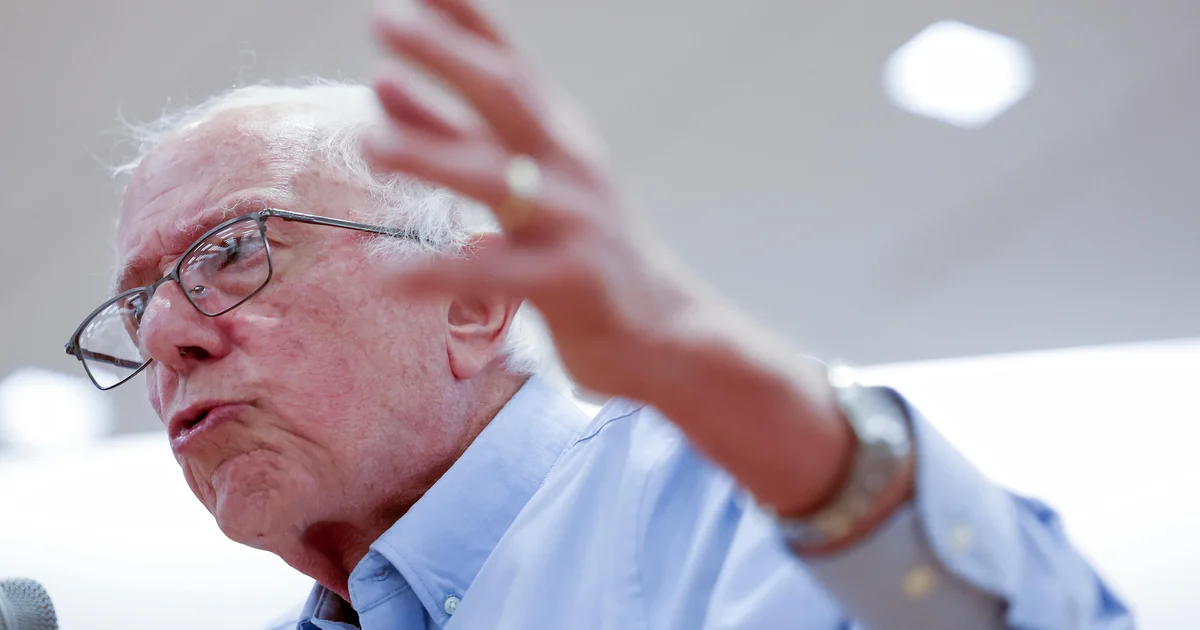
Steve Bannon and Bernie Sanders joined members of both US political parties in Washington on Tuesday to demand a human-centred approach to artificial intelligence and stronger safeguards around its development.
The pair appeared at the Pro-Human Assembly alongside lawmakers from across the political spectrum, as concerns grow over the impact of increasingly powerful AI systems on jobs, communities and public safety.
“Let us be clear — artificial intelligence and robotics are the most transformational technologies in the history of humanity,” Mr Sanders said as he opened his remarks. “And they will impact the lives of every man, woman and child in our country.”
The event came amid warnings from figures in the technology industry about the risks of a race to develop more advanced systems. Jacob Coxon, an AI researcher who recently resigned from Anthropic, said the technology was currently safe for people to use but could eventually pose a threat to humanity.
“If you have a super advanced intelligence, it could — it will be smart enough to kill us,” Mr Coxon said. He accused Anthropic and OpenAI of “gambling with our lives” by competing to develop increasingly powerful AI models.
Anthropic chief executive Dario Amodei has called for a slowdown among leading AI laboratories, a position later echoed by OpenAI chief executive Sam Altman and Elon Musk. Members of Congress from both parties have also urged caution.
Lawmakers call for humans-first approach to AI
Republican congressman Chip Roy said the debate extended beyond party politics, pointing to concerns among his constituents in Texas about the water consumption and noise associated with data centres.
“They raise questions about their future. They raise questions about what it means for their children, their communities,” Mr Roy said. “So, the question here is, how do you harness the power of human-created technology to put — as we are here to discuss — humans first?”
Mr Roy said some of his free-market Republican colleagues had criticised him for raising the issue. He also disagreed with Donald Trump’s position that a strong president was all that was needed to protect the public from AI, and questioned whether technology executives might be seeking to dominate the market.
“Might they be self-interested?” Mr Roy said. “Might they want to corner the market and have a monopoly environment?”
Democratic congressman Greg Casar compared the current competition between the United States and China with the Cold War, arguing that geopolitical rivalry should not override shared human interests.
“We may be Americans or Soviets or Chinese, but we are still human,” Mr Casar said. “Now just as back then, we need a pro-human approach.”
“No one can end the AI arms race. It’s up to us to end the AI arms race,” he added.
Democratic congresswoman Lori Trahan highlighted cross-party efforts in Congress, including legislation she introduced with Republican congressman Jay Obernolte that would provide for independent assessments of frontier AI models.
“Humans are not means to artificial ends,” Ms Trahan said. “We are ends in ourselves.”
Polling from May found that 65 per cent of Americans believed AI would reduce the number of jobs, while 67 per cent thought the federal government probably or certainly would not ensure that the technology was used appropriately.
Ms Trahan said the issue had gained bipartisan momentum but acknowledged that it was more difficult for Republican lawmakers to act when Mr Trump was publicly dismissing concerns about rapid AI development.
Trump dismisses fears as concerns grow
Mr Trump posted seven times about AI on his Truth Social account on Monday, repeatedly describing fears about rapid development as a “HOAX” and saying the technology needed only a strong president such as himself.
Vice-president JD Vance adopted a more cautious tone, saying voters’ concerns and the risks posed by AI needed to be addressed through thoughtful regulation.
“You know, it’s something that we’re concerned by, but we want to make sure that we actually regulate smartly, and we’re thoughtful about the risk here,” he said. “There are obviously risks to AI; there are some benefits to AI.”
House Speaker Mike Johnson said he and AI company leaders would meet Mr Trump at the White House within the next week.
