


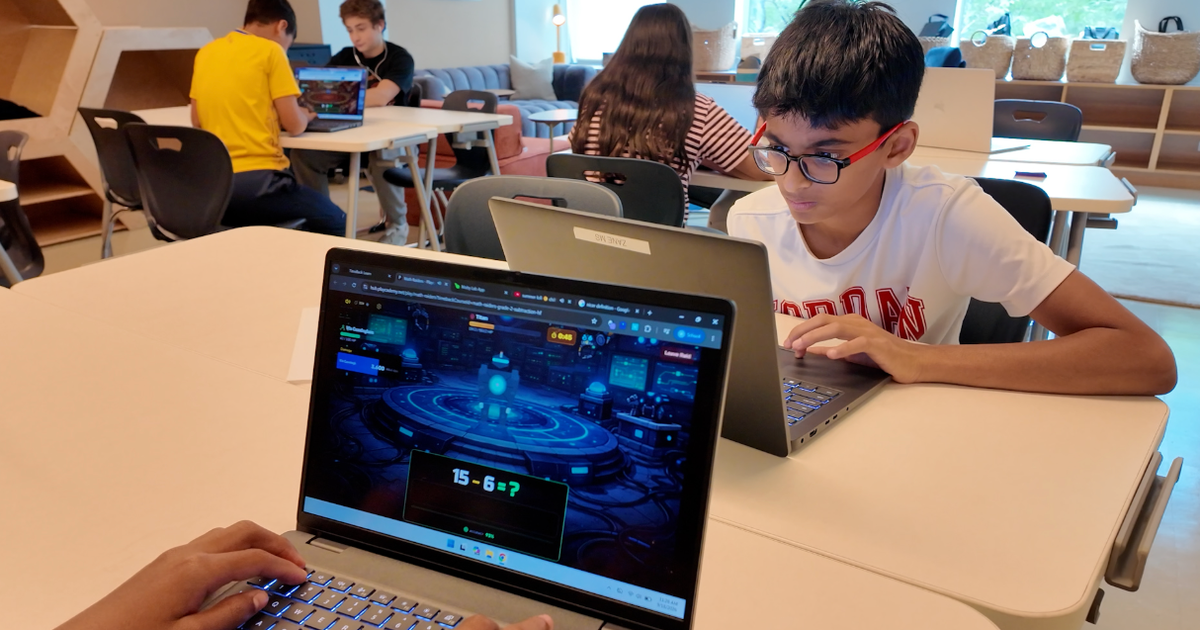
An AI-powered private school in Chicago has replaced traditional classroom teaching with adaptive software that it says enables pupils to master core subjects in about two hours a day.
Alpha School, a for-profit network founded in Austin, Texas, charges $55,000 (£41,000) a year for its Chicago campus, which opened this autumn for children from pre-kindergarten to eighth grade. The adults on site are known as “guides”, rather than teachers.
Students begin the day at 9am by working on laptops across maths, reading, writing, language and science. Alpha says its system allows pupils to progress at their own pace and develop mastery of each subject before moving on.
Zane Shah, 13, joined the school this year after attending traditional schools. He said the two hours of academic work achieved what he had previously covered during a typical eight-hour school day.
“I feel like I can be more focused instead of having 20 to 30 kids in a classroom all talking at once,” he said.
How Alpha School’s AI learning model works
The school’s proprietary platform, called TimeBack, is used across Alpha’s campuses and at several affiliated private schools. It adapts to each pupil’s performance, returning to earlier concepts when a student repeatedly struggles with a particular type of problem.
Alpha says the system is designed to operate more like a private tutor than a chatbot. It does not simply provide answers, and the school says it uses a closed system that does not draw information from the open internet.
A global learning science team, including licensed teachers and curriculum specialists, reviews pupil data each day. The team monitors progress, develops the curriculum and can provide remote coaching when a student needs further help.
Brian Howell, Alpha Chicago’s dean of parents, said: “It’s important to understand that they’re not interacting with chatbots. They’re not getting answers from AI.”
Most of the guides do not have a background in education. A February analysis by the University of Colorado’s National Education Policy Center found that about one-third of Alpha guides had education training or degrees.
Carrington Haas, the school’s lead guide, said staff focused on pupils’ motivation and emotional wellbeing rather than delivering academic lessons. She rejected the description of Alpha as teacherless, saying: “I think it’s the future. And it’s not teacherless because we’re still there and we’re still very much teaching the life skills that they need to know.”
Howell said the model was based on mastery, with pupils expected to demonstrate understanding before advancing. He also rejected the idea that students were simply being left in front of screens, saying that humans remained responsible for decisions about their day and learning.
Binoy Shah, Zane’s father, said he had noticed a change in his son’s engagement. “Now we’re getting three to five minutes of conversation [about] what he did at school, and he’s excited about it,” he said.
Experts question AI school claims
Education experts have raised concerns about Alpha’s approach and its claims about pupil outcomes. Rebecca Winthrop, a senior fellow at the Brookings Institution who has visited Alpha campuses, said families should recognise that the model was experimental.
“There’s no clear externally validated evidence around the results they claim,” she said, adding that deep reflection and making meaning were important to learning and long-term outcomes.
Carol Corbett Burris, executive director of the Network for Public Education, accused Alpha of treating education as a profit-making venture. She said the founders had also implemented the TimeBack model at Unbound Academy, a free public charter school in Arizona, which she claimed had performed poorly compared with other state schools.
Alpha says its pupils score in the top 1% on national standardised tests and that it does not select applicants according to previous grades or test results. It says students are admitted for being coachable, self-motivated and open to its approach, and are asked to leave only for behavioural problems rather than academic performance.
