


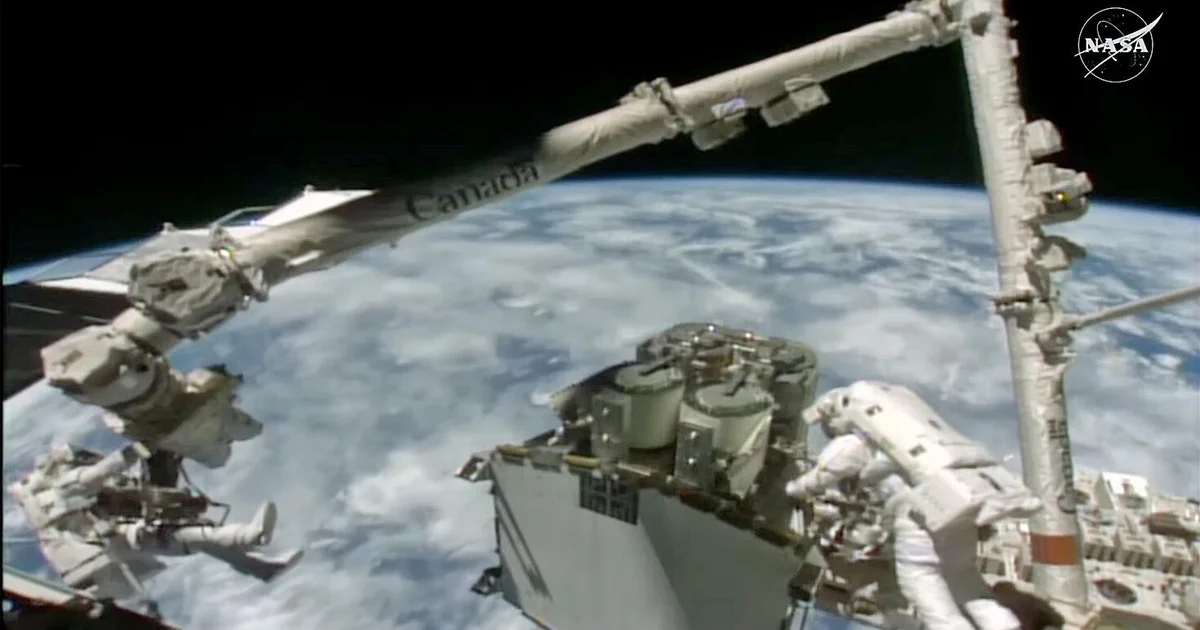
Two astronauts have begun the final phase of a years-long upgrade to the International Space Station’s power system, installing one of the last two roll-out solar arrays during a spacewalk.
NASA astronaut Anil Menon and Canadian Space Agency astronaut Joshua Kutryk switched their suits to battery power at 7.57am EDT on Thursday, beginning a planned six-and-a-half-hour operation outside the station.
The spacewalk is the eighth of the year and the 285th since construction of the International Space Station began in 1998. It started while the station was passing through orbital darkness, prompting Kutryk to remark: “The night is dark and full of wonders.”
The work forms part of an upgrade that began in 2021, when the first of eight International Space Station roll-out solar arrays, known as IROSAs, was installed.
Although smaller than the station’s original solar panels, the new arrays use more efficient solar cells. The six installed so far have increased the station’s available power from about 152 kilowatts to roughly 200 kilowatts.
Once the final two arrays are in place, the station is expected to have about 215 kilowatts available to support life-support systems, scientific research and visiting spacecraft through its planned retirement and de-orbiting in 2030.
The last pair of IROSAs arrived earlier this month aboard a SpaceX Cargo Dragon capsule. Folded in half and stored in the spacecraft’s unpressurised trunk, they were removed by the station’s robotic arm and positioned on the left side of its power truss.
Menon, who has already completed three spacewalks this year, and Kutryk, undertaking his first extra-vehicular activity, were due to install the seventh array on a support fixture at the base of one of the station’s left-side solar wings.
The astronauts first had to release the folded array. Menon was then to be carried towards the mounting point on the end of the station’s 58-foot robotic arm, operated remotely by flight controllers at the Johnson Space Center in Houston.
The folded array weighs about 750lb and is approximately 10ft long. Garrett Hehn, a spacewalk flight director, said controllers had devised a series of manoeuvres designed to rotate around the array’s centre of mass, reducing the physical strain on Menon while he held it.
At the mounting point, the astronauts were to secure the array to its support frame, unfold its two halves and bolt them together. Electrical connections will be made while the station is on the night side of Earth, when the solar arrays are not producing power, before the new blanket is deployed.
The arrays unroll without motors, using stored energy in a mechanism that has been compared to a reverse tape measure. Hehn likened the process to a “snap bracelet”, saying it would take about 10 minutes.
Menon and Kutryk are due to carry out a second spacewalk next week to install the eighth and final IROSA on a solar wing at the far end of the power truss. Because the robotic arm cannot reach that position, the astronauts will pass the folded array between them in stages before attaching and deploying it.
Gaurang Patel, a senior manager in NASA’s Low Earth Orbit Programme, said the operation would “essentially complete our power augmentation upgrades”.
