


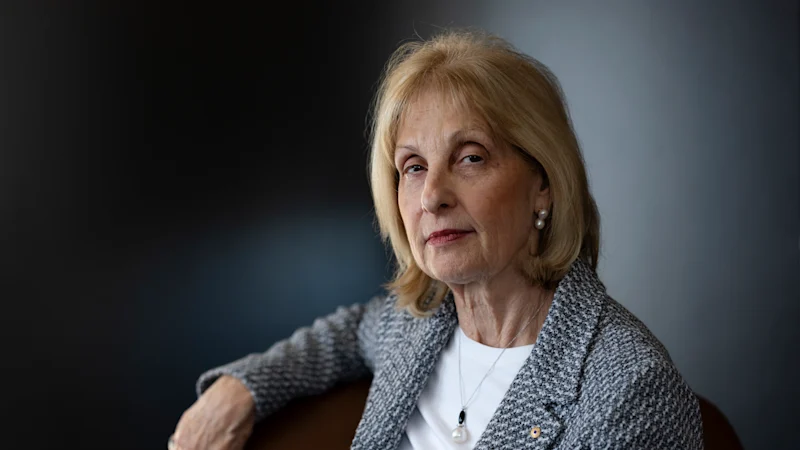
Progressive activists motivated by social justice are fuelling a new form of antisemitism in Australia by giving hostility towards Jews an “intellectual and cultural credibility”, the country’s antisemitism envoy has warned.
Jillian Segal’s report, due to be released on Friday, argues that criticism of the Israeli government is increasingly being transferred to Jewish Australians, who have no influence over Israel’s policies. It identifies this form of antisemitism as a growing threat alongside far-right extremism, Islamist extremism and the far left.
Segal said some people who believed they were defending human rights had made antisemitism more acceptable by presenting it through a progressive lens.
“What we have is antisemitism that I describe as much more in the middle: well-intentioned people who are concerned about the policies of the state of Israel and feel critical of them,” she said.
“And they transfer that criticism to Jewish members of society in Australia … through a lens of thinking that they are upholding progressive values and human rights.”
The report says Jewish Australians have faced hostility, online abuse, exclusion, doxxing, graffiti and violence. It also warns that Zionism – the belief in Israel’s right to exist as a Jewish state – is increasingly being used as a proxy for antisemitism.
“Increasingly, and often to avoid appearing transparently and obviously antisemitic, it has become common to vilify, target and ostracise ‘Zionists’ rather than ‘Jews’,” the report says.
Segal said Israel and its government should be subject to criticism like any other democratic state, but argued that Jewish Australians should not be held responsible for decisions made by its leaders.
Online hate and public broadcasters
The report describes the online environment as one of the most significant accelerators of contemporary antisemitism, with conspiracy theories and abuse spreading rapidly on social media.
Segal said there had been “an explosion of hate” directed at Jews after Hamas’s October 7 terror attack, followed by a further increase after the Bondi terror attack. The report says social media was then flooded with denials of the killings and claims that the incident had been staged.
One of its more contentious recommendations is the creation of an independent external complaints watchdog for the ABC and SBS. Segal said Jewish Australians had raised concerns about coverage of Israel and the Middle East which they believed was disproportionate, misleading or inaccurate.
The report says some Jewish Australians had been abused as “baby killers” or accused of supporting genocide simply for believing Israel had a right to exist. The ABC and SBS defended their reporting and existing complaints procedures at the Royal Commission on Antisemitism and Social Cohesion earlier this year.
Segal also recommends that public funding be withheld from individuals or organisations that engage in or tolerate antisemitism. The proposal would apply to grants supporting the arts, culture, sport and university research.
“My principle is that government money should not be used to foment hate in any sphere,” she said.
Universities criticised over response
Universities are accused in the report of failing to respond adequately to antisemitism on campus, including during encampments, office invasions and disruptive activism affecting Jewish staff, students and visitors.
Although vice-chancellors endorsed an agreed definition of antisemitism in 2025, the report says no university had adopted a uniform definition this year.
Jennifer Westacott, chancellor of Western Sydney University, acknowledged what she called “a collective failure to address the escalating severity of antisemitism” in the sector.
“Universities have to be places where ideas can be respectfully contested,” she said. “They have to be places of debate, and they can be places of peaceful protest, but they should never be places of hate or fear.”
Other recommendations include training for visa decision-makers, education on antisemitism in schools, the public sector and business, and a national healthcare taskforce.
Multicultural Affairs Minister Anne Aly said antisemitism was a serious challenge and Jewish Australians had the right to feel safe.
“We must never allow international conflicts to become a licence for hatred here at home,” she said. “Australians can hold different views, including on events overseas, without turning against one another.”
The Royal Commission on Antisemitism and Social Cohesion is due to deliver its final report on December 18.
