


Businesses adopting artificial intelligence risk creating costly AI lock-in unless they keep the underlying models interchangeable and retain control of the software layer that coordinates them, according to an analysis of enterprise technology strategy. The recommended approach is to rent access to models from providers such as OpenAI and Anthropic while owning the “harness” that manages data, prompts, agents and workflow decisions.
The argument is based on the expectation that companies will soon use many specialised models rather than rely on a single system. Language, reasoning, forecasting, vision, speech, video and smaller local models could each perform different tasks, with an orchestration layer deciding which is used and when.
That makes the harness a critical point of control. It determines how models are selected, how much they cost, what information they receive and how lessons from previous work are recorded.
Why AI lock-in is becoming a strategic risk
Traditional software lock-in often developed over years, as businesses accumulated data and code that could not easily be transferred to another provider. The analysis argues that AI dependencies can form much faster because models, pricing and capabilities are changing rapidly.
Companies that build important operations around one language-model provider may find themselves tied not only to its pricing but also to its preferred tools, data formats and governance systems. Switching provider could then require rebuilding workflows rather than simply changing a supplier.
The risk is compared with the way database-specific programming languages once trapped businesses in particular systems. Although standard SQL remained portable, logic written in a proprietary dialect could leave companies facing the cost of rewriting years of work before they could move elsewhere.
A similar problem can arise when an AI assistant becomes the main place where staff work. Removing it would no longer be a straightforward software change, but a company-wide migration involving processes, records and accumulated knowledge.
Memory and context are described as particularly quiet forms of dependency. Prompts refined over time, embeddings, agent memory and other information about how a business operates may be stored in formats that only the original provider can use.
Fine-tuning proprietary data through one provider can create another barrier. The model may become better at the company’s work, but leaving could mean abandoning the knowledge built up through that process.
The case for owning the AI harness
The harness is the orchestration layer above the models. It can route individual tasks to different systems, apply business rules, record results and feed successful methods back into future work.
In this model, the harness contains much of the organisation’s practical intelligence. It decides whether a task needs an expensive frontier model, a smaller specialist system or a locally operated model, rather than sending every request to the same provider.
That flexibility could also help businesses control spending. The analysis points to examples of companies spending hundreds of thousands of dollars a month on frontier inference before identifying workloads that could be handled by cheaper specialist models.
Routing does not mean abandoning the most advanced systems. Instead, their use would be concentrated on tasks that genuinely require them, while routine or high-volume work is directed to less expensive alternatives.
Image, audio and video systems could be managed in the same way. A single harness capable of working across different types of model would allow a company to select the least expensive option that meets the required quality level.
By contrast, coding agents tightly linked to one model family may offer strong performance in a particular area while providing little flexibility. The analysis contrasts proprietary systems such as Claude Code with open projects including OpenClaw, Hermes, OpenCode, Aider and Pi, whose code can be inspected, adapted and run on a company’s own infrastructure.
The distinction is not simply between different products. It is between owning an operating layer that can be changed and renting one whose rules, models and commercial terms are controlled by a supplier.
Open-weight models are narrowing the gap
The case for keeping models interchangeable rests partly on the rapid improvement of open-weight systems. The analysis says the performance gap between leading closed models and their open counterparts has narrowed considerably, while the price difference remains substantial.
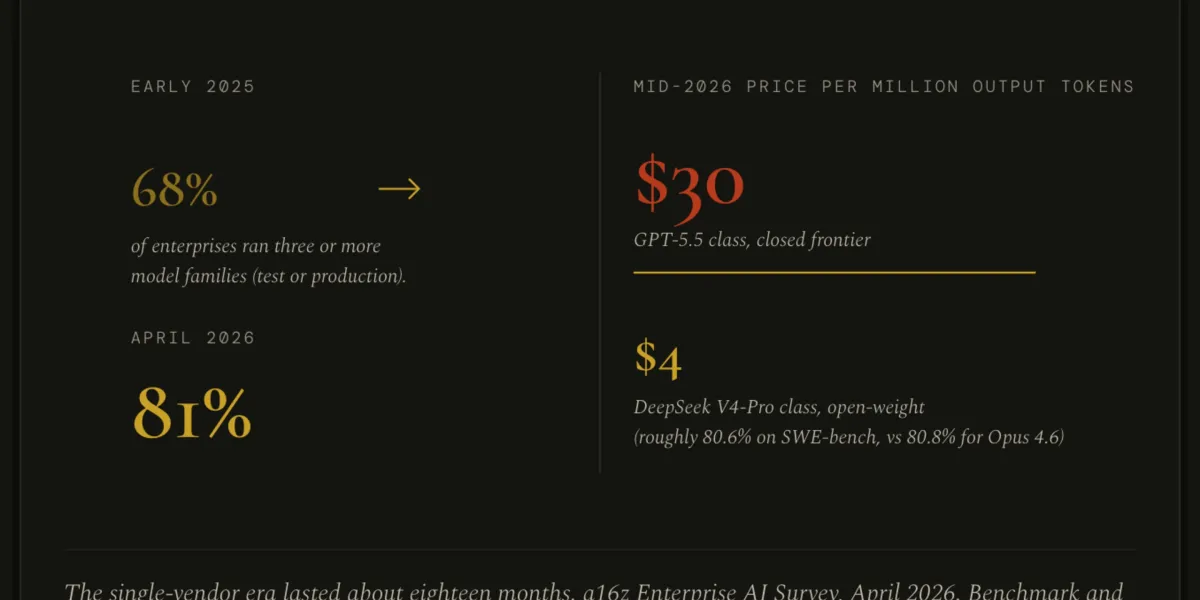
It cites DeepSeek V4-Pro recording 80.6 per cent on SWE-bench Verified, close to Claude Opus 4.6 at approximately 80.8 per cent, and says Kimi K2.6 later exceeded Opus on the same benchmark. It also says the gap on knowledge benchmarks has fallen from between 20 and 30 percentage points in 2023 to roughly three to five points in 2026.
The analysis places the cost of GPT-5.5-class closed models at about 30 dollars per million output tokens, compared with around four dollars for equivalent open-weight application programming interfaces. On that basis, treating one provider’s model as a permanent foundation could leave businesses paying premium prices for work that has become increasingly interchangeable.
It also points to the rapid uptake of Grok Bot, which launched on 11 August 2026 and reached approximately one million devices five weeks later, as an illustration of how quickly a non-frontier model can alter the commercial picture.
The broader conclusion is that the leading model today may not remain the leading model for long. Architecture built around a current winner could therefore become a constraint when a stronger or cheaper alternative arrives.
Where businesses should keep control
The proposed approach is to make the model layer replaceable while retaining ownership of three other elements: the gateway, the agent blueprint and the context layer.
A gateway would provide a common route to different models, making a change of provider a configuration adjustment rather than a major rewrite. The analysis says 81 per cent of enterprises were using three or more model families in testing or production by April 2026, up from 68 per cent a year earlier.
The agent blueprint would contain prompts, tool definitions, retrieval rules and settings in provider-neutral formats. Verification tests would then check that an agent still behaves correctly when the model underneath it changes.
The context layer would govern what the system knows, how current that information must be, who can access it and what retrieval costs. The analysis describes this as replacing prompt engineering as the central discipline in building useful AI systems.
Businesses are also advised to consider where their main data is stored. Moving information from a software provider’s system of record into infrastructure controlled by the business could reduce the provider’s influence over future AI applications.
Some software companies are responding by offering headless application programming interfaces so their systems can remain a data layer beneath whichever AI interface wins. Others are accused of making it harder for customers to use their own data outside the vendor’s platform.
Networks offer a different kind of advantage
Not every form of dependency is presented as harmful. Network effects can strengthen a service for both the provider and its users when additional participants improve the value available to everyone.
The analysis points to affiliate-marketing networks, search, navigation, online marketplaces and payment services as examples where scale can benefit customers rather than simply increasing the cost of leaving.
It distinguishes this from a private data store that improves only one company’s internal system. A network can learn from activity across a market and return sharper insights to its participants, creating an advantage that does not depend on a single model remaining the best.
That model is described as a “network refinery”: a system in which each new company broadens the information available to the network. Unlike a proprietary data well, its value comes from the wider market rather than from deepening dependence on one provider.
The analysis argues that this is the form of data advantage worth pursuing because the network remains useful even as the models underneath it become commodities.
Self-improving systems increase the stakes
The harness is also identified as the place where systems can improve over time. An agent can perform a task, have the result assessed, record what worked and use that lesson on the next attempt.
Examples cited include Andrej Karpathy’s AutoResearch, which ran 700 machine-learning experiments on one graphics processor over two days, research into agents that improve their own harnesses, and DeepMind’s AlphaEvolve system, which used evolutionary code search to improve a matrix multiplication algorithm.
The significance, according to the analysis, is that the compounding benefit does not necessarily reside in the model. It sits in the process that scores work, stores lessons and applies them again.
If that process is controlled by a supplier, the company using the AI may be renting not only the model but also the improvement loop built from its own operations. If it owns the harness and its memory, the resulting knowledge can remain portable as providers change.
The recommended principle is therefore straightforward: rent the model, own the harness and retain control of the context and data architecture around it. Companies that preserve the ability to test, switch and route work across providers will be better placed to adapt as AI capabilities and prices continue to move.
