


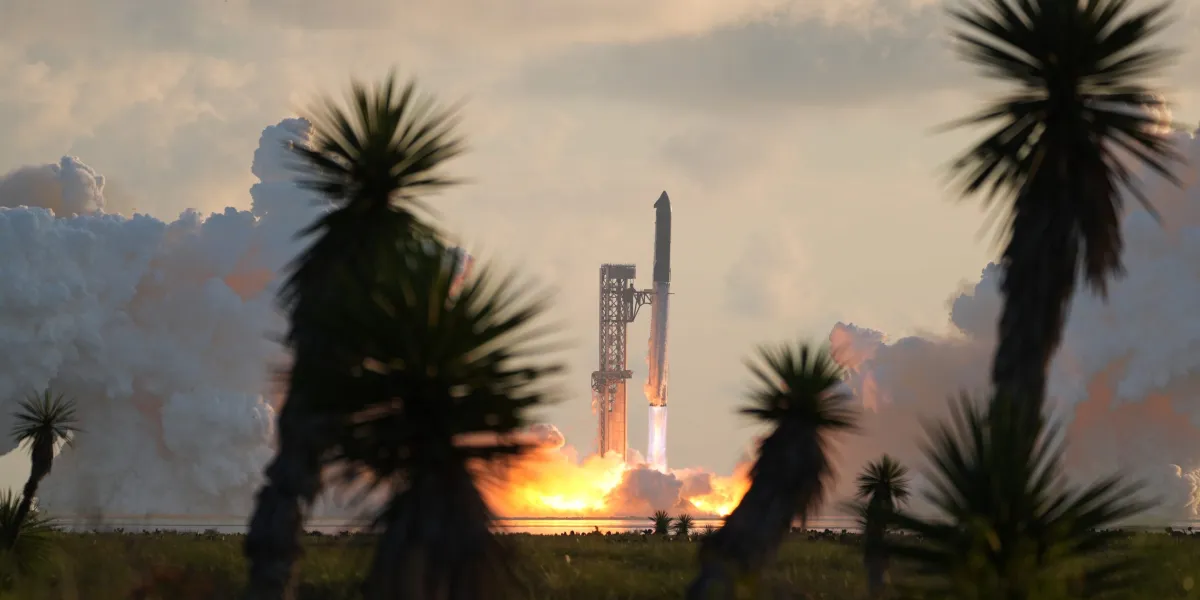
SpaceX’s Starship reached orbit for the first time on Monday, delivering 26 advanced Starlink satellites before the company ended the mission several hours earlier than planned.
The 407ft (124m) spacecraft was intended to complete six laps of Earth during a flight lasting almost 10 hours. Instead, SpaceX said it would re-enter over the Pacific and splash down north of Hawaii about three hours after liftoff from Starbase in southern Texas.
Starship reached its planned altitude of 170 miles (275km) and travelled at about 17,500mph (28,000kph), but flight controllers decided to bring it down after only a couple of orbits. The company did not give a reason for shortening the flight.
The mission came close to failing in its early stages when one of Starship’s engines shut down too soon. After several tense minutes, controllers judged that the remaining engines were sufficient and continued with the flight.
“Starship is orbital,” Mission Control announced as observers at the Texas launch site cheered.
NASA administrator Jared Isaacman congratulated SpaceX for reaching orbit and for “managing every step in a safe, responsible and especially inspirational way”.
Starship carries latest Starlink satellites
The satellites were released one at a time from the spacecraft, adding to the 11,000 older Starlink models already providing internet service. Their deployment prompted further cheers from SpaceX supporters watching at Starbase.
It was the 14th full-scale Starship launch from Texas in three years. Earlier test flights travelled no farther than the Indian Ocean, halfway around the world, with some ending in fiery crashes after briefly reaching space.
The first-stage booster was not designed to return to Starbase during Monday’s mission. It instead fell into the Gulf of Mexico within minutes of the morning launch.
SpaceX has said it wants to establish that Starship can operate safely before attempting to bring it back to the launch site. If the spacecraft returns successfully, giant mechanical arms could be used to catch it as it hovers above the pad.
Elon Musk said earlier this month that the company was proceeding cautiously because debris falling over land could damage SpaceX’s public standing. “That’s why we’re being extremely cautious here,” he said.
The rocket was built to be fully reusable, with the aim of reducing launch costs. SpaceX recovered the previous Starship from the Indian Ocean in July, allowing engineers to inspect it and modify the new spacecraft’s heat shield.
Starship’s role in NASA’s moon programme
SpaceX is seeking certification for Starship to conduct orbital flights, a key step in its plans for lunar and Mars missions. The spacecraft is expected to play a role in NASA’s Artemis programme, which is due to involve a series of orbital rendezvous between astronaut capsules and competing lunar landers.
Artemis III could take place as soon as next summer, with Jeff Bezos’s Blue Moon lander and Starship due to take part in separate stages of the mission. Artemis IV, scheduled for no sooner than 2028, is intended to carry astronauts to the Moon using whichever lander is ready first.
Musk originally developed Starship with Mars in mind, including plans to launch large numbers of spacecraft carrying the first settlers. SpaceX also intends to use it to transport satellites in large quantities and eventually phase out its Falcon 9 rocket.
A second Starship launch site is nearing completion at Florida’s Kennedy Space Centre, while a third is planned for Louisiana. Depending on the findings from Monday’s flight, SpaceX could attempt another launch and a return to the pad by the end of this year or early next year.
