


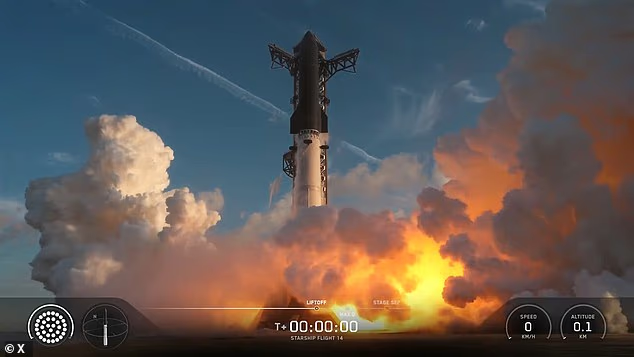
SpaceX’s Starship reached orbit for the first time after one of its engines shut down unexpectedly during Monday’s test flight, forcing controllers to assess whether the mission could continue.
The uncrewed 40-storey rocket lifted off at about 8.46am ET from the company’s Starbase complex on the Gulf of Mexico near Brownsville, Texas.
About 15 minutes into the flight, one of the Starship upper stage’s Raptor 3 engines stopped working. The spacecraft compensated for the failure while engineers considered whether to proceed with the orbital manoeuvre.
Controllers ultimately gave the go-ahead. Starship completed the burn needed to enter orbit roughly 20 minutes after launch, reaching its target around five minutes later.
The flight is planned to last about 10 hours, with the spacecraft completing six circuits of Earth before a single-engine burn takes it out of orbit. It is expected to come down in the Pacific near Chile.
SpaceX hopes eventually to recover the spacecraft and fly it again, as part of its ambition to develop a fully reusable rocket.
At two minutes and 34 seconds into the flight, Starship performed a successful hot-stage separation from the Super Heavy Booster 21. The booster then carried out a landing burn above its intended splashdown area in the Gulf.
Despite the engine shutdown, Starship completed the burn that carried it into space at about 9am ET. Around eight and a half minutes later, a dispenser in the nose began releasing 26 third-generation Starlink satellites, which have 10 times the capacity of their predecessors.
The satellite deployment was complete by 9.54am ET, with engineers continuing to monitor the spacecraft as it remains in orbit.
The test was SpaceX’s first attempt to send Starship around Earth after 13 previous flights failed to reach orbit. A successful mission would increase confidence that a modified version could be ready for NASA’s planned Artemis Moon landing in 2028.
NASA administrator Jared Isaacman congratulated SpaceX on the launch, writing: “Gorgeous launch, getting Ship to orbit and managing every step in a safe, responsible, and especially inspirational way.”
He added: “NASA, along with the rest of the interested public, is excited to help where we can and for Starship missions to become routine!”
SpaceX has been testing Starship in its full configuration since 2023, making modifications through successive flights. The company hopes the latest mission will begin a new phase of development, including tests of refuelling the rocket in orbit.
