


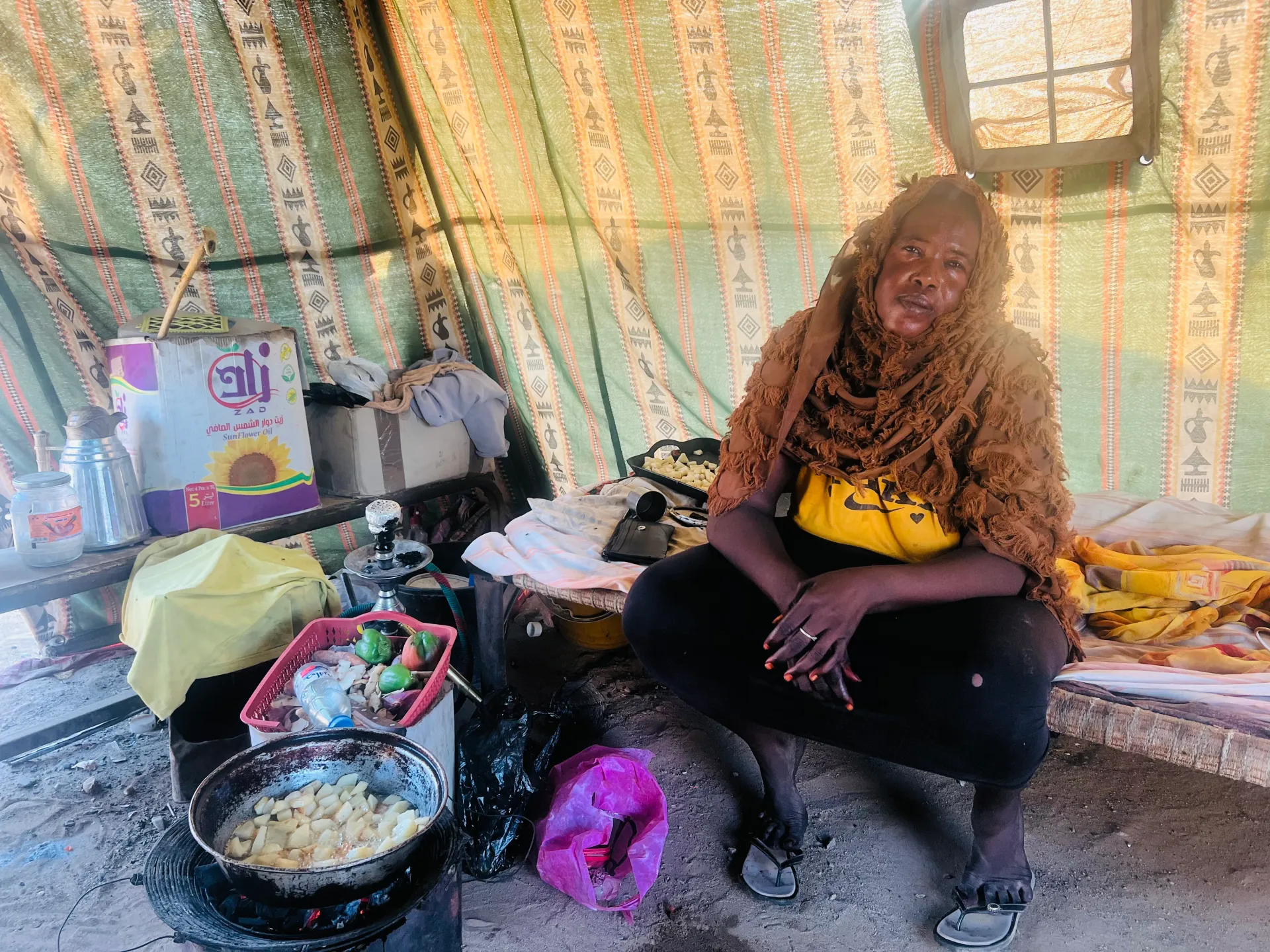
Widowed Sudanese mothers displaced by the war are facing hunger, untreated illness and the threat of gender-based violence, as humanitarian assistance falls far short of the scale of need. In Port Sudan, women who have lost husbands and children are struggling to care for families while living in shelters and camps with little income or support.
Arafa Abdelaziz, 33, fled Omdurman after her husband and eight-year-old son were killed during the conflict between the Sudanese Armed Forces and the paramilitary Rapid Support Forces (RSF).
Her husband died days after fighting began in April 2023. Five months later, her son was killed by a stray bullet during clashes near a market in Omdurman, in Khartoum State.
“My son was playing outside the house with his friends when I suddenly heard a loud noise. When I went outside, I found that his head had been shattered by gunfire,” she said.
With fighting continuing, Arafa eventually left the city with her six-year-old son, who has a condition affecting his development. Their journey to Port Sudan lasted 15 days.
Near Jebel Aulia, south of Khartoum, she said RSF fighters stopped the vehicle carrying them. The passengers were robbed and assaulted, she said, and the women were threatened with violence against their children.
“They asked every woman carrying a child how she wanted her son to be killed. I told them to kill me before they touched my son,” Arafa said.
She said one of the fighters struck her with a rifle butt when she tried to protect her child, leaving her unconscious for more than an hour. After she regained consciousness, she said, she saw young women travelling on the bus being raped, including in front of their fathers.
In October, UN Women said 12.7 million people, mostly women and girls, needed support for gender-based violence in Sudan – four times the figure before the war. The agency warned that sexual violence was being used as a weapon of war and that women and girls faced risk while fleeing, living in displacement camps and searching for food, water and shelter.
Widowed Sudanese mothers left without support
Arafa arrived in Port Sudan without money or possessions apart from the clothes she was wearing. Her son’s condition had worsened during the journey, while irregular access to his medication left her unable to manage his health properly.
Having no relatives or friends in the city, she first went to a school sheltering displaced families before being moved to a displacement camp. She now relies largely on aid, but cannot afford to give her son medication regularly.
“Sometimes he imagines strange things because of his illness,” she said. “Yesterday, he told me he could see a lot of blood on the ground. It makes me think every day about his future with this condition.”
She said she was afraid to leave him alone in case he suffered a seizure or injured himself.
The war has killed as many as 150,000 people and forced millions from their homes. The United Nations says income levels have fallen to those last seen in 1992, while extreme poverty is worse than in the 1980s.
Women have increasingly become the sole guardians of displaced households because of conscription, deaths and men leaving their communities or the country for work. The UN’s 2025 Gender Snapshot found that 75 per cent of female-headed households in Sudan were food insecure, three times the rate among male-headed households.
The Mashad Observatory has recorded 72,202 cases of widowhood since the war began. It said the loss of a household’s main income could increase the risks of economic exploitation, gender-based violence, forced or early marriage and interrupted education.
The organisation also warned that widows faced worsening mental health because of cumulative trauma, overwhelming responsibilities and a lack of psychosocial services. It called for longer-term support, including cash assistance, vocational training, access to work, healthcare, education and legal protection.
Humanitarian agencies have said Sudan’s 2026 response plan, intended to reach 20.4 million people, has received only 47 per cent of the 2.9 billion US dollars needed.
Zahra Idris, 39, is among the women now left to support a family alone. She fled Khartoum with her husband and two children as shelling intensified and reached Port Sudan three years ago.
The family moved from a rented house to a school shelter after they could no longer afford the rent, and were later transferred to a displacement camp. Zahra’s husband died of heart disease two months ago, leaving her with little support beyond dwindling humanitarian assistance.
“Since my husband died, my fears have grown. I cannot go out to look for work until I complete the mourning period prescribed in Islam, which lasts four months and ten days,” she said.
Her 12-year-old son has an intellectual disability and needs regular medical care. Zahra said she hoped he could attend a school for children with disabilities but could not afford the treatment or education.
“There is no one to help me. I just want my son’s condition to improve enough for him to attend a school for children with disabilities,” she said.
