


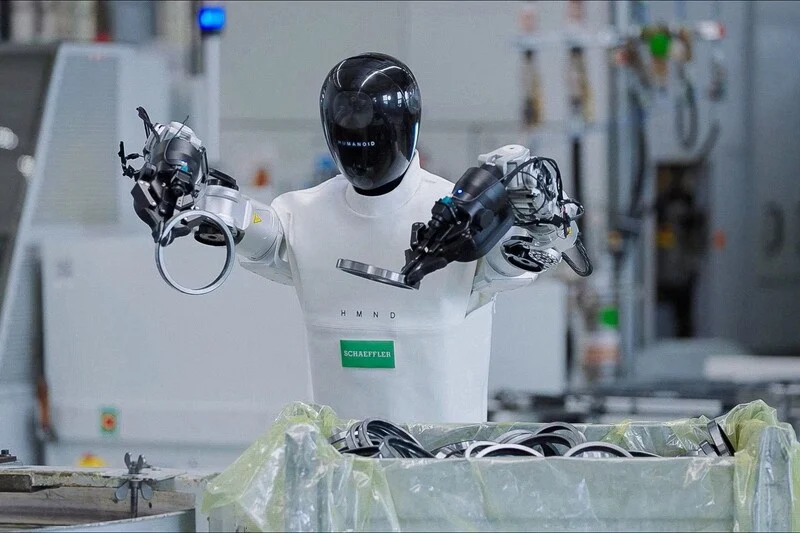
Robotics adoption remains limited among Swiss companies, with only 4 per cent using service robots, 3 per cent employing industrial robots and 1 per cent operating humanoid robots, according to a UBS survey of about 2,500 businesses.
The study, conducted with market research firm Intervista in March, found that robot use is concentrated in particular parts of the economy rather than spread widely across Swiss industry and services.
Industrial robots are most common in electrical equipment and machinery, where 38 per cent of companies reported using them, followed by the metals sector at 27 per cent. Service robots have made their strongest progress in education, with adoption reaching 14 per cent.
Humanoid robots remain at an early stage. Their use was reported by 10 per cent of companies in the materials sector and 7 per cent in education, although they remain a niche technology across the wider economy.
Robotics adoption trails other technologies
The survey showed that robotics is considerably less established than several other emerging technologies. Cloud computing was used by 32 per cent of Swiss companies, while the Internet of Things reached 10 per cent and 3D printing 8 per cent.
Overall, 43 per cent of businesses said they used at least one of the 11 technologies covered by the research. More than half, or 57 per cent, used none of them, while a further 25 per cent used only one. Just 18 per cent had adopted two or more.
Company size was a significant factor, with large businesses generally more likely than small and medium-sized enterprises to use the technologies surveyed. UBS said the gap reflected differences in resources, digital infrastructure and the ability to implement new systems.
The average number of technologies used by each company is expected to rise from 0.8 to 1.5 over the next five years. Industrial robots are expected to expand particularly in mechanical engineering and vehicle manufacturing, while cloud computing and the Internet of Things are also forecast to gain ground.
UBS said humanoid robots and quantum computing were likely to remain longer-term prospects rather than technologies poised for broad adoption in the immediate future.
The survey indicated that the main challenge for companies was shifting from access to technology to putting it into practical use. Skills shortages, data governance, cyber security, regulation and financing were identified as factors that could determine whether planned investment turns into actual deployment.
