


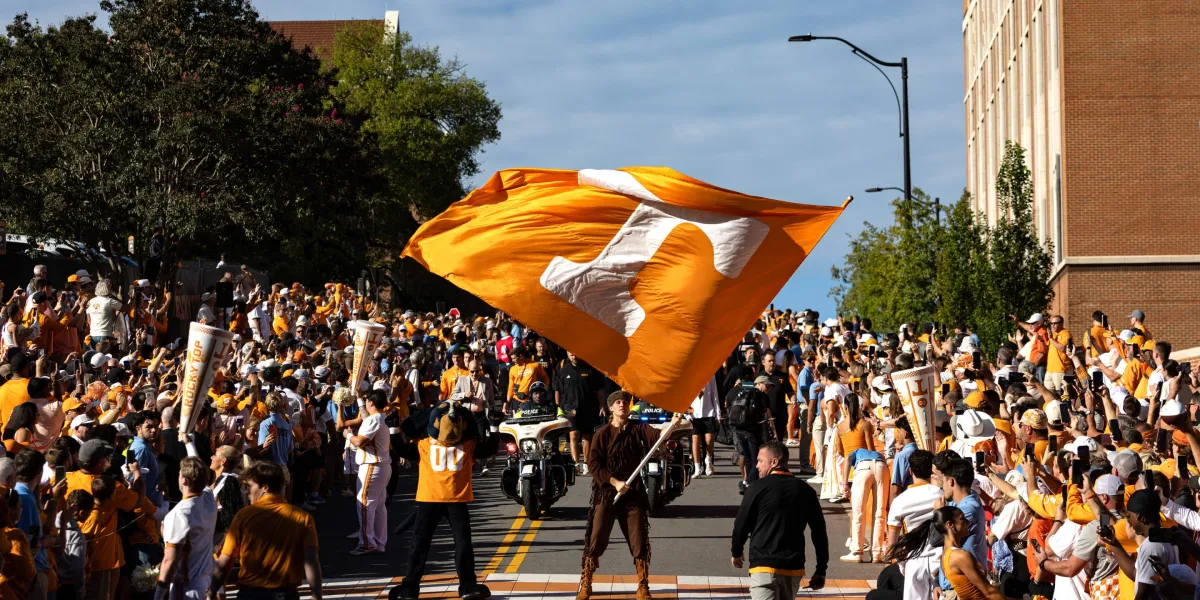
Donald Trump attended the college football clash between Texas and Tennessee at Neyland Stadium after officials worked with the Secret Service to protect communications between coaches and players from possible disruption.
The Southeastern Conference game in Knoxville was already one of the weekend’s biggest fixtures, with the No. 1-ranked Texas Longhorns facing the No. 14 Volunteers. Trump’s visit added heightened security measures and a particular focus on the effect of his movements on team radio systems.
Texas head coach Steve Sarkisian had warned that teams needed to be prepared to lose headset communication whenever the president entered or left the stadium, or moved elsewhere inside it.
ABC and ESPN reported that both universities had coordinated with the Secret Service over audio channels in an effort to keep communications clear. An official timeout could have been used if there was a serious disruption.
Trump landed in Knoxville at 11.28am local time, ahead of the midday kick-off, as Air Force One made a low-altitude flyover while the teams warmed up below.
His motorcade reached Neyland Stadium as the national anthem was being sung at 11.59am. The president was shown on the stadium’s video screens seated between Tennessee’s two US senators, including Marsha Blackburn, who is running for governor of the state.
Security checks at the stadium perimeter proceeded relatively smoothly. Officials opened the venue 30 minutes earlier than usual, while supporters were offered half-price concessions for arriving early.
Neyland Stadium, which has an official capacity of 101,915, was nearly full an hour before kick-off. The game was also the venue’s 30th consecutive sell-out.
Why headset communications became an issue
Coaches use headsets to communicate with one another and to relay plays to quarterbacks. The systems can be affected by crowd noise, technical problems or security measures introduced when a president is present.
The issue had already arisen during last season’s College Football Play-off final between Miami and Indiana in New Orleans. Sarkisian said Miami coach Mario Cristobal believed Trump’s departure late in the game had disrupted the Hurricanes’ communications during their final possession.
Indiana coach Curt Cignetti disputed that account but said communications had briefly failed at a crucial stage. On his weekly radio show, Cignetti recalled that when Trump left “around the 7-minute mark … there were two or three plays we couldn’t hear at all.”
One of those plays was a misdirection touchdown run by Miami’s Malachi Toney. Cignetti said the communication device returned immediately after the score and worked normally for the rest of the game.
A media pool report said Trump left that stadium with just under eight minutes remaining in the fourth quarter. The White House rejected the suggestion that his departure had caused problems, posting on X: “No, President Trump’s departure from the CFP championship in January did not cause headset or comms issues for the teams.”
Trump has attended regular-season and national championship college football games, as well as the Army-Navy game. He also attended Game Three of the NBA Finals in June, the 2025 Daytona 500 and the World Cup final in July, and last year became the first sitting president to attend a Super Bowl.
His trip to Knoxville marked the first time he had watched Texas quarterback Arch Manning play at the stadium where Manning’s uncle, Peyton, became famous.
