


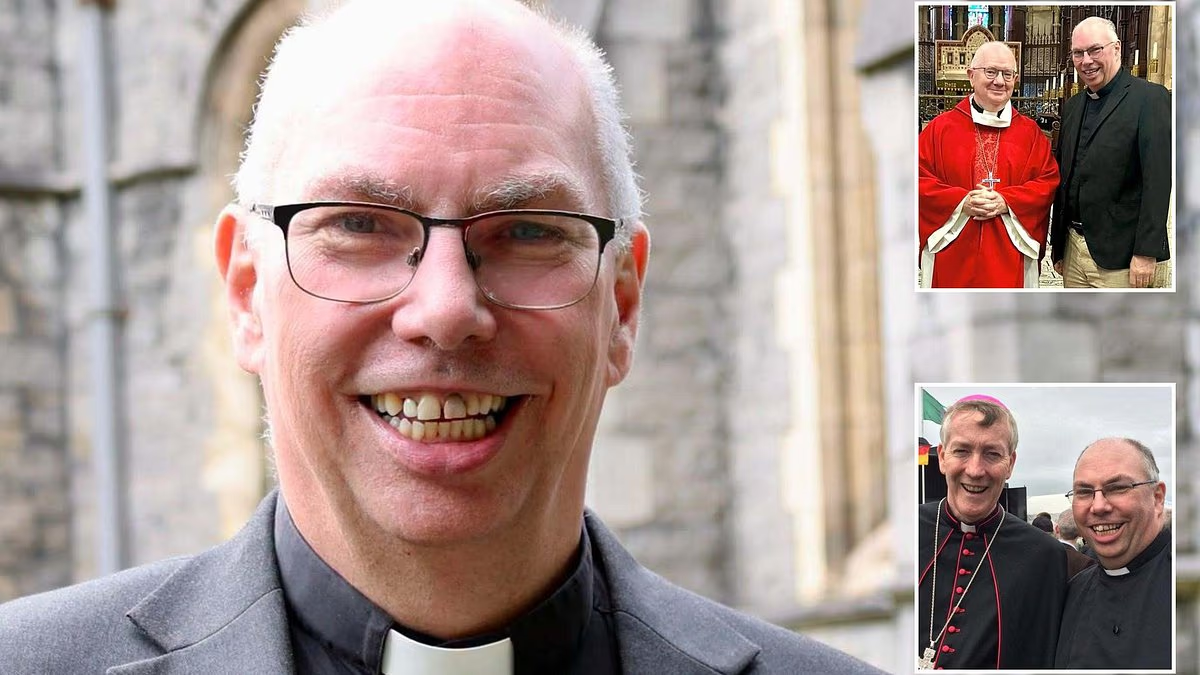
THE newly elected Church of Ireland Bishop of Cork previously admitted forging bank statements and putting €1,000 from a fund to help the poor in his own account.
A damning dossier of documents obtained by the Mail shows how bishop-elect Andrew Orr confessed to mishandling the monies between 2005 and 2007.
It also shows a litany of book-keeping errors, with money being taken from the parish’s operational account to shore up the fund, which had built up a near-€35,000 overdraft.
A similar dossier was circulated to clergy in 2022, when Rev Orr was appointed archdeacon in the diocese.
An independent audit of the discretionary fund account found that it was operated in an ‘improper manner’, but said there was no evidence that Rev Orr financially benefited from his actions.
Bishop-elect Orr was working in the Castleknock area of west Dublin as a rector during the period in question.
He was elected as the Bishop of Cork, Cloyne and Ross in June of this year, though it has yet to be made official.
A date for his consecration as bishop has not yet been set.
The financial irregularities came to light in August 2006, when a new treasurer raised questions regarding a €21,500 transfer from the parish’s main account to the discretionary fund, to which then-Reverend Orr was the only one with access.
Initially, Reverend Orr said that €11,000 of the cash had been paid for Castleknock church building work, while the €10,500 had been paid for fencing work at St Mary’s church in Clonsilla.
The discretionary fund had been established to help those in need and would typically be spent on giving people in the community some financial support, usually small sums such as €100 or €200.
It was never meant to be used for other parish work.
The typical yearly income of the discretionary fund was €5,000, which was generated from fundraising.
However, once the real accounts were laid bare, it could be seen that it had often been operating at overdraft levels of between €33,000 and €35,000.
Reverend Orr, right, with former Primate Richard Clarke
In November 2006, Reverend Orr claimed that the €10,500 was for fencing work.
However, following examination, it later emerged that the company never carried out the work and had never been commissioned to do it, the documents claim.
Minutes from a later meeting describe the supposed fencing work as ‘completely fictitious’.
This was exposed after the finance committee demanded access to the discretionary fund accounts.
Weeks after he was asked for the documents, Reverend Orr handed over what appeared to be legitimate Ulster Bank statements.
However, after examination, they were deemed to be false, something he later admitted.
The report said: ‘Just immediately prior to the December select vestry meeting, the rector passed an envelope to [the treasurer] across the table saying, “I was lucky that the bank were able to give me a print-out for the whole period from Jan 2005 to date” on the discretionary fund account.
‘Later that evening when the treasurer looked at the print-out, he ascertained due to a number of small inconsistencies, that the printout was a falsification and not a true record of the account.
‘A visit to the Ulster Bank confirmed that this was not a true print-out.
‘While the bank would not give any details of the transactions in the account, they did confirm that this print-out was not printed at any of their branches,’ the finance committee report stated.

Andrew Orr (right) with Kildare and Leighlin Bishop Denis Nulty
Minutes of a meeting, which have been seen by the Mail, said Reverend Orr ‘forged the bank logo onto a piece of paper and made up false transactions to show the DF [discretionary fund] operating correctly’.
Earlier in January 2007, the finance committee met with the archdeacon to put their questions to the rector about the account.
Reverend Orr told the assembled group he had done ‘foolish things’ but advised everyone that he had not taken any funds.
In the previous couple of days, the committee had been able to obtain copies of recently written cheques from the bank, including one written in August 2006 for €1,000 which was lodged to the rector’s own personal bank account.
The rector said that this cheque had been written from his own account as the proposed recipient had said they were reluctant to receive a cheque from the fund at any time other than Christmas.
The report added: ‘He then proceeded to give a convoluted version of events detailing how he had written a cheque (on his personal account) prior to going on holidays and left it in the parish office to be paid to the recipient in September.
‘There were also queries relating to a bank draft for €1,100 debited from the discretionary fund in December 2006, made payable to his wife and himself.
‘He explained that he could not find the discretionary fund cheque book and therefore lodged the monies to his own account and distributed the monies from there,’ it said.
After explaining the situation, Reverend Orr agreed to meet with the archdeacon to provide evidence of these two transactions.
The damning report from the finance committee to select vestries of the Church of Ireland Castleknock and Mulhuddart with Clonsilla added: ‘In relation to the €1,000 lodged to his own account, the rector claimed to “search” the Parish Office for the cheque for €1,000 to the alleged recipient, as it had never been debited out of his bank account.
‘He was aided in this search by another reverend, who discovered an envelope with a cheque for €1,000, dated in August 2006.’
Reverend Orr then met with the archdeacon and provided bank statements on his personal accounts and the cheque for €1,000 as evidence.
‘The archdeacon pointed out that this discovered cheque was in numerical sequence with recently cashed cheques on the rector’s account and therefore could not have been written in August 2006.’
The finance committee’s report reads: ‘The archdeacon asked the rector to seriously consider his position and thereafter, the rector went missing for several hours. Later the following day, the rector was admitted to St Patrick’s Hospital.’
After this investigation began, the rector paid €1,000 to a parishioner. When the recipient of the €1,000 was interviewed by the treasurer they stated: ‘At no stage (either in August 2006 or in January 2007) did they request monies from the discretionary fund.
‘They had previously accepted a cheque drawn on the discretionary fund for €450 in December 2005. At no stage did they tell the rector that they would object to receiving a further cheque drawn on the discretionary fund.
‘When they did receive the cheque in January 2007, they were so astonished that they followed the rector from the meeting and asked “Are you sure this amount is really for me?”’
In February of 2007, a statement was sent to several select vestries about what was happening. It said that ‘the rector fully admits that he has been inept and has grossly mismanaged the discretionary account resulting in this difficult task for both treasurers and the select vestries’.
It added: ‘He admits to and regrets falsifying the bank printouts but he didn’t want the members of the vestries to think he could not manage what is in effect a simple book-keeping exercise so he panicked when he realised the amount of the overdrawn balance involved.
‘Regrettably, it has to be said that there is now a complete breakdown of trust between the finance committee and the rector, due to these events which have unfolded over a period of time.’
By 2008, the Church of Ireland called an emergency meeting to vote no confidence in Reverend Orr’s leadership.
The motion was passed on September 25, 2008, with 12 votes in favour, none against and with two abstentions. Reverend Orr was informed of the decision in writing after he failed to meet with delegates over the matter.
That document stated his behaviour ‘had demonstrated a lack of respect for the formal committee structure.
‘As communications between you and Castleknock and Mulhuddart select vestry have irretrievably broken down, we will be in communication with the archbishop directly.’
A spokeswoman for the Church of Ireland said: ‘The events referred to occurred 20 years ago in the parish of Castleknock and Mulhuddart with Clonsilla.
‘They were investigated fully and resolved at the time.
‘In response to the information circulated anonymously to various individuals and media outlets, the Church of Ireland can confirm that 20 years ago, Archdeacon Andrew Orr suffered a breakdown while in ministry in the parish of Castleknock and Mulhuddart with Clonsilla.
‘Parish administration suffered as a result and the process of sorting the parish finances out included the assistance of an external accountant, commissioned by the diocese of Dublin & Glendalough.
‘The report provided assurance that the rector, who had fully co-operated with the investigation to the extent of offering access to his own personal accounts, had not misappropriated any funds for personal gain and the situation was rectified, with the Archdeacon of Dublin, David Pierpoint, exercising additional oversight.
‘On each occasion when he has been promoted since then, due diligence has been exercised in the processes followed.
‘Archdeacon Orr recovered fully and, during the two decades since, has contributed almost 20 years of fruitful ministry in two dioceses, including the diocese to which he has recently been elected as bishop.
‘It is disappointing that these anonymous allegations have been articulated despite a full investigation at the time.’
