


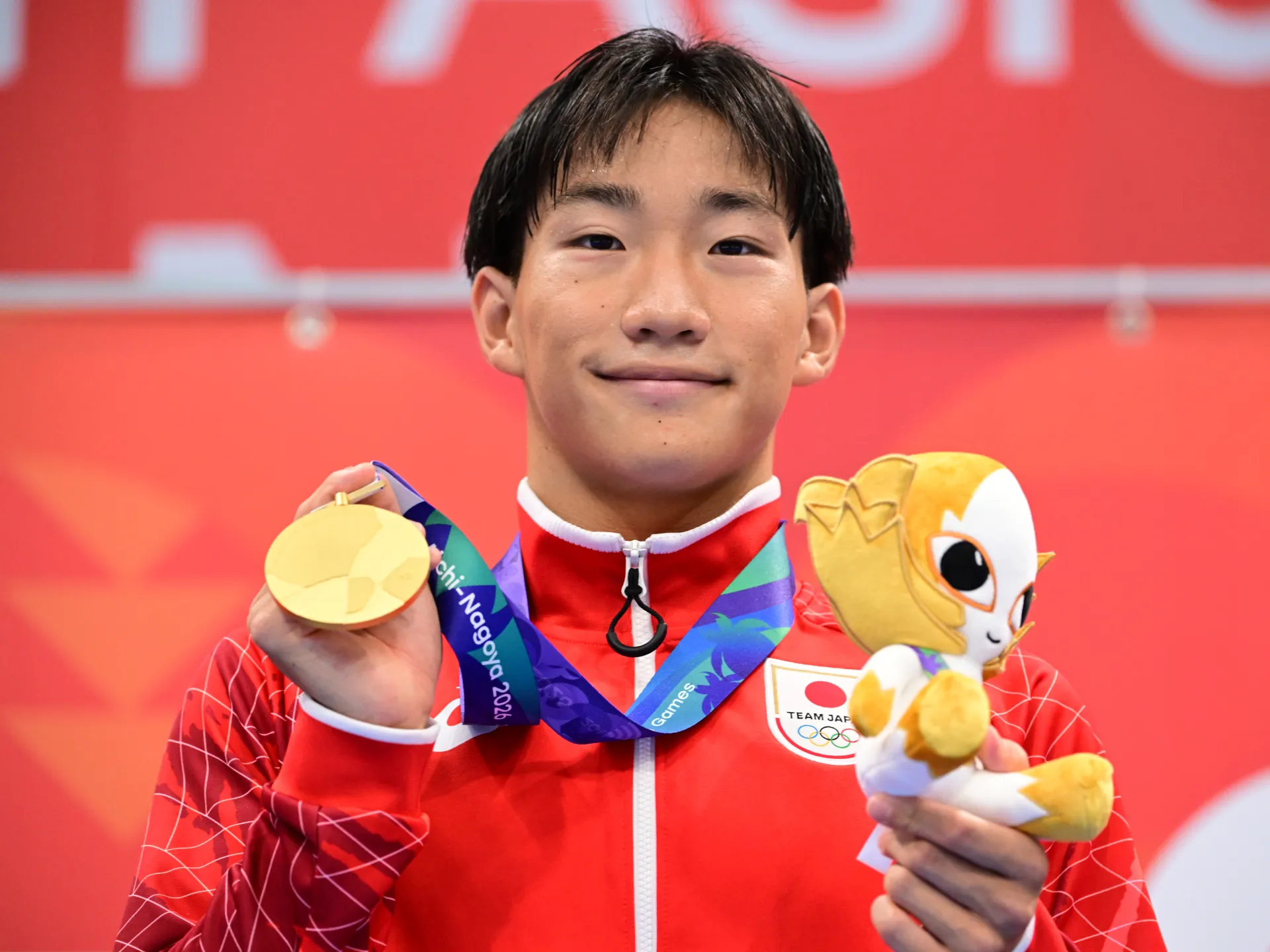
Teenage stars at the Asian Games made a striking impact in Japan, collecting historic gold medals, setting records and challenging established champions across swimming, athletics, archery, squash, skateboarding and e-sports.
Among the standout performers were China’s 13-year-old swimmer Yu Zidi, Japan’s 11-year-old e-sports champion Yuki Kurihara and a group of young athletes who arrived at their Games debut with little regard for the reputations of their older rivals.
Records and gold medals in the pool
Yu was named female Most Valuable Player after winning three swimming gold medals and breaking three Asian Games records.
She triumphed in the women’s 200 metres butterfly, 200m individual medley and 400m individual medley. Her time of 2:06.10 in the 200m individual medley was a world junior record and the second-fastest time ever recorded.
“I don’t think I am what people describe as a prodigy,” Yu said after receiving the award. “I will continue to train hard, push myself and work alongside young athletes across Asia to inspire more young people to love and take part in sports, especially swimming.”
China’s Zhang Zhanshuo, 19, emerged as another dominant figure in the pool, winning seven gold medals – the largest haul at the Games.
Zhang set Games records in the 400m and 800m freestyle and an Asian record in the 200m. He also helped China win the men’s 4x100m and 4x200m freestyle relays, both in Asian-record times.
“The Asian Games is not the goal. I’m still aiming for the Olympics and competing with the best,” he said.
China finished the swimming programme with 30 gold medals from 41 events, while Japan won seven titles.
Japan’s 17-year-old Shin Ohashi provided one of the home crowd’s defining moments when he broke the world record in the men’s 200m breaststroke. His time of 2:04.83 made him the first swimmer to go under 2:05 in the event.
Ohashi also won gold in the 100m breaststroke, sharing the title with China’s Dong Zhihao, and collected bronze in the 50m breaststroke. He added silver medals in the men’s and mixed 4x100m medley relays.
The record came only a week after Ohashi had recovered from Covid-19. He said he was surprised and honoured that Olympic champion Leon Marchand knew who he was after the Frenchman described him as a “scary” prospect ahead of the 2028 Los Angeles Olympics.
“I respect him because I know just how strong he is. But if I want to win, he’s someone I know I’ll have to beat,” Ohashi said.
Young champions in athletics and archery
China’s Yan Ziyi, 18, produced a winning throw of 70.46 metres in the women’s javelin at her Asian Games debut. It was enough for gold and a Games record, despite being her first and only attempt.
The mark was the sixth-best in history and comfortably exceeded the 62.70m throw of Olympic champion and home favourite Haruka Kitaguchi. Yan, already the world number one and Asian record holder, is closing in on Barbora Spotakova’s world record of 72.28m.
Her compatriot Chen Yujie, 17, established herself as one of Asia’s leading sprinters by winning the women’s 100m in a new Games-record time.
Chen followed that gold with silver in the 200m and victories in the women’s and mixed 4x100m relays. Asked how much faster she hoped to run, she replied: “I have no limits.”
Japan’s Taiju Goto narrowly missed out on the men’s 400m hurdles title, but his silver medal came with a world under-18 best, an Asian under-20 best and a personal best of 47.93 seconds.
The 17-year-old had run under 50 seconds eight times during the season. His Asian Games result came after he won silver at the World Under-20 Championships in August.
In archery, India’s Kumkum Mohod became the first Indian to win an individual recurve gold medal at the Games. The 17-year-old also helped India take gold in the women’s team recurve event and won mixed team silver alongside Dhiraj Bommadevara.
Mohod’s individual victory included a quarter-final win over South Korea’s reigning world champion and Olympic medallist Kang Chaeyoung, followed by a semi-final victory against China’s Zhu Jingyi.
“Ever since I’ve made it to the national team, I’ve been visualising this moment. I had visualised shooting an X, and that is exactly what happened,” Mohod said.
Milestones beyond the gold medals
Anahat Singh, 18, added a women’s singles squash silver medal for India. The world junior champion was competing at her second Asian Games, having won two bronze medals at Hangzhou 2023 in the mixed doubles and women’s team events.
Singh’s most significant performance in Japan came in the semi-finals, where she produced a comeback against Japan’s Satomi Watanabe, the world number six. Singh called it the best win of her career before losing the final to Malaysia’s world number five, Sivasangari Subramaniam.
Japan’s Yuki Kurihara made Asian Games history in the e-sports competition. At 11, he became the youngest gold medallist in the event’s history after winning Puyo Puyo Champions.
“I’m really happy. The gold medal is really beautiful, shiny and heavy,” Kurihara said after the final.
Kurihara began playing the game in his first year of primary school, where he still studies, and soon started winning tournaments. He obtained his professional licence in April and regularly competes successfully against adults, including players three times his age.
Skateboarding also produced a number of teenage medallists. Taipei’s 12-year-old Ku Yong-yan won men’s park silver with 87.33 points, while Japan’s 15-year-old Izuru Nagahara took gold.
China’s Zhu Yuanling, also 15, won the women’s street competition. Cao Shiqi, who finished fourth in the women’s park event, was the youngest athlete in China’s delegation.
Together, the young competitors provided some of the clearest evidence of a new generation emerging across the Asian Games, combining landmark victories with performances against opponents far older and more experienced.
