


The National Weather Service says at least four twisters touched down during Monday’s storms — including an EF1 with 110mph winds that tracked from Lansing into Munster, Indiana — while the search for a contractor swept into a Downers Grove storm sewer ended in tragedy
Two tornadoes have been confirmed in the Chicago area following Monday’s severe weather, with the National Weather Service rating the twister that struck Lansing, Illinois, an EF1 with peak winds near 110mph and a second in Glen Ellyn, DuPage County, an EF0. Survey teams ultimately confirmed at least four tornadoes across the forecast area, alongside damaging straight-line winds of more than 70mph in Carol Stream and Downers Grove. Around 530,000 ComEd customers lost power at the height of the two rounds of storms, which triggered tornado and thunderstorm warnings across Illinois and Northwest Indiana, and the search for a contractor swept into a Downers Grove storm sewer later ended with the recovery of the worker’s body.
Four tornadoes and winds above 70mph
Completed NWS surveys show the Lansing tornado carved a path roughly 6.3 miles long and up to 400 yards wide, damaging homes, trees and power infrastructure as it tracked across the state line into Munster, Indiana, before lifting. The Glen Ellyn tornado, which reached peak winds near 80mph, stayed on the ground for about 1.5 miles with a maximum width of around 75 yards, with damage largely confined to trees, fences and minor structural harm — consistent with its EF0 rating, according to NWS Chicago.
The two named twisters were not the only ones. Survey teams also confirmed an EF0 near Peotone, Illinois, and another weak tornado in Northwest Indiana. Beyond the tornado paths, the NOAA Storm Prediction Center logged dozens of severe wind reports across northern Illinois and Northwest Indiana, with numerous gusts measured or estimated above 70mph — straight-line winds blamed for much of the tree damage and many of the outages.
Restoring power to half a million customers
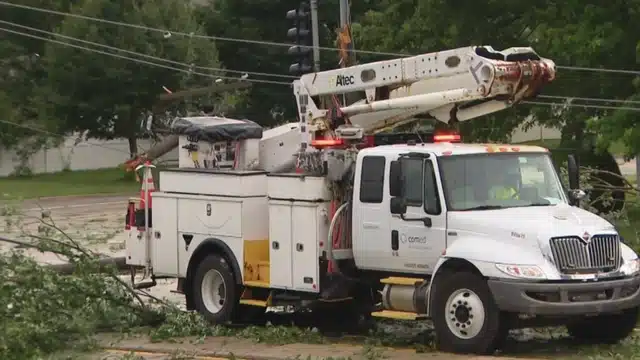
ComEd chief operating officer David Perez described the event as “a massive weather event” requiring “a multi-day restoration”, saying approximately 530,000 customers lost power in what he called an “extreme wave of weather systems”. By late Tuesday morning, more than 325,000 customers across the city and suburbs had been reconnected, with over 2,300 workers in the field — 1,200 of them drafted in from outside the area. “One customer outage is too many,” Perez said, pledging that the utility was “working around the clock to restore power to all customers safely” and “working aggressively to provide localized restoration times by the end of the day”. Customers can follow progress on the ComEd outage map, and by Tuesday evening the company reported fewer than 50,000 customers still cut off — meaning more than 90 per cent of those affected were restored within roughly 24 hours.
In Northwest Indiana, NIPSCO outages peaked at 61,000 customers before falling below 20,000 early on Tuesday, with most of the remaining problems concentrated in Chesterton and Valparaiso. The utility had not offered a restoration estimate as of Tuesday morning, directing residents to its own outage map, but later reported that nearly all customers were back on supply by Wednesday, crediting mutual-aid crews and round-the-clock repairs, with the last outages limited to isolated pockets needing significant work.
‘It only lasted 10 minutes’: south suburbs bear the brunt
Some of the worst destruction hit the south suburbs. In Hazel Crest, high winds tore through a row of townhomes, displacing dozens of residents, and officials met on Tuesday morning to assess the damage. Anthony Avenue and 171st Street suffered particularly badly, with bricks ripped from buildings, walls sheared away and one woman’s bed left visible from the pavement. The outage map showed more than three-quarters of homes in the village without power. Michael Willis, who hurried over during the storm to check on his elderly aunt — who was unharmed, though her unit was not — struggled to take in the scale of it, saying the destruction was hard to believe given that “it only lasted 10 minutes at the most”.
Nearby Lansing saw homes and roofs damaged and trees splintered, with limbs strewn across lawns and about 1,000 ComEd customers cut off in that community alone. In Steger, the fire department said the midday storm brought 80mph winds that downed power lines and trees across the village, prompting more than 40 calls for service to clear roads and deal with immediate hazards. Homewood, Flossmoor and Tinley Park also recorded extensive damage. Tinley Park resident James Bell said he spotted the storm from his window and ran for cover with his dog, reaching the bottom of the stairs as it struck: “It instantly went from how it looks now to greenish black,” he said, with debris flying past the door as they sheltered in the basement. “I never heard any sirens going off,” he added, though a tornado warning did sound on his phone.
The disruption extended to community facilities, with the Homewood-Flossmoor Park District listing closures affecting its pools, the Iron Oaks Environmental Learning Center, the Millennium Park Splash Pad, programmes at the Irwin Center and Coyote Run Golf Course. The western suburbs were not spared either: in Glen Ellyn, the storms uprooted a tree during a tornado warning and sent it crashing onto a home more than 100 years old.
Shelters open as displaced families take stock
The American Red Cross is assisting people affected in Lake, Will and southern Cook counties, opening shelters in Steger to the south and Gurnee to the north where anyone in need can find food, charge devices and access community resources. A Red Cross employee said 21 people displaced by Monday’s storms were staying at the Steger shelter, among them Aaliyah Mcphearson of Hazel Crest and her two young children. Her mobile phone footage showed an HVAC unit dumped on the lawn, roofing tarp draped down the side of a building and large sections of the structure blown into the car park, wrecking many of the vehicles there; she said instinct took over as she grabbed her children and fled downstairs.
Her boyfriend, Shewond Gibbs, recalled how quickly it escalated. “The storm came out of nowhere,” he said, describing light rain, then sirens, then “things just started going through the window, stuff started caving in”. He admitted he had not slept, letting his family rest while “trying to think what’s going to go on” and how they would recover their home. The Steger Fire Department, meanwhile, urged residents to treat every downed power line as live and dangerous, and warned anyone running a portable generator to keep it outside in a well-ventilated spot to avoid carbon monoxide poisoning.
Worker’s body recovered from storm sewer
The storms also turned deadly in Downers Grove, where two contractors were swept into a storm sewer near Curtiss and Washington streets in the downtown area on Monday afternoon. Crews from at least half a dozen west suburban fire departments entered the system in search of the pair, and around 3pm neighbours filmed one contractor being wheeled to an ambulance after a two-hour operation — found some 200 feet from where he entered, and taken to Advocate Good Samaritan Hospital in good condition.
Rushing water forced teams to abandon the hunt for the second worker on Monday night as conditions became too dangerous, and by Tuesday morning officials had reclassified the effort as a recovery operation. The Village of Downers Grove said the search would resume once it was safe, and the Daily Herald later reported that the worker’s body was recovered after water levels dropped enough for crews to re-enter the system, with the DuPage County Coroner identifying the victim and ruling the death accidental. Resident Mike Lane likened the ordeal to the 2018 rescue of a youth football team from Thailand’s Tham Luang cave: “I thought this was going to be like a movie or something,” he said. “It is like the scariest thing ever.”
As the clean-up continues, the Illinois Emergency Management Agency said it is coordinating damage assessments with local governments to establish whether any communities qualify for state or federal disaster assistance, with preliminary evaluations carrying on after the storms cleared the region.
