


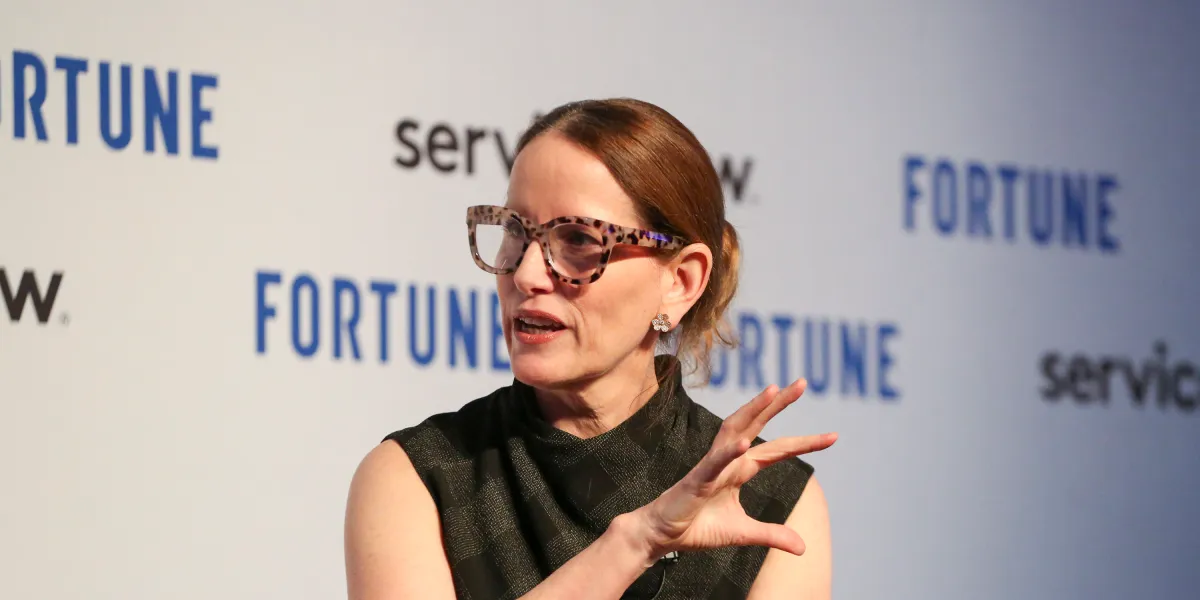
Companies leading in artificial intelligence are being separated from other organisations less by their technology than by investment in people, training and operational discipline, according to Diana David, ServiceNow’s director of futures.
Speaking at Fortune’s AIQ Summit, David said the biggest gap identified in ServiceNow’s Enterprise AI Maturity Index was talent investment. Some 57% of the organisations classed as “pacesetters” provide ongoing AI upskilling, compared with 4% of other organisations.
The difference is even wider when it comes to attracting, hiring and retaining AI talent: 68% of pacesetters do so, against 10% of the rest.
“It’s really operational discipline, right?” David said. “It’s not just technology, operational discipline, and transformation.”
Pacesetters account for roughly 21% of the organisations surveyed and scored more than 60 on the index, with an average score of 74. The remaining organisations averaged 45.
The leading group was also more likely to be building unified data systems, with 64% on that path compared with 14% of other organisations. Around 57% had a clear and strong AI vision, against 21% elsewhere.
AI leaders focus on redesigned workflows
Autonomous, multi-step workflows remain relatively uncommon. While about 59% of companies surveyed have moved beyond the pilot phase, only 9% are using workflows that operate without human checks at every stage.
Among the pacesetters, that figure rises to 36%, compared with 2% of other organisations. David said these systems extended beyond isolated uses, rather than being applied to “just one little point of sale”.
She criticised what she called the idea of “AI adoption for everyone”, saying broad access to tools did not necessarily produce better performance. “95% of everybody has X, Y, Z,” she said. “But it is not translating into productivity, and it’s often not with training, and that doesn’t equal maturity.”
Jeremy Kahn, Fortune’s AI editor, said many businesses had initially supplied employees with AI tools and allowed widespread experimentation before concluding that the approach was too expensive and had delivered no productivity gains. Some are now concentrating on particular uses, while others have inserted agents into existing workflows or replaced an employee with one.
David said successful adoption needed to begin with senior leadership, followed by a clear vision for change and training tailored to AI and specific functions. Executives should consider how a process would be designed from scratch, rather than adding AI to an old or broken system.
“I think it starts with leadership,” she said, describing the need for “growth mindset, an idea, and a vision for change of what the company can become, followed with specific training around AI and specific functions.”
She acknowledged that the pace of technological change could make businesses reluctant to redesign their processes. Her proposed approach was to establish a vision, align data, select workflows, assign responsibility and continue to iterate, rather than attempt an immediate organisation-wide overhaul.
According to the index, 59% of organisations do not have long-term human resources plans for AI, while 42% of employees say they are not receiving enough training. The average return on investment reported by pacesetters was 160%.
The companies making progress are spread across the economy. Technology businesses accounted for about one in five places on Fortune’s AIQ 75, followed by financial services. Construction and engineering accounted for six places, while food and healthcare each had five.
The index’s average score has fluctuated since it began in 2024. It fell from 44 to 35 before recovering to 51 this year, a decline David attributed to AI generating widespread attention before delivering measurable value for businesses.
ServiceNow plans to add agentic AI to the AIQ next year. The assessment will examine what organisations are deploying, where it is being used and whether they are achieving commercial value, which David said would provide a better measure of business maturity than simply having AI tools available.
