


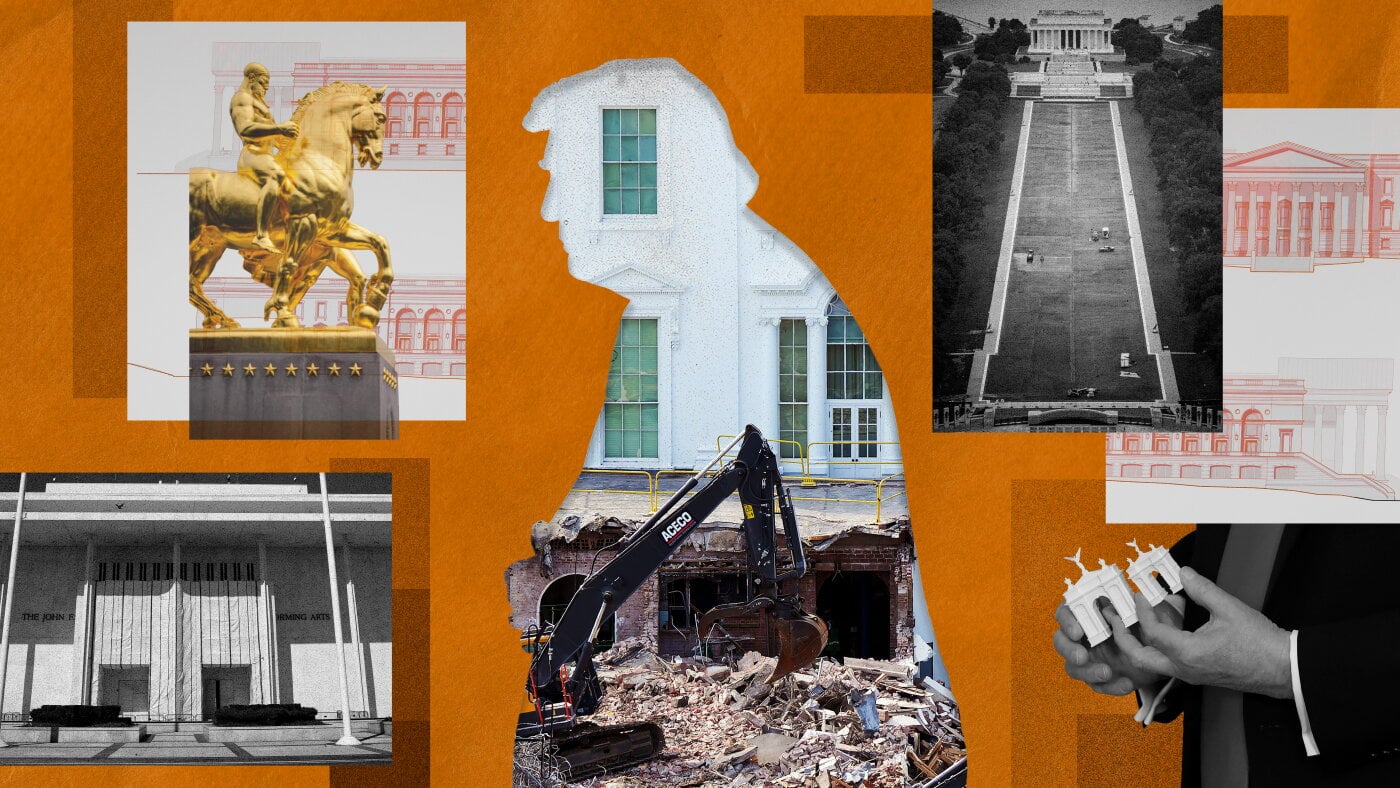
Donald Trump’s drive to reshape Washington has prompted lawsuits, protests and widespread public opposition, while historians and legal experts warn that the president is treating the capital’s landmarks as if they were his personal property.
During his second term, Mr Trump has overseen plans for a vast White House ballroom after demolishing the East Wing, installed a helipad on the South Lawn and paved over the Rose Garden. Work to resurface the Lincoln Memorial Reflecting Pool in what was described as “American flag blue” has also run months behind schedule.
The president has described himself as the “builder-in-chief”, telling reporters in May: “The best thing I do in life is build.” His administration says the projects will improve the White House and the nation’s capital for future generations.
But critics say the programme reflects a desire to secure a personal legacy rather than preserve the historic character of Washington. Greg Werkheiser, whose law firm Cultural Heritage Partners is involved in several lawsuits against the projects, said Mr Trump’s sense of self-worth appeared to be closely tied to his image as a developer.
Mr Trump has also backed plans for a sculpture garden dedicated to “national heroes” in West Potomac Park and wants to transform the locally popular East Potomac Golf Links into a championship-level course.
He has sought to add his name to the Kennedy Center, or have the building demolished, and is attempting to fast-track a proposed 250-foot arch near Arlington Memorial Cemetery. The project was initially presented as a monument to Mr Trump himself before being rebranded as a military complex.
A White House spokesman, Davis Ingle, said the president could “walk and chew gum at the same time”, arguing that he was delivering on campaign promises while ensuring the capital was “properly glorified” and maintained.
“Thanks to the Builder-in-Chief, no other president has done more to beautify our Nation’s interior than President Trump,” Mr Ingle said.
Trump’s Washington construction projects
Mr Trump has linked many of the schemes to preparations for the United States’ 250th anniversary. Yet he has also acknowledged that his efforts are intended to shape how he is remembered.
“Nobody will do it once I’m gone,” he said in a recent interview. “When I leave here, nobody will.”
Tim Naftali, a historian at Columbia University, said there was a distinction between a president acting as a builder and one behaving as an owner. “The president of the United States does not own the United States,” he said. “The president of the United States doesn’t even own the White House.”
Previous presidents had altered or renovated the White House, Mr Naftali said, but generally acted as custodians and sought congressional authorisation and funding. Mr Trump has not done so for his construction projects, despite Republicans controlling both chambers of Congress.
Mr Naftali said the building programme was a symptom of a wider belief that Mr Trump alone represented the federal government. He warned that the approach could establish a precedent for future presidents and weaken the separation of powers.
Charles Birnbaum, founding president of the Cultural Landscape Foundation, which sued over the reflecting pool, said historic standards and established conventions were no longer being applied. He also criticised the appointment of non-expert allies to federal arts panels responsible for reviewing construction in Washington.
“All of these proposals that we’re seeing, what they have in common is they’re not preserving and protecting. They are destroying, diminishing, altering,” Mr Birnbaum said.
A long-running dispute over Trump’s development record
Questions about Mr Trump’s approach to historic preservation date back to his early career in New York. Barbara Res, who ran construction for the Trump Organization in the 1980s, said he was a developer rather than a builder, making high-level decisions while sometimes intervening in technical details.
She recalled that he had pushed for measures such as reusing old heating and ventilation equipment in new ductwork to reduce costs. “When we were doing the work, he didn’t really know much about construction,” she said.
One of the most prominent controversies involved the Bonwit Teller department store on Fifth Avenue, which Mr Trump bought in 1979 before demolishing it to make way for Trump Tower.
Penelope Hunter-Stiebel, then a curator at the Metropolitan Museum of Art, tried to save two 15-foot limestone sculptures and an art deco metal grille from the building’s façade. She said an agreement had been reached with the Trump Organization, but that the grille disappeared and demolition crews later destroyed the sculptures.
Mr Trump’s organisation said at the time that carefully removing the sculptures would have cost more than their estimated value and delayed demolition. Ms Res later said Mr Trump had given her a different account, claiming the Metropolitan Museum had declined the works.
The incident was followed decades later by a $1.375 million settlement of a class-action lawsuit concerning undocumented Polish labourers involved in the demolition.
Ms Hunter-Stiebel described the episode as Mr Trump’s first experience of the power that came with being a major developer. She said she feared the same pattern was now being played out on a much larger scale in the US capital.
Mr Naftali said presidents had traditionally pursued memorials to earlier leaders rather than monuments to themselves. Franklin Roosevelt, he noted, wanted only a small granite marker bearing his name, while his administration helped create the Jefferson Memorial.
The dispute over Mr Trump’s projects therefore extends beyond individual buildings, monuments and construction delays. Critics say it raises a broader question about whether the White House, Congress and the country’s historic sites can remain subject to constitutional checks while a president seeks to make his mark on them.
