


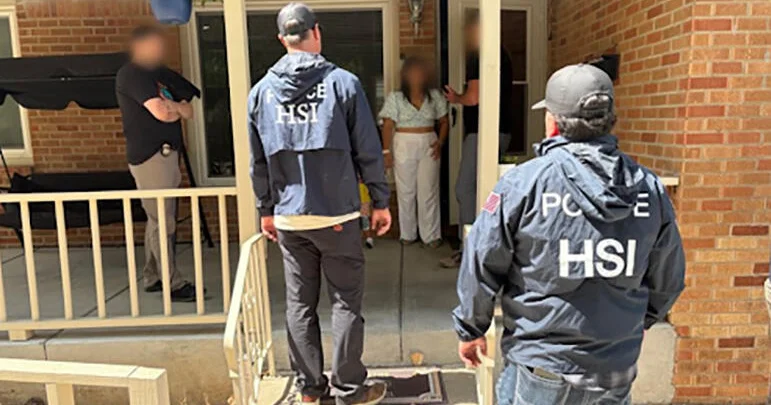
Armed federal agents have been visiting homes in several US states to question residents about their immigration status and whether they have registered to vote or cast ballots, as part of a Homeland Security operation targeting suspected non-citizen voters.
The door-to-door campaign has intensified during the midterm election season, with visits continuing into the past weekend. Homeland Security Investigations (HSI), an enforcement arm of Immigration and Customs Enforcement, has deployed agents to locations including California, Georgia, Missouri, Pennsylvania, Washington and Wisconsin.
The Department of Homeland Security has claimed that as many as 250,000 non-citizens could be illegally registered to vote, although election experts have disputed the accuracy of that estimate. Since the beginning of the Trump administration, 156 people have been charged with voting-fraud-related offences, according to the Department of Justice.
Critics have warned that the presence of armed officers at private homes could intimidate lawful voters and discourage them from taking part in elections.
“What we’re seeing now is the federal government is inserting itself into the state process for verifying their voter roles in an unprecedented way,” said Jessica Marsden, a lawyer for Protect Democracy, which is suing the federal agency over the visits.
She said the operation appeared “maximally designed to scare lawful voters from participating”.
The Justice Department said HSI agents in California had arrested more than 20 people, all green card holders, over allegations that they had illegally registered or voted. In one case, dozens of agents went to the home of a 72-year-old man from Belize, who was arrested in his pyjamas over claims that he had voted illegally in four previous elections.
A DHS spokesperson said the agency was “actively rooting out and investigating election fraud wherever it can be found”. The department said it was committed to ensuring that “American citizens and only American citizens are electing American leaders”.
Eric Balliet, a former HSI agent who served under several administrations, said the home visits represented a significant departure from the agency’s usual work.
“In my 23 years with HSI, I never engaged in or was aware of any incident of initiative that sent Special Agents to private residences to verify the eligibility of voters,” he said.
Homeland Security voter investigations
Internal documents show that hundreds of agents were reassigned from other cases to investigate alleged non-citizen voters under a “surge” initiative. The work followed a June directive ordering ICE to assist with the deportation of people accused of voting while not being US citizens.
Images and videos posted by HSI accounts show agents knocking on doors, with some carrying firearms. One photograph from Kansas City showed four agents at the home of a woman standing on a porch holding a child’s hand.
The woman was identified by the Justice Department as Mariana Alexandra Dewey, a Peruvian national charged with four voting-fraud-related offences, including allegedly casting a ballot in the 2024 election. Her case has not yet been heard.
In one video, agents appear to hold a document labelled “Target List”. An HSI agent familiar with the operation said the lists were compiled using internal databases, voter rolls and other datasets, with names matched against citizenship information from US Citizenship and Immigration Services.
A whistleblower said USCIS employees had been asked to review voter information relating to tens of thousands of people, including citizens, at a rate of 40 subjects a day. DHS denied that the work was rushed or subject to a quota on criminality.
“There is no quota on criminality. DHS will pursue each and every illegal voter to the fullest extent of the law,” a spokesperson said.
Protect Democracy said the process risked producing large numbers of false matches. Ms Marsden cited an earlier case in Nevada, where Homeland Security officials initially said they had identified nearly 16,000 non-citizens on voter rolls but were ultimately unable to provide evidence of a single illegally registered voter.
DHS said that people who were in the US legally and had not broken other laws “have nothing to fear”. Civil rights advocates have nevertheless warned that the operation could deter naturalised citizens and other lawful voters from going to the polls.
