


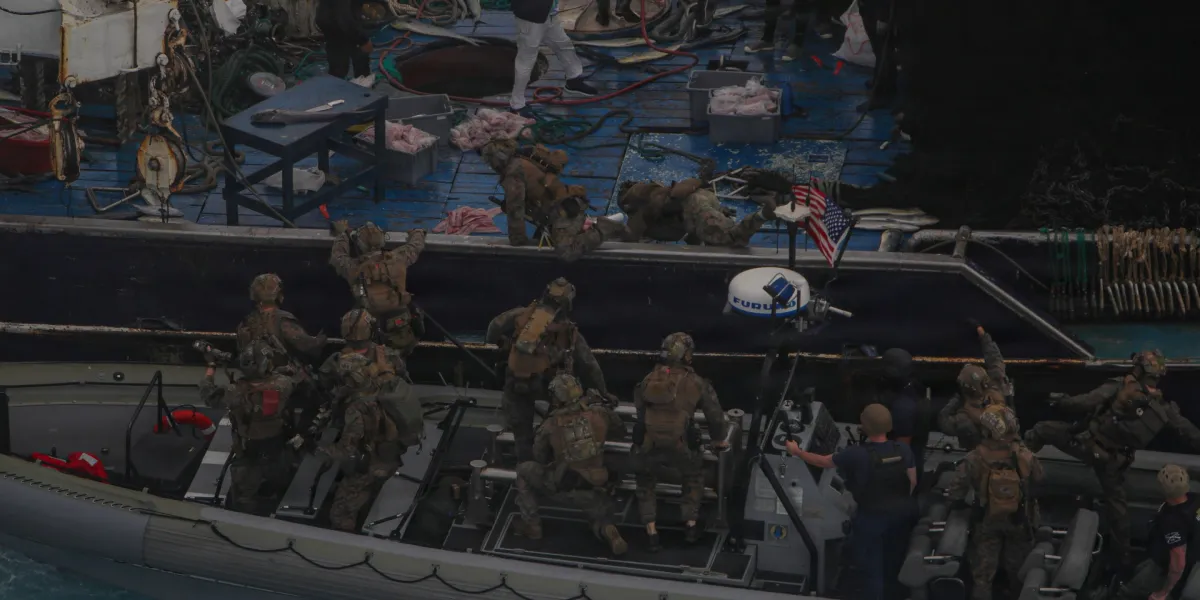
Three seized Iranian oil tankers carrying almost six million barrels of crude are heading towards the United States after being intercepted by naval forces during the blockade imposed by President Donald Trump.
The Tifani and Majestic X are now off the coast of Brazil, having been boarded in the Indian Ocean in April. A third vessel, known as the Lenore and also as the Davina, has passed the Cape of Good Hope and is travelling west into the Atlantic after being intercepted in June.
Each ship is a very large crude carrier capable of transporting up to two million barrels. With Brent crude trading at about $106 a barrel, the cargoes have a combined value of nearly $600 million.
“Nearly six million barrels (valued at nearly $600M) of seized Iranian crude oil are quietly crossing the Atlantic Ocean towards the United States of America,” Tanker Trackers said in a post on X.
The US naval blockade began in April and targeted vessels attempting to enter or leave Iranian ports, as well as Iran-linked ships operating anywhere in the world, including the Indian and Pacific oceans.
A brief ceasefire led to the blockade being lifted over the summer, but Mr Trump reinstated it several weeks later as his administration shifted towards economic pressure rather than military strikes.
Prize law and the seized Iranian oil tankers
The legal mechanism being used to pursue the seizure and forfeiture of the tankers is known as prize law, an ancient body of maritime law with roots in the Middle Ages.
Unlike civil seizure proceedings, which require the US government to identify a statutory breach and establish jurisdiction, prize law does not require a warrant or demand that a seizure be linked to an existing statutory violation.
It allows the Defence Department to seize an enemy vessel, rather than relying on law-enforcement bodies such as the Coast Guard to act under civil seizure laws.
In the United States, prize law is reflected in the Constitution’s Captures Clause, which sets out rules for capturing and confiscating enemy vessels during wartime. Abraham Lincoln used the Prize Act of 1812 to blockade Confederate ports during the American Civil War, while the law was most recently invoked during the Spanish-American War.
If the tankers reach an American port, they are likely to be brought to the Texas coast, home to major oil refiners and the US Attorney’s Office for the Southern District of Texas in Houston.
The office, led by Aaron Reitz, has said it is prepared to represent the United States in federal court proceedings over prizes brought to Texas.
Mr Reitz has not said whether the Justice Department will rely on the Prize Act of 1812, the Captures Clause or another legal authority.
“Our national security interests may require the United States military to seize vessels or cargo supporting the enemy during military conflict,” he said. “If that happens, our federal courts must be ready to adjudicate the disposition of these captured vessels and cargo.”
He added: “Prize law is an ancient body of maritime law—already codified in statute but which we are now reviving—that sets the rules for how seized maritime property is condemned, returned, or disposed of.”
