


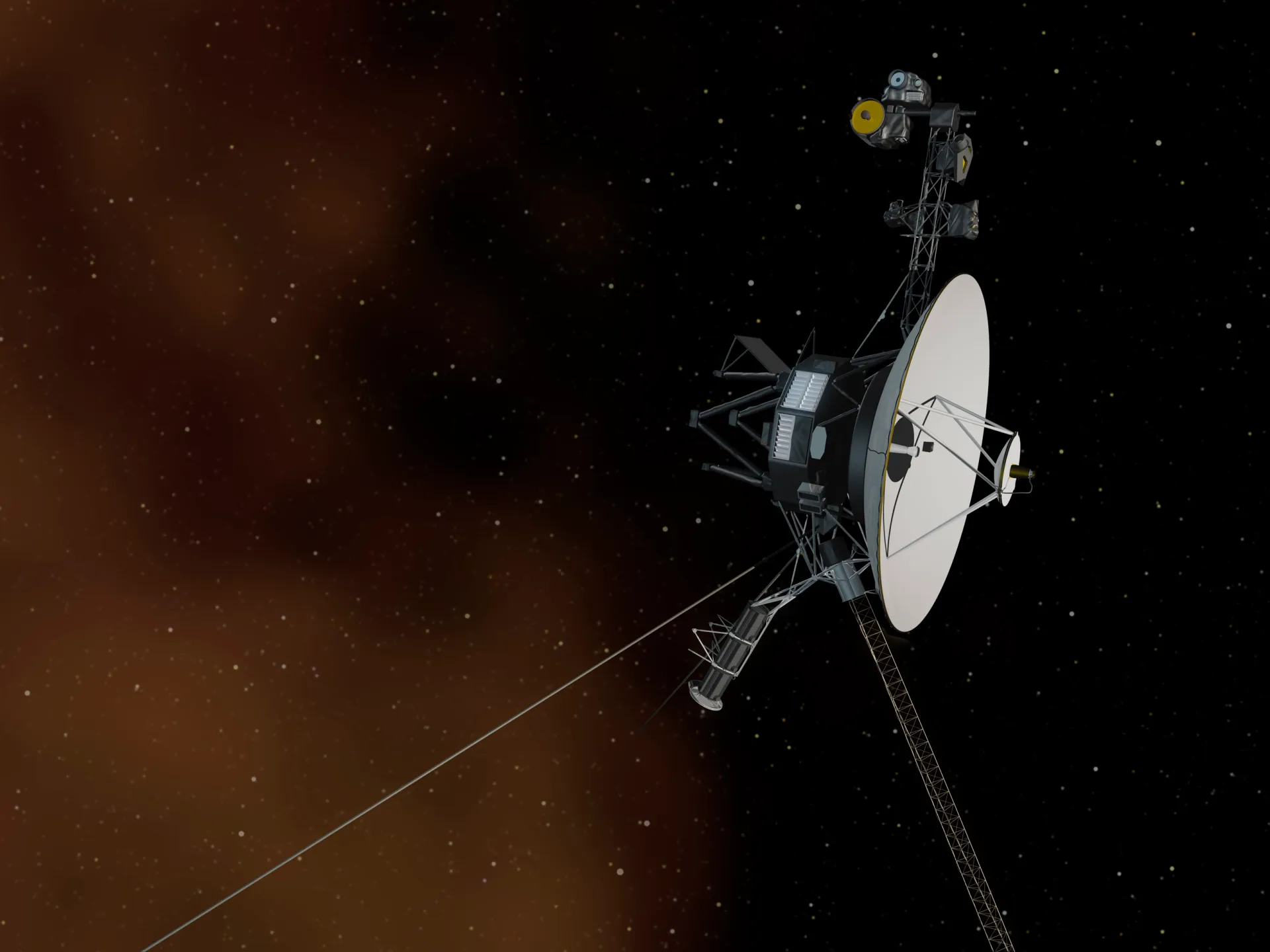
NASA’s Voyager 1 probe is due to become the first human-made object to travel one light-day from Earth, marking a milestone for the spacecraft nearly five decades after its launch.
The probe is expected to reach the distance on Wednesday, having travelled at least 16 billion miles since it was sent into space in 1977. One light-day is the distance light covers in 24 hours.
Voyager 1 completed its Saturn flyby in 1980, bringing its main planetary mission to an end. It is now travelling through interstellar space at roughly 36,000 miles per hour.
Despite its age, the plutonium-powered spacecraft continues to send daily readings to Earth. Its data includes measurements of the strength and direction of the magnetic field, pressure, dust and galactic cosmic rays.
Voyager 1 continues mission with limited NASA team
NASA estimates that Voyager 1 would need 18,000 years to cover a full light-year, and twice that time before it came close to another star.
The spacecraft is maintained by a small team of NASA engineers, who send commands about once a week and more frequently when problems arise. Communication was briefly lost in October, and the team has not yet established what caused the failure.
Voyager 2, launched shortly after its sister probe, is expected to reach the one-light-day distance from Earth in 2035. Both spacecraft continue to relay information from beyond the solar system.
Suzanne Dodd, Voyager 1’s project manager, has described the probe as “a national treasure” and compared the work carried out by the two spacecraft to the role of weather satellites.
Voyager 1 has also had a lasting cultural impact. In 1990, it captured the image known as the “Pale Blue Dot”, showing Earth as it travelled away from the planet.
Bill Nye of the Planetary Society said: “All of us — everyone on Earth — have been touched by these missions.”
