


Perth Racing’s 2026 spring racing season is set to put fashion firmly in the spotlight, with Ascot Racecourse preparing for five Saturdays of racing, a $10 million prize pool and a new home for Fashions on the Field.
The Pinnacles Carnival begins next Saturday with Champion Fillies’ Day, an event Perth Racing chief executive James Oldring said was a fitting setting for the fashion competition because it celebrated female equine excellence.
“With our biggest prize pool to date, I have no doubt the standard of stylish entrants will be spectacular,” Mr Oldring said.
The day marks a shift for the competition, which has traditionally been associated with the racing calendar’s most prominent events. It also comes as racegoers embrace a more individual approach to dressing, with bold silhouettes, sculptural millinery and clothes designed to be worn beyond the track expected to feature prominently.
Spring racing fashion moves beyond the fascinator
Headwear remains central to race-day style, but fashion advisers say the traditional last-minute fascinator is losing ground to more deliberate designs.
Emma Daley, associate buyer at Elle Boutique, has identified the pillbox hat, famously associated with Jacqueline Kennedy, as one of the season’s leading choices. She suggests updating the shape with details such as tulle veils, tassels, brooches or feathers.
Claremont Quarter fashion director Teagan Sewell is also backing proper hats, particularly raffia styles and intricate woven designs. At the more theatrical end of the market, she points to British milliner Stephen Jones as an example of how headwear can become an artwork in its own right.
Ms Sewell, who has previously worked as Myer’s national travelling stylist and judged Fashions on the Field, said the strongest outfits often included something personal.
“I always gravitated towards entrants who brought something personal: an element they’d made themselves, a hat developed with a milliner or a piece customised by a dressmaker,” she said.
Her comments reflect a broader change in racewear, with individuality increasingly valued alongside polish. The strict expectations once attached to the racecourse have softened considerably since the early days of Fashions on the Field.
The competition was introduced by the Victoria Racing Club in 1962 in an effort to attract more women to Flemington. At the time, women’s racewear was expected to include headwear, stockings, gloves and modest hemlines, while men were generally required to wear tailored suits, polished shoes, ties and classic hats.
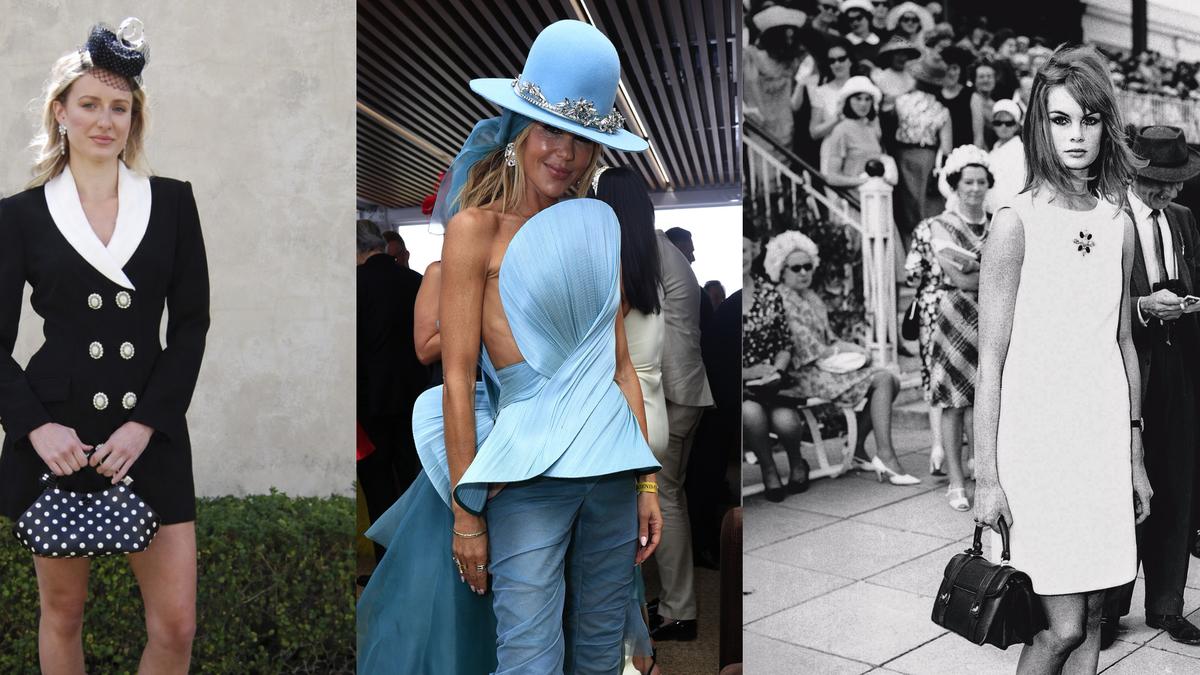
Those conventions were dramatically challenged three years later when model Jean Shrimpton attended Flemington in a sleeveless white minidress that sat 10 centimetres above the knee. She wore no gloves, stockings or hat, prompting widespread criticism and earning the outfit the description “the dress that stopped the nation”.
The look later became associated with the arrival of the miniskirt in Australia, a reminder that race-day fashion has often been a place where established rules are tested.
Bold shapes and colour take centre stage
This year’s advice is less about following a single formula than creating impact through proportion, texture and colour. Ms Daley highlights dramatic tailoring and fabric manipulation, including Melbourne designer Toni Maticevski’s strapless ivory Marigold Fringe dress.
Other options include an oversized blazer worn as a minidress, where dress codes allow, or a three-piece suit finished with an exaggerated silk bow. Carla Zampatti tailoring, along with the architectural shapes associated with Rebecca Vallance and Aje, are among the suggested sources of inspiration.
Cinched waists, peplum details and polka dots are also being paired with sharper tailoring. Ms Daley points to Self-Portrait’s black tailored blazer minidress as an example of a look that can be made distinctive with a striking bag.
Colour is expected to range from cornflower blue, icy pink and buttery yellow to chocolate brown, cobalt and tomato red. Stylist and fashion jewellery designer Bridget Hudson said the racing season, apart from Derby Day, offered an opportunity to be more adventurous with colour.
Tonal dressing remains an option, while more daring combinations include powder blue with red, chocolate with buttery yellow, and chartreuse with violet. Ms Sewell has suggested pink with red or green with blue, while Bright Tomato has been identified as an inspiration for a head-to-toe look or a smaller accent in shoes or millinery.
For those reluctant to commit to a vivid outfit, a red accessory or a pastel look finished with a stronger detail can provide a less demanding way into the trend.
On footwear, pointed pumps remain a dependable choice, while sculptural heels, jewelled mesh slingbacks and subtle shimmer can bring more personality to a monochrome outfit.
Texture, accessories and clothes with a longer life
Texture is set to play an important role alongside colour, with organza, feathers, fringe, embroidery and beading all offering ways to add interest without relying on excessive decoration.
Ms Hudson expects sheer details and feather trims to soften tailoring, while Ms Sewell favours the contrast between woven raffia and structured clothing. Designer Jana Kachel is backing bold colours, playful prints and feminine silhouettes, while OnceWas founder Belinda Abbott has highlighted flowing shapes, botanical prints and delicate embroidery.
Accessories are not being treated as an afterthought. Satin, faux fur, shells, feathers, raffia and beaded handbags can provide a focal point for a relatively simple outfit, with contrasting textures often more effective than matching a bag precisely to the shoes.
Ms Hudson recommends choosing jewellery with a clear role rather than adding every possible piece.
“I only add jewellery if it contributes to the look – every accessory should have a purpose,” she said.
For men, the advice is to look beyond the conventional navy suit. Linen-blend tailoring and relaxed separates in chocolate, olive, burgundy, bone or powder blue can be paired with a pocket square, tie pin or brooch, while dark brown leather shoes provide a considered finish.
Sunglasses should receive the same attention as the rest of the outfit, although racegoers have been advised to check enclosure dress codes before deciding whether to leave out a tie.
The emphasis on considered purchases also extends to sustainability. RMIT University fashion academic Dr Rashmita Bardalai said rental fashion, resale, vintage clothing and outfit repeating were becoming more important as shoppers considered affordability, sustainability and the longer-term value of what they bought.
“Rather than treating style and sustainability as competing priorities, many consumers are finding ways to achieve both,” Dr Bardalai said.
Nicole Adolphe, head of style at The Iconic, said shoppers were increasingly looking for pieces that could be worn at weddings, summer celebrations and other occasions after race day.
She recommends beginning with a statement dress featuring an unusual neckline, bold colour or interesting texture, or choosing a matching set such as a tailored blazer and skirt. A sculptural earring, distinctive clutch or piece of headwear can then complete the outfit.
Comfort is also a consideration for racegoers spending several hours on their feet, with wedges, block heels and, where dress codes permit, ballet flats offering alternatives to delicate high heels.
Perth Racing is adding a charitable element to the season’s focus on reuse through its Pass the Hat initiative. Racegoers are being encouraged to donate pre-loved hats and fascinators, which will be sold on Champion Fillies’ Day to raise funds for Telethon and support children in need in Western Australia.
For Ms Sewell, the most successful race-day outfit is ultimately one that feels authentic and can be worn again.
“Above all, choose pieces you can see yourself wearing again and bring enough of yourself to the styling that the outfit feels lived-in and your own,” she said.
