


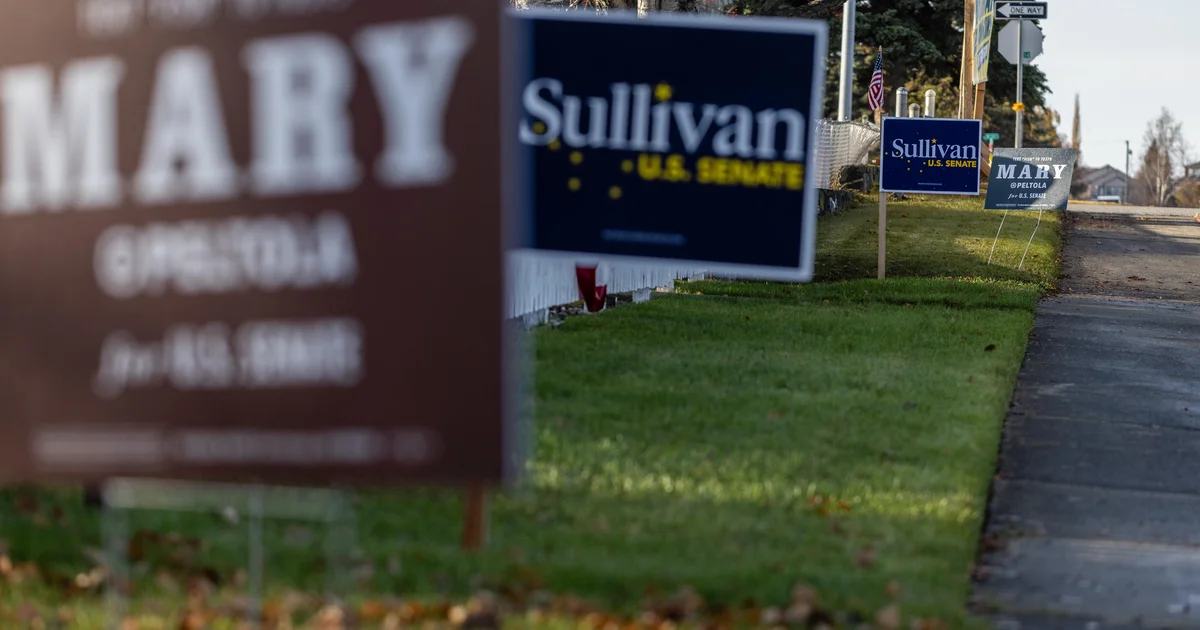
Alaska’s Senate race has been thrown into fresh turmoil after the state’s Republican governor ordered an investigation into claims that people linked to Mary Peltola’s campaign helped recruit a second candidate named Dan Sullivan to confuse voters.
Governor Mike Dunleavy acted after reporting alleged that a Democratic operative who had worked with Peltola’s campaign and national Democrats encouraged Daniel J. Sullivan to enter the contest against Republican incumbent Dan S. Sullivan.
Peltola has denied involvement, calling the allegations “just another distraction” during a campaign stop. The Democratic Senatorial Campaign Committee also said it was “not involved with Dan J. Sullivan”.
The controversy has intensified an unexpectedly close contest in a state won by Donald Trump by double digits in 2024. The second Sullivan, who is also a Republican, secured 2.5% in August’s top-four primary.
Why are there two Dan Sullivans on the Alaska ballot?
Alaska introduced a non-partisan primary and ranked-choice general election in 2022 after voters approved the new system in 2020. The changes were intended to reduce the influence of party primaries and limit political polarisation.
Four candidates are contesting the Senate seat: Daniel J. Sullivan, incumbent Dan S. Sullivan, fellow Republican Gerald Heikes and Democrat Mary Peltola.
Voters can rank as many or as few candidates as they choose. If nobody receives more than half of first-choice votes, the lowest-placed candidate is eliminated and their supporters’ votes are redistributed according to their next preference until one candidate has a majority.
Peltola led the primary with 49.5%, followed by Senator Sullivan on 41.4%. Daniel J. Sullivan finished third.
Daniel J. Sullivan is a retired teacher from rural Alaska. He announced his candidacy in June and has rejected accusations that he is a sham candidate, saying he genuinely wants to run for the Senate.
Alaska elections director Carol Beecher initially ruled that he should not appear on the ballot, saying there had been a “determined effort and a deliberate attempt” to confuse voters.
Beecher said Daniel J. Sullivan had at one stage tried to register simply as “Dan Sullivan”, despite not having previously voted under that name. She also said he sought to use “S” as his middle initial, matching the incumbent, and that the two campaign websites appeared similar.
However, a judge overturned the decision, ruling that the state did not have the authority to determine whether a candidate was standing in good faith. Alaska’s Supreme Court upheld that decision, allowing both names to remain on the ballot.
The ballot lists Daniel J. Sullivan as “Sullivan, Daniel J. Jr.” without a party affiliation. The incumbent appears below him as “Sullivan, Dan S. (Registered Republican) Incumbent”. Republicans have nevertheless been warning voters not to confuse the two candidates.
The party has used a radio jingle urging voters: “Dan S., Daniel, Gerry – just don’t rank Mary!”
Investigation and legal challenge
Mr Dunleavy said the reported recruitment effort raised questions about whether Alaska’s election laws had been breached. He directed the Department of Public Safety to examine whether criminal charges or civil action were justified.
“Today’s New York Times reporting reveals disturbing new evidence of an organized effort to manipulate Alaska’s elections by recruiting candidates — including one with the same name as an incumbent US Senator — to deliberately confuse voters and misdirect their votes,” he said.
Senator Sullivan’s campaign said Alaskans “deserve the truth”, while spokesman Nate Adams accused Peltola and her campaign of “gaslighting Alaskans” and denying a scheme they had allegedly been running.
The New York Times report described the effort to encourage Daniel J. Sullivan as part of a broader attempt to attract more candidates to the race. Peltola’s campaign has denied helping to put him on the ballot.
The dispute has also drawn intervention from the Trump administration. The Justice Department has filed a lawsuit seeking to challenge certification of the result if the incumbent loses because voters unintentionally selected the other Sullivan.
Attorney General Todd Blanche said the department was not asking the state simply not to certify the election. He said that if a court found the result had been determined by voter confusion rather than the electorate’s wishes, the election should not be certified.
Donald Trump said Peltola should not be allowed to run, describing the alleged conduct as “ELECTION FRAUD”. Peltola’s campaign called the Justice Department action “a despicable political threat to overturn an election”.
Alaska’s other senator, Republican Lisa Murkowski, opposed the lawsuit, saying the state ballot had clearly distinguished between the candidates. But after the reported revelations, she said Alaskans deserved “the honest truth” from Peltola and her campaign, describing the allegations as a “pattern of lies and coverups”.
Election law expert David Becker said Alaska’s courts had already considered whether the ballot arrangement involved wrongdoing and ruled under state law. He said the Justice Department lawsuit had “almost certainly” no legal basis to stop certification and that voters would still decide the Senate race.
